



About Untangle Threads
Most puzzles keep their rules in a tutorial. Untangle Threads keeps its only rule in one line at the top of the screen: Crossings: 1. A few glowing nodes hang over a dark starfield, joined by straight threads. Two of those threads cross, and those two are drawn in red. Get the number to zero and the level is over.
You never touch a thread. You drag a node, and every thread tied to it stretches and swings along behind it. That is the whole of the game: the threads are welded to their nodes, the nodes go wherever you drop them, and the puzzle is finding the arrangement where nothing overlaps.
We came back to it this week and played for ten minutes without a break, long enough to finish eleven levels of the opening world, Neon. In all that time the counter at the top never read anything but one.
That is the finding worth carrying into the game. Every board we opened had four nodes, and every board opened on a single crossing. The twelfth we reached looked like the first, dealt a different way.
The game is credited to Flagwin Studio and lists it there from March 2026.
Twelve levels, four nodes, one crossing
Neon does not grow. From the first level to the twelfth, the board held four nodes and the counter opened on a single crossing. On the deals we could read clearly, the threads ran in one closed loop, twisted once so that two of them met. The cure for a twisted loop is to carry a node round to the other side, which is why one drag so often did the whole job.
What varies from level to level is the drawing, not the puzzle. Some deals arrive spread across the board with the crossing obvious; others arrive squashed, with nodes overlapping and threads running almost parallel, so that you spend your moves separating them before you can even see the problem. That is where our seven- and eight-move finishes went.
The game's own description promises six worlds with a twist each: nodes locked in place, nodes that drift, a cap on moves. It calls Neon the warm-up, and after ten minutes in it we have no argument with that. We never left it, so the other five are not something this page can tell you about.
What the stars actually reward
Every finish brings up the same card. "Great!" across the middle, a row of three stars with as many lit as you earned, the line "Moves: 2 New record! Perfect!", and two buttons underneath: Menu and Next.
The scale is harsher than the wording suggests. Finishing quickly lit the whole row and added the "Perfect!": that held for every level we solved in three moves or fewer. Our two slow finishes, at seven moves and at eight, lit a single star each.
We never saw a two-star card, so where the middle band begins is a guess we are not going to make.
Two things follow from that. The first is that the card congratulates you either way: "Great!" and "New record!" sit above a single lit star as readily as above three, because any first finish on a level is a record. The second is that if the stars matter to you, the lever is Restart in the pause menu rather than perseverance. Once you are past three moves you are in the range where our finishes scored one star, and no amount of careful play afterwards puts the other two back.
The puzzle has a name in mathematics
A set of points joined by lines is what mathematicians call a graph, and a graph that can be laid out flat with no line crossing another is a planar graph. Every level here is a planar graph that has been deliberately drawn badly.
The idea reached browsers in 2005 with Planarity, written by John Tantalo at Case Western Reserve University from a concept by Mary Radcliffe. It worked the same way: a tangle of points and lines, and you move the points one at a time until no lines cross.
One consequence is worth knowing, and it matters more now that we know how Neon is built. With four nodes a solution always exists, whichever threads join them. The smallest tangle that can never be undone needs five nodes, each one tied to all the others. Since every board we saw had four, no level in this world can be a trick. If the counter will not drop, the answer is a different place for a node, never a rule you have missed.
The hint asks for an advert
A button marked Hint sits under the board on every level, and the small print beneath the word reads "watch ad". We have left it alone across both of our sessions, so what the hint shows is not something we can report. On a four-node board you are unlikely to want it.
The pause button at the top right opens a short menu: Resume, Restart, Menu, and a switch for sound that was already on. It is worth knowing where that menu is for the Restart alone.
Who it suits
It suits players who want a puzzle with no clock. Nothing counts down, nothing moves on its own, and the only pressure on the screen is the move counter. The look is calm to match: cyan nodes, thin glowing threads, and a slow field of stars behind them. It is a good thing to open for five minutes while something else loads.
It suits less anyone hoping to be stretched. We gave Neon ten minutes and it never asked us for a second idea, only for a steadier hand with the first one. Whether the later worlds ask for more is the question this page still cannot answer.
More line and rope puzzles
Twisted Rope 3D is the closest relative: ropes instead of threads, and the same job of getting them apart. If you prefer joining lines to separating them, Turnline: Relaxing Puzzle and Connect Line both have you rotate pieces until a network closes, and Hard Puzzle: Color Lines has you draw paths that must keep out of each other's way. The rest are under puzzle games.
Screenshots
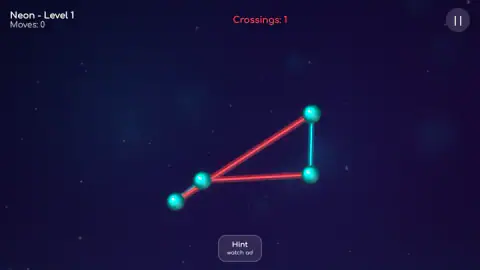
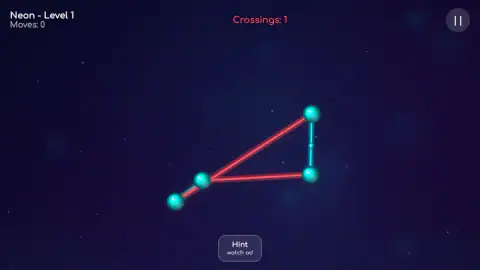
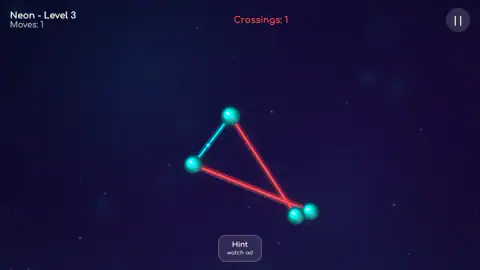
Taken by opening the game ourselves and letting it run — not supplied by the publisher, and not the same picture every other site shows.
How to play Untangle Threads
- Read the top of the screen. The world and level name sit at the top left with a Moves counter under them. The Crossings counter sits in the middle, in red for as long as anything is tangled.
- Find the red threads. Red means that thread crosses another one. A thread that crosses nothing glows cyan, and a small spark of light runs along it.
- Drag one node. Press on a node, pull it somewhere else, let go. Its threads follow. That is one move, whether or not it helped.
- Bring Crossings to zero. A card comes up with your stars on it and a Next button.
What we picked up while playing:
- Pull, do not nudge. Almost every level we finished fell to a long drag that carried a node clean across the board, and nine of the eleven were over in three moves or fewer. The two that cost us dearly were the two where we opened with small adjustments.
- Never let the nodes bunch together. Our worst stretch was on level three. Six moves in, all four nodes sat in a clump the size of a coin, the threads between them so short that we could no longer see which two crossed. Pulling one node far out again is what ended it.
- A failed drag still costs a move. The counter rises on every node you pick up and drop. Stars come off that counter, so a careless try is not free.
- Missing the node is free. A drag that begins on empty space moves nothing, and the counter stays where it was.
- Watch for the straight line. Level six opened with its four nodes almost in a row and one thread lying on top of another. Nothing was hidden from us; it was simply drawn so that we could not read it. Spreading the nodes out is the first move, not a wasted one.
Controls
| Drag a node | Moves it, and every thread tied to it follows; letting go counts as one move |
|---|---|
| Click the pause button (top right) | Opens the Pause menu with Resume, Restart, Menu and a Sound switch |
| Click Hint (under the board) | Offers a hint in exchange for watching an advert; we did not use it |
| Click Next (result card) | Goes straight to the following level; Menu, beside it, leaves the level behind |
Features
- Glowing nodes joined by straight threads on a dark starfield; you move the nodes, never the threads
- A live Crossings counter at the top of the screen, and a Moves counter under the level name
- Threads that cross turn red; a thread that is clear glows cyan, with a spark running along it
- Every level we reached in the first world used four nodes and opened on a single crossing
- Stars are scored on moves alone: one, two or three moves earned three stars and the word Perfect
- A drag that does not fix the crossing still counts as a move; a drag that misses the node does not
- The hint button asks you to watch an advert first
- Made by Flagwin Studio
Game details
- Developer
- Flagwin Studio
- Release date
- March 2026
- Last updated
- August 10, 2026
- Added here
- January 2026
- Technology
- HTML5
- Platforms
- Browser (desktop, mouse), Browser (mobile & tablet, touch)
- Classification
- Puzzle
- Saved progress
- Saving, when available, is managed by this game. Mava cannot confirm your level.
FAQ
How do you play Untangle Threads?
Drag the glowing nodes around the board. The threads between them stretch and follow, and the level is solved when no thread crosses another. A counter at the top of the screen shows how many crossings are left, and crossing threads are drawn in red.
What do the red threads mean in Untangle Threads?
A red thread is one that currently crosses another thread. A thread that crosses nothing glows cyan, with a small spark of light travelling along it. The Crossings counter at the top is red as well while any crossing remains.
How hard does Untangle Threads get?
The first world, Neon, barely gets harder at all. We played eleven levels of it in one sitting and every board had four nodes and a single crossing, the twelfth looking much like the first. What changes between levels is how the tangle is drawn, not how big it is.
How do you get three stars in Untangle Threads?
Use as few moves as possible. Finishes in one, two and three moves all lit three stars and added the word Perfect to the result card, while finishes in seven and eight moves lit only one. If you have already spent several moves, Restart in the pause menu is faster than carrying on.
Does every move count in Untangle Threads?
Every node you pick up and drop counts, whether or not it helps. Levels where we nudged nodes short distances cost us seven and eight moves and a single star each. A drag that starts on empty space moves nothing and is not counted.
Is there a hint in Untangle Threads?
Yes. A Hint button sits under the board on every level, and the small print beneath the word reads watch ad. We have never used it, so we cannot say what the hint shows. On a four-node board you are unlikely to need it.
How many worlds does Untangle Threads have?
The game's own description lists six, each with a twist of its own: locked nodes, drifting nodes, a cap on moves. We have only ever played the first, Neon, which that description calls the warm-up, so the other five are not something we can describe.
Who made Untangle Threads?
It is credited to Flagwin Studio. It was published on 18 March 2026. It is listed for PC, Android and iOS.