



About OUTSIDE: a minimal grid puzzle where the floor disappears behind you
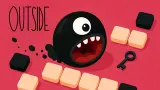
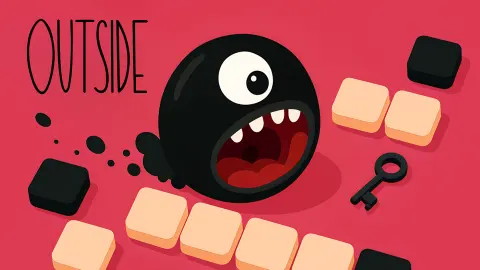
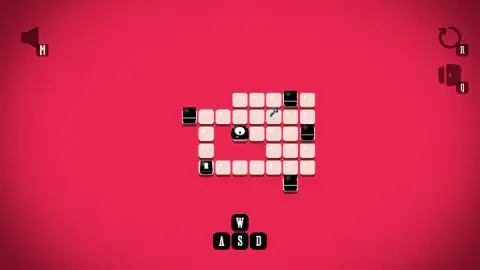
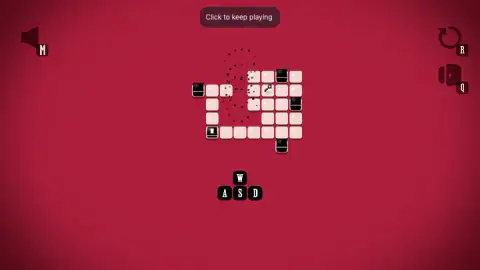
Level one of OUTSIDE hides nothing from you. A key. A black slab with a keyhole cut into it. Four more black slabs breaking the edges, and twenty-six pale slabs floating on a deep pink screen. All of it fits in one view, and the little picture between the two arrows on the menu is not an illustration of the level — it is the level, drawn at full detail and shrunk to the size of a stamp.
So you begin with perfect information. The first press is where you find out that perfect information was the easy part.
A press here is not a step. The blob travels until something solid ends the journey, so the question is never where do I want to go. It is what is going to stop me. Count what sits behind each direction out of the opening square. To the left, nothing: the slab that would be there is missing. Downwards, the same notch. Upwards, two pale slabs and then open air. Only to the right is there floor running all the way to something solid — a black block, three squares along.
We pressed up, because the key is up and to the right and that is where your hand goes. The blob crossed its two slabs, took them apart on the way, and left the board. No message appeared, nothing flashed, and the level simply sat there afterwards with a column missing out of its middle and no character standing on it.
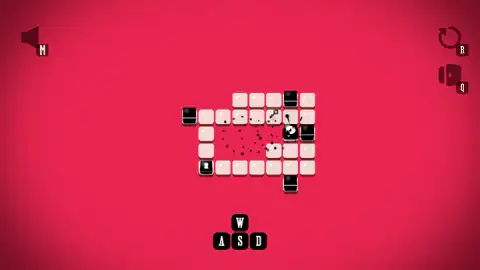
Later we pressed right instead, and the difference is the whole game. The blob crossed three slabs and stopped dead against the black block at the end of the row, still alive, with a hole behind it and crumbs settling into the gap.
It is credited to Brokellusion, and so does the game, which signs its own level screen in the bottom-right corner.
One honest note, because it shapes what follows. We have played it three times on a desktop keyboard, the longest run a little over ten minutes, and we have still not finished a level or touched the key. This page can tell you what one press does to a board and the mistake that will cost you your first dozen attempts. It cannot tell you how many levels there are or how it ends.
The black slabs are the only brakes in the level
Games built on sliding movement almost always fence you in. The board has a border, you slide until you hit it, and the worst a bad direction costs you is a turn. OUTSIDE does not do that. The pale slabs are the floor and they are also the whole world; past the last one there is only pink.
So the black slabs are not scenery, and they are not obstacles in the usual sense. They are the only thing in the level that can end a move with you still on the board. A direction with one behind it is a move. A direction without one is an exit.
Two of the pictures here are the same board one press apart: the blob in the middle of the island, then the blob three squares right, jammed against the slab that caught it. A third shows the other outcome, which is a column of missing floor and nobody standing on the board.
Now look at the opening square of level one with that in mind. The key sits up and to the right, which makes up the natural first press and the wrong one. The move the board offers is right, the only line out of the starting square with a block at the end of it. Level one is quietly teaching you to stop reading the floor as a map of where things are, and start reading it as a map of where you can be stopped.
The floor is the thing you are spending
The vanishing is easy to see and easy to underrate. The slabs do not grey out or get marked as used. They come apart, the pink shows through, and a drift of black crumbs hangs in the hole afterwards like dust in a sunbeam. The square you set off from goes with the rest.
A puzzle where the path destroys itself behaves nothing like a maze. In a maze a dead end costs you the walk back. Here there is no walk back: the route you took is a hole now, and whatever you failed to pick up is on the far side of it. The level becomes a question about sequence rather than route-finding, and there is usually one order in which you can take the key and still have floor under you at the keyhole.
It also explains why a level can be this small. Two dozen slabs is not much of a maze. It is quite a lot of a sequencing problem.
Between screens, the ink floods in
Puzzle games rarely bother with a transition. OUTSIDE has one, and it is most of the personality the game has. A sheet of black pours in from the top in thick rounded drips, swallowing the island, the speaker, the restart arrow and the door, until there is nothing left but a strip of pink at the bottom. Then it peels away and the next screen is underneath. Sometimes it climbs from the bottom edge instead, in the same fat fingers.
The level menu has a second trick of the same kind. Look past the level number and the pink field behind it is a strip of film, sprocket holes marching along the top and the bottom, as though the levels were frames waiting to be projected. There is no narrator here, no story text, no title cards and a palette of three colours. Those two touches are the whole of the game's voice, and they are why a board of two dozen slabs does not feel like a spreadsheet.
Everything Brokellusion makes has this shape
Four games carry the Brokellusion name, three of them on our shelves, and playing two of them back to back makes the house style obvious.
About a Frog opens on the same two-panel -SELECT CONTROL- screen, puts the same speaker, looping arrow and door in the same three corners, and — this is the giveaway — its lily pads vanish behind the frog exactly the way these slabs vanish behind the blob. Same idea about floors, different animal. It is the one in this family we have played through, so its page goes further than this one does.
Origin swaps the grid for platforms and keeps the protagonist: a small black shape with one eye, collecting things to open an exit. FILL THE HEART keeps the sliding and swaps the goal. All three went up within weeks of each other in mid-2025 and all three were updated in the same month of 2026, which is a studio tidying its whole shelf at once rather than drifting away from it.
If you want the grid without the disappearing act, Solve the maze is the plain version: walls that stay where they are, a route to find, and no edge to fall off. Our other puzzle games are stocked with floor that behaves.
Screenshots
How to play OUTSIDE: a minimal grid puzzle where the floor disappears behind you
- Choose the keyboard. The first screen offers two white panels marked
-SELECT CONTROL-, one drawn with a keyboard and one with a gamepad. We took the keyboard and stayed there. - Press the space bar, do not click. The level screen says
press SPACE to STARTalong the bottom. That line is a sentence, not a button, and clicking it does nothing at all. - Pick your level with the side arrows. Two black triangles flank the level number. A padlock where the picture should be means that one is not open yet.
- Study that picture first. It is the board. Same slabs, same blocks, same key, same starting square, so you can plan the whole level from the menu before you commit to anything.
- Move with W A S D or the arrows, reach the key, and the slab with the keyhole is what it is for.
What our runs actually taught us:
- Before you press, look for the brake. Not for the key — for the black slab that will end the journey. If nothing is standing in that direction, you are about to walk off the edge rather than make a move.
- The prompt at the bottom is decoration, not a setting. Sometimes it is four keycaps reading
W A S D, sometimes four arrow buttons. Both turned up in the same session on the same keyboard, so there is nothing to choose. - The corners never move. A speaker marked M top left; a looping arrow marked R and a door marked Q top right. Once your blob has gone, R is the only thing on screen worth reaching for.
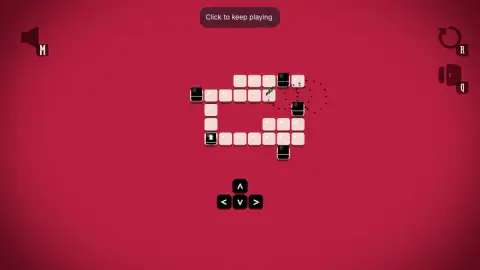
- The board stops for an ad break. The level dims, a banner reading
Click to keep playingappears across the top, and a black panel with a purpleContinue playingbutton waits in the middle. Your keys do nothing until you clear it, and it caught us out again and again before we learned to check the top of the screen. - Nothing is keeping score. No points, no clock, no counter of moves. The only measure of how you are doing is how much floor is left.
Controls
| W A S D or the arrow keys | Move. One press is a journey, not a step — you travel until a black slab stops you, or until you run out of floor |
|---|---|
| Space | Starts the level you are looking at on the level screen. The words "press SPACE to START" are an instruction, not a button |
| Left and right arrows (on the level screen) | Browse levels. A padlock in place of the thumbnail means that one is not open yet |
| R | The looping arrow in the top-right corner. We read it as restart, and it is the only thing to reach for once your character has left the board |
| Q | The door icon beside it, which we take to be the way back to the level screen. We did not open it |
| M | The speaker in the top-left corner, for sound |
Features
- The whole level fits on one screen, and you can see it from the menu: the picture between the two arrows is the level itself at full detail, shrunk to the size of a stamp
- A press runs until something solid ends it. The black slabs are the only brakes in the level, and a direction without one behind it is an exit, not a move
- A floor that does not stay — cross a run of pale slabs and they come apart behind you, leaving a trail of black crumbs and no way back
- The island has no railing. Three of the four directions out of the opening square of level one end in open air
- Level one is 26 pale slabs inside an eight-by-six box, four black blocks, one key and one black slab with a keyhole cut into it. Nothing else
- No score, no timer, no lives and no move counter on any screen we played, and levels open in order: browsing past the first one showed a padlock
- Made by Brokellusion, a studio with four games
Game details
- Developer
- Brokellusion
- Release date
- June 2025
- Last updated
- August 10, 2026
- Added here
- June 2025
- Technology
- HTML5 (Unity WebGL)
- Platforms
- Browser (desktop, keyboard), Browser (mobile & tablet)
- Classification
- Puzzle
- Saved progress
- Saving, when available, is managed by this game. Mava cannot confirm your level.
FAQ
How do you play OUTSIDE?
You move a small black blob with one white eye around an island of pale slabs, heading for a key and then for a slab with a keyhole cut into it. One press sends the blob travelling until something stops it, and every slab it crosses comes apart behind it. The whole board fits on one screen, so nothing is hidden — the difficulty is working out the order.
What are the controls in OUTSIDE?
W, A, S and D, or the four arrow keys. The prompt at the bottom of the screen shows the keycaps at some moments and four arrow buttons at others, and both turned up in the same desktop session, so neither is a mode you have to pick. Three buttons sit in the corners throughout: a speaker marked M, a looping arrow marked R, and a door marked Q.
Why will OUTSIDE not start when I click the screen?
Because the line that says press SPACE to START is a sentence, not a button. An earlier session of ours lost most of four minutes clicking it. Pick the level you want with the left and right arrows, then press the space bar, and the board appears.
Why did my character disappear in OUTSIDE?
Because you ran off the floor. The edge of the island is not a wall: if there is nothing solid in the direction you press, the blob keeps going past the last slab and is gone. It happened to us on the very first press of level one, and the board just sat there afterwards with a column of slabs missing and no character on it. The looping arrow marked R in the top-right corner is the way back.
Why do the slabs disappear in OUTSIDE?
They come apart as you cross them. Two of our pictures show the same level before and after a single press to the right: three slabs of that row have gone, including the one the blob set off from, and a trail of black crumbs is still drifting through the gap. That is the whole design — the floor is a resource you spend, and the order you spend it in is the puzzle.
How many levels does OUTSIDE have?
We cannot tell you, and we would rather say so. Three sessions on a desktop keyboard, the longest of them a little over ten minutes, never closed level one, so we never saw a second board. What we can say is that they unlock in order: browsing past the first level on the menu showed a padlock where the picture should be.
Does OUTSIDE have ads?
The board stops for an ad break now and then. The level dims, a banner reading Click to keep playing appears across the top, and a black panel with a purple Continue playing button waits in the middle until you dismiss it. Our run was told the ad had been skipped that time, so we cannot say what another player is shown there, only that the interruption is real and your keys do nothing until you clear it.
Who made OUTSIDE?
The game signs itself on its own level screen, bottom right, with a copyright line dated 2024, while the portal lists it as published in June 2025 and last updated in August 2026. We found no studio site to check the name against a third source.