

About Zip Zap
Most physics puzzles in a browser hand you something to aim, something to draw or something to drop. Zip Zap hands you a machine that is already built, already standing still, and gives you no way to add a single part to it. The only thing you are allowed to do is make one of its joints fold, and then let go.
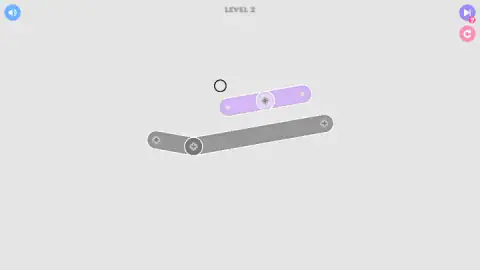
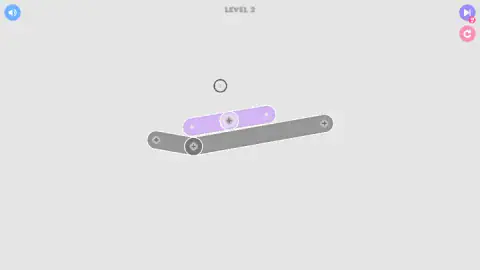
The screen around that machine is close to empty. A pale grey background. The word LEVEL and a number in grey capitals across the top. A blue loudspeaker in one corner; a pink restart arrow and a purple skip-forward button in the other. No score. No timer. No lives, no energy bar, no coins, and not one sentence of tutorial text anywhere we could find it.
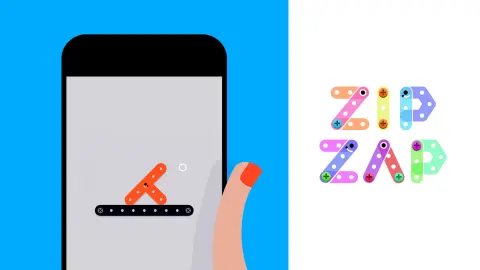
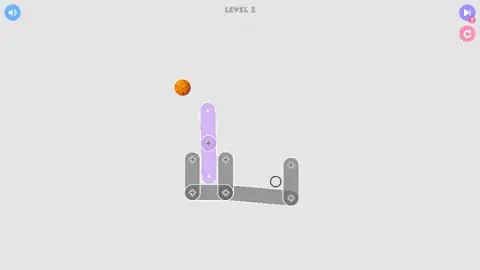
The machine is built from rounded capsules, some grey and some lilac, joined end to end. Every joint carries a small cross inside a circle, and the free tip of each capsule carries a pale dot. Floating nearby, touching nothing, is a thin black ring. Later levels add a loose ball: ours was an orange basketball, seam lines and all, hanging in the air with nothing underneath it.
The game is credited to Drivix Games.
The listing dates the game to 2025 and its most recent update to August 2026. Our session ran about ten minutes. We cleared the first level, spent the second working out which parts of the machine were ours to move, and then lost to the third again and again without ever solving it. Everything below is what we could see with our own eyes; where we could not work something out, we say so plainly.
Grey is the floor, lilac is the lever
The game never tells you which parts answer to your finger. It shows you, in a colour scheme it never breaks.
We have three pictures of the same level two, taken across about two and a half minutes. In all three the grey pair of capsules is in precisely the same place: same elbow, same tips, same angle, not a pixel of difference. In all three the lilac pair is somewhere else — up and to the right in the first, dropped and tilted left in the second, settled almost flat in the third. Nothing else on the screen changed at all.
Level three repeats that colour scheme with a bigger cast. Grey capsules build a frame — two uprights, a floor, a ramp sloping off to the right and a post standing where the ramp ends — and a single lilac capsule stands upright in the middle of it with a hinge at its waist. The ball hangs over the lilac one, which is the game telling you where to press without printing a word.
So the colour is a promise. Grey is terrain: it holds the shape of the problem and will not negotiate with you. Lilac is the part that will answer. That is a great deal of teaching for a game with no words in it, and it is why the first few seconds of a new level are better spent looking than clicking. Work out which capsules are yours, and the level stops being a mystery and starts being a question about timing.
Why a search for "zip zap" lands you in a drama class
Type the name into a search box and most of what comes back is not a game you can play in a browser at all. It is Zip Zap Zop, the warm-up that drama teachers and improv groups have been running for decades. Everyone stands in a circle. One person claps towards someone else and says "zip". That person claps on to a third and says "zap". The third passes it along with "zop", and round it goes. Stumble, say the wrong word or hesitate too long, and you are out of the circle.
It is a collision of names and nothing more. But it is an uncomfortably good description of the puzzle you are actually playing. In both, nothing is yours to keep: something arrives, you pass it on, and the chain is only as good as its clumsiest handover. Here the circle is a line of hinged bars, the clap is a ball coming down out of the air, and hesitating means watching the whole structure settle into a shape that can no longer reach anything.
The two buttons after you fail
The failure card offers a straight trade, and it is the only thing in this game that asks you for anything.
Retry, in orange, restarts the level. Skip, in blue, is drawn with a tiny film strip and the letters AD beneath it, and it moves you past the level you are stuck on. The same skip-forward symbol sits in the top right corner of the playfield while you are playing, with a small pink badge on it, so the offer is never more than one press away. We did not take it, so we cannot tell you how long the advert runs or what it shows.
What we can tell you is the shape of the bargain. Nothing is locked behind that button, nothing is on a timer waiting for you to give in, and in both of the game's cards the free option is the one on top. Clear a level instead and the same layout comes back with friendlier words: a card headed Level Cleared, a face in sunglasses, Replay in orange, Next in blue. The colours mean exactly what they meant a moment earlier.
Between those cards the game wipes itself clean with seven columns of pastel colour that sweep across the screen in a descending staircase — pink, pink, lilac, periwinkle, blue, mint, pale yellow. It is the only moment in Zip Zap that looks like decoration, and it is over in a second.
More machines that answer a single press
If this is the kind of puzzle you want — one press, then watching physics finish the sentence — Planko is the nearest thing on our shelf: tap a plank, it drops, and a ball has to find its way down whatever you left standing. Save the Dummy and Pull Him Out Online both make you remove one thing at a time and live with what happens next, which is the same discipline from the other direction. Mini Switcher swaps the folding joint for a gravity switch and runs it across about thirty levels. All four live in puzzle games, alongside everything else here that is solved by thinking rather than by reacting.
Screenshots
How to play Zip Zap
- Press and hold on the machine to contract the joint under your pointer. A mouse and a thumb do the same job here.
- Let go. The release is where the movement comes from: the folded part springs back, the balance changes, and gravity takes over.
- Look at the colours before you touch anything. They are the only instruction the game gives you, and the next section explains what they say.
- Work towards the thin black rings. They are the only things on screen that are neither machine nor button, and they stay exactly where they are while everything else moves.
- When it goes wrong, take the orange button. A card headed Level Failed drops over the screen with the level number and a sad orange face, and the orange way out of it costs nothing.
What we only learned by being there:
- A ring that has been reached is drawn differently. Early in level two ours was a hard black outline with nothing inside it. Half a minute later the same ring was a thinner grey one with a small dot at its centre. On a later attempt it was hard black again.
- Retrying puts everything back exactly where it was. Our ball began its fall from the same point attempt after attempt, which makes this a puzzle you can beat by repeating a plan precisely, rather than a test of reflexes.
- The restart arrow in the top right is free and permanent. It is the quickest way to end a run you have already ruined, and we used it more than any other button.
- The game is nearly silent. In ten minutes of play we heard one sound, right at the beginning. Nothing marks a success and nothing marks a failure except the card at the end.
Controls
| Press and hold on a part of the machine | Contracts the joint you are holding. We played with a mouse; on a touch screen it is the same gesture under a thumb |
|---|---|
| Release | Lets the folded part go. The movement, and whatever that movement throws, comes out of the release rather than the press |
| The pink circular arrow, top right | Restarts the level from its exact starting position. It is free, it is always there, and it was the button we used most |
| The purple skip-forward button, top right | Carries a small pink badge and matches the Skip button on the failure card. We never pressed it, so we will not describe what it shows |
| The blue loudspeaker, top left | Sound. The game made one noise in our whole session, so we could not hear what this button changes |
| Arrow keys | Nothing we could detect. That is not proof they are dead, but every working control we found was under the pointer |
Features
- One screen, one machine, one gesture: hold a joint to fold it, let go, and gravity finishes the move for you
- Colour is the entire tutorial. Across three pictures of the same level our grey capsules never shifted a pixel and the lilac ones were somewhere new in each one
- A playfield with nothing on it but the level number and three buttons — no score, no timer, no lives, no coins and no text
- Retries are exact. The ball fell from the same point attempt after attempt, so a plan that nearly worked is worth repeating move for move
- Nearly silent: one sound in ten minutes of play, and nothing at all to mark a win or a loss
- The failure card gives you a free Retry and a Skip marked AD. Nothing in the game is locked behind the second one
- Between levels seven columns of pastel colour sweep down the screen in a descending staircase
Game details
- Developer
- Drivix Games
- Release date
- August 2025
- Last updated
- October 24, 2026
- Added here
- July 2025
- Technology
- HTML5 (2D physics)
- Platforms
- Browser (desktop), Browser (mobile & tablet, touch)
- Classification
- Puzzle
- Saved progress
- Saving, when available, is managed by this game. Mava cannot confirm your level.
FAQ
What kind of game is Zip Zap?
It is a free browser physics puzzle played with a single gesture. Each level puts a machine of hinged bars on an almost empty grey screen, and you press and release its joints to make it fold, tip and fall towards a thin black ring. There is no score, no timer and no written tutorial: the level number across the top is the only text the playfield carries.
How do you play Zip Zap?
Press and hold on a part of the machine to contract the joint under your finger, then let go. The release is what produces the movement, so the game is really about choosing which joint to fold and when to release it. It works the same with a mouse or a thumb, and the listing offers it for desktop, Android and iOS alike; the arrow keys did nothing we could detect.
Which parts of the structure can you actually move in Zip Zap?
The lilac ones. We have three pictures of the same level taken over about two and a half minutes: in all three the grey capsules sit in exactly the same places, and in all three the lilac pair is somewhere different. Level three uses the same colour scheme, with grey capsules forming a frame and one lilac capsule standing in the middle of it. Grey is terrain; lilac answers you.
What are the black rings in Zip Zap for?
They are the things you are trying to reach — the only objects on screen that are neither machine nor button, and they never move while you work. One of ours changed how it was drawn during a level, from a hard black outline to a thinner grey ring with a dot at its centre, and it was back to hard black on a later attempt. We never cleared a level with a ring on screen, so that is what we saw rather than a rule we proved.
How many levels does Zip Zap have?
We cannot tell you, and we would rather say so than guess. The cards between levels number them — we saw Level Cleared on level one and Level Failed on level three — but nothing on the playfield shows a total, and we never got past the third one. What we can say is that level three is a real step up from level two: more capsules, a loose ball, and a target placed where the machine has to carry something to it.
Does Zip Zap have ads?
The game asks, and never forces. When a level is failed you get a card with two buttons: an orange Retry, which costs nothing, and a blue Skip drawn with a small film strip and the letters AD, which moves you past the level. The same skip symbol, with a small badge on it, sits in the top right corner while you play. We never pressed either of them, so we cannot describe the advert itself.
Is Zip Zap the same thing as Zip Zap Zop?
No. Zip Zap Zop is a drama and improv warm-up played standing in a circle, where you clap towards someone and say zip, they pass it on with zap, the next with zop, and anyone who stumbles or hesitates is out. It shares nothing with this game but a name. It is also most of what a search for the words turns up, which is worth knowing before you go looking for the puzzle.
Who made Zip Zap and when did it come out?
It is credited to Drivix Games. The listing dates the release to 2025 and the most recent update to August 2026. The two forms of the release date we could find disagree by a single day, which is why this page gives the month and not the day.