



About Slide And Divide
Most number puzzles on the web are about making numbers bigger. Two equal tiles meet, become one tile worth double, and you chase a total. Slide And Divide runs the other way. Every good move makes a number smaller, and the best moves clear a square instead of filling one.
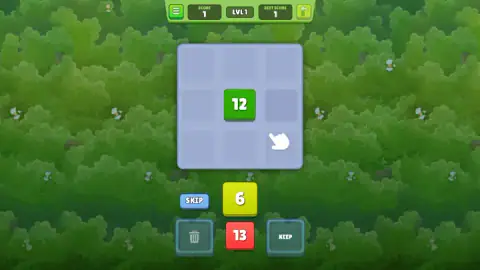
The game shows its working. In one of our games a green twelve sat in the middle of the board and we were handed a six. We slid the six into the empty square beside it, and for a moment the board printed the sum across the tile: 12 ÷ 6 = 2. The big number became a two, and the tile we had just placed was gone.
What turns that into a puzzle rather than a sum is space. The grid fills up fast, and some numbers are stubborn: a seven can only be cut by a one or another seven. Every tile you put down without dividing anything is one square less to work with, which is why the game gives you a bin and a box to park a tile in.
Slide And Divide is credited to Zop Technologies WLL and was published in September 2026. We have played it across several sittings in a desktop browser with the mouse, the longest a little over ten minutes, on two different board sizes.
Division instead of merging
Games in the 2048 family reward you for doubling. Two matching tiles meet, become one bigger tile, and the board slowly fills with numbers that are harder to pair. Slide And Divide inverts that. A division always leaves a smaller number behind, and the tile that did the dividing is used up, so a good move costs you nothing in space.
That changes what you are looking for. In a merge game you hunt for twins. Here you hunt for factors, the numbers that go into another number exactly, and that is why the game is quiet practice for anyone learning their times tables. Some numbers are generous: a twelve takes a two, a three, a four or a six. A fifteen is fussier, since only a three, a five or another fifteen will touch it. A seven, an eleven or a thirteen takes nothing but one and itself, because those are prime numbers, whole numbers that cannot be split into equal groups at all.
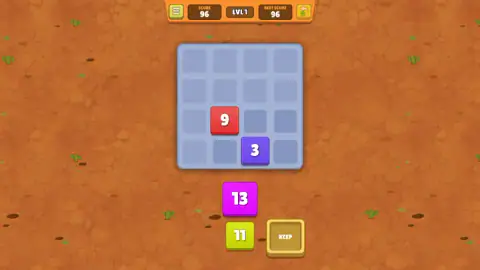
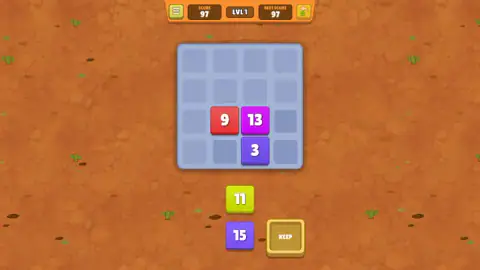
Our longest game showed what that costs. A red nine and a magenta thirteen sat in the same two squares from one end of it to the other, because nothing we were handed fitted either of them. The board was never full, but it was never really empty either.
What a move is worth
Putting a tile down where it divides nothing is worth a single point. Our score went from 96 to 97 when we dropped a thirteen into a free square and nothing happened to it.
Dividing pays properly, and it pays for the number you cut rather than the number you leave behind. Cutting the twelve with a six took our score from 1 to 24. In an earlier game we cut a twelve with a four instead, and the score moved by exactly the same twenty-three points. Two divisions of the same number, two different tiles, one reward: there is nothing to gain by hoarding the neat divisor, so make the cut when you can.
One thing did not behave the way the label suggests. Our run on the bigger board peaked in the nineties, and a later game on the small board opened with both boxes, score and best score, showing the same low figure. Whatever that second number counts, it did not remember what we had done before.
Bin it, keep it, or place it
Under the board sits the tile you are about to place. Under that, a row of three: a bin on the left, the next tile in the middle and the KEEP box on the right. The first time you play, the game labels two of them itself, delete blocks over the bin and hold blocks over KEEP, with a white hand pointing at the square it wants you to use. A SKIP button sits beside your tile if you would rather get on with it.
That row is the real decision in Slide And Divide. The board only gives you one tile at a time, so when the tile is useless you choose between losing it and losing the box. The KEEP box holds a single tile: we parked one there while it had nothing to divide, pulled it out several moves later to make a cut, and the tile we were holding at the time stayed in our hand.
Across the top of the screen there is a menu button on the left, your score, the level and your best score in a row, and a yellow button on the right with a curved arrow on it that looks like an undo and carries a small counter. We never pressed it, and the level never moved off one.
Nine squares or sixteen
The title screen deserves a second look before you hit play. Above the green arrow sits a small blue button reading 3x3, and that is the size of the grid. We played one game on that nine-square board and another on a sixteen-square one, and the difference is not decoration. On the small board, one number you cannot cut is a ninth of everything you own, and two of them more or less decide the game. On the bigger board there is room to leave a problem alone for a while.
The scenery changes with it. One of our games ran over orange desert dotted with cactus; the one that opened with the tutorial ran over a green forest with birds crossing it.
What we saw, and what we did not
We have played Slide And Divide in a desktop browser over several sittings. In all of it we made two clean divisions, both of a twelve, and spent much of the rest of the time holding tiles that fitted nothing on the board. An ad panel opened over the game more than once while we played.
So there is plenty we cannot tell you. We have never filled a board, so we have not seen the game over screen, and we only have the game's own description for how a run ends. We never saw the level change, and we do not know what would move it. We do not know whether the bin or the undo button cost you anything, because we used neither. We do not know whether a tile can divide two neighbours at once. We heard no music.
It is a calm puzzle with no clock, and that is the point of it. It suits children who have learned their times tables and want to use them for something, and adults who like a small number problem they can pick up for a minute. If you want a maths game that drills you against a timer, this is not it.
More number puzzles
Merge Mania is another number game from Zop Technologies WLL, this time about merging equal numbers in a grid. Numbers Match 2448 is the merging side of the same idea, with number blocks you drag and combine. Fish Divider is the other puzzle in our catalogue with division in its name, and Number Merge 10 asks you to find groups of numbers that add up to ten. More are in our puzzle category.
Screenshots
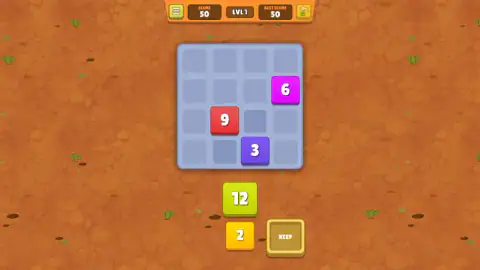
Taken by opening the game ourselves and letting it run — not supplied by the publisher, and not the same picture every other site shows.
How to play Slide And Divide
- Choose your board before you start. The title screen has a small blue button above the green play arrow, and it sets the size of the grid.
- Look at the tile raised under the board. That is the one you are placing. The smaller tile in the row below it is the one coming next.
- Find a number on the board that your tile divides exactly, with nothing left over, and drag your tile into an empty square touching it. The sum appears, the number shrinks and your tile is spent.
- If nothing fits, drop the tile into the KEEP box to save it, or into the bin to throw it away.
- Keep squares free. The game's own description says the run ends when there is nowhere left to put a tile.
Tips from our sessions:
- Aim at the empty square, not at the number. Dropping a tile straight onto the number it divides did nothing for us. It has to land in a free square touching that number.
- Ignore the colours. We had a lime eleven and a lime twelve in the same game, and a red nine sitting next to a red thirteen. The colour of a tile tells you nothing about its value, so read the digits.
- Watch the slot under your tile. It shows what is coming, so you can decide whether to spend a divisor now or wait. An eleven parked in that slot was the tile in our hand one move later.
- Deal with the awkward numbers first. A twelve can be cut four different ways. A thirteen can be cut by one tile and by itself, so if you leave it alone it will still be there when the board is full.
Controls
| Board size button on the title screen | Sets how big the grid is; it read 3x3 when we looked, and we also played a four-by-four board |
|---|---|
| Drag a tile with the mouse or your finger | Slide it into an empty square next to the number you want to divide |
| Drag a tile to the KEEP box | Park it for later; the box holds one tile, and the tutorial calls it "hold blocks" |
| Drag a tile to the bin | Throw away a number that fits nowhere; the tutorial calls it "delete blocks" |
| Yellow button, top right | A curved arrow that looks like an undo, with a small counter on it |
Features
- A board size you choose before you start: we played one run on nine squares and one on sixteen
- Division instead of merging, so the numbers on the board get smaller as you play
- The sum appears over the square as it happens, in the form 12 ÷ 6 = 2
- A tile in hand, the next tile in the slot below it, and a KEEP box that holds a third
- A bin for a number that fits nowhere, named by the tutorial itself
- Dividing a twelve was worth twenty-three points both times we managed it, whichever tile did the cutting
- No clock and no level change: the level label read one in everything we played
Game details
- Developer
- Zop Technologies WLL
- Release date
- September 2026
- Last updated
- September 22, 2026
- Added here
- September 2026
- Technology
- HTML5 (2D)
- Platforms
- Browser (desktop, mouse), Browser (mobile & tablet, touch)
- Classification
- Educational , Puzzle
- Saved progress
- Saving, when available, is managed by this game. Mava cannot confirm your level.
FAQ
What is Slide And Divide?
Slide And Divide is a free number puzzle that runs in the browser, made by Zop Technologies WLL. You place numbered tiles on a grid, and a tile dropped beside a number it divides cuts that number down. The board shows the working, so a twelve cut by a six visibly becomes a two.
How do you play Slide And Divide?
Drag the tile you are holding into an empty square next to a number it divides exactly. That number is divided and the tile you used disappears. If the tile fits nowhere, park it in the KEEP box or drop it in the bin, and try to stop the board from filling up.
How does division work in Slide And Divide?
The tile you place divides its neighbour and is spent. When we slid a six into the empty square beside a twelve, the board printed 12 ÷ 6 = 2 over the square and the big tile became a two. Dropping a tile straight on top of a number did nothing for us; it has to go in the empty square next to it.
How big is the board in Slide And Divide?
That is up to you. The title screen has a small button above the play arrow that sets the board size, and it read 3x3 when we looked. We played one game on that nine-square grid and another on a sixteen-square one, where a single awkward number costs you much less room.
What does the KEEP button do in Slide And Divide?
KEEP is a box at the bottom right that holds one tile for later; the tutorial labels it "hold blocks". We parked a tile there while it had nothing to divide, then pulled it out when the right number appeared. Taking the kept tile did not cost us the tile we were holding.
How do you lose in Slide And Divide?
The game's own description says the run ends when you can no longer place a tile, which happens when the board fills with numbers you cannot divide. We have not reached that point, so we have not seen the game over screen.
Who made Slide And Divide?
It is credited to Zop Technologies WLL, which also made the number game Merge Mania. Slide And Divide was published in September 2026.
Is Slide And Divide good for practising division?
Yes, in a quiet way. Every move asks whether one number goes into another exactly, and the numbers we saw were all fifteen or under. It does not set sums or time you, so it suits children who know their times tables as well as adults.