




About Make the Glass Happy
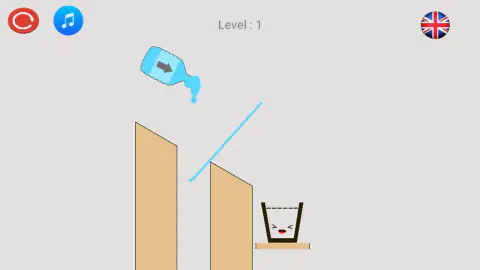
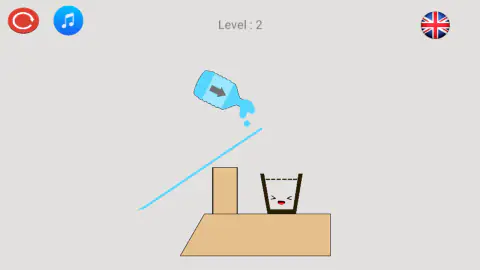
Draw a line in most browser puzzles and gravity takes it off you. The bridge sags, the plank tips, the thing you built slides off the thing you built it on. Make the Glass Happy does the opposite and never mentions it: a line you draw stays exactly where you put it, even with nothing holding it up. In the first level we drew a short diagonal in clear air between two wooden columns, let go, and it hung there like a shelf bolted to nothing.
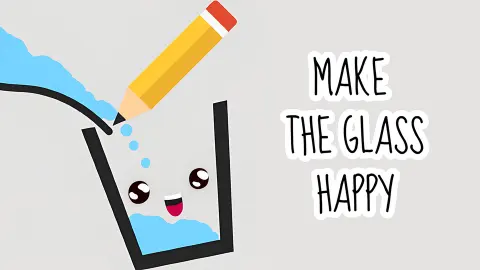
Every level is the same three pieces. A bottle near the top, already pouring. A glass at the bottom, with a dashed line drawn across it just below the rim. And between them, wooden shapes arranged so that the water misses. You get one tool, a drag of the mouse, and whatever you drag becomes a surface the water will run along.
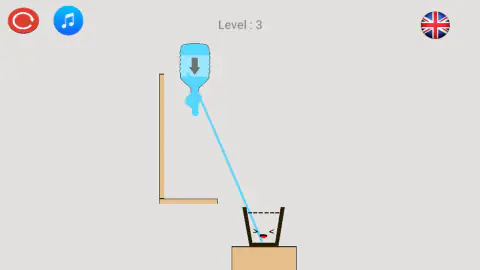
The briefing is a single grey arrow printed inside the bottle, pointing the way the stream is about to go. In the first levels it points right. Later it points straight down, and later still down and to the left, which is the game's way of saying that the fall is about to start somewhere you are not looking. There is no text, no tutorial hand, no arrow on the floor.
Lazy GameDev published it in June 2025 and last touched it in August 2026. Players there have given it, which for a puzzle with no score and no leaderboard is a decent number of people bothering to rate it at all.
Your line is a shelf, not a drawing
The one rule that changes how you play is the one the game never states. Lines have no weight. They do not fall, bend, snap or drift, and they do not need to touch the ground, a wall or each other. Draw one short stroke in empty space halfway down the screen and it will sit there holding water for as long as the level lasts.
That turns the puzzle from building into aiming. In a bridge-drawing game you spend your time worrying about supports. Here supports do not exist, so the only question is geometry: where does the stream need to be redirected, and at what angle, to end up inside a glass that is three obstacles away. A single well-placed stroke is usually worth more than a long elaborate one, and the levels we cleared fastest were cleared with one line.
It also means a failed attempt leaves evidence. The line you drew is still on screen after the water has run out, showing exactly where it caught the stream and where it sent it. Look at that before you press restart.
Every piece of wood is a simple machine
The tan shapes are not scenery. Each one is doing a job, and the jobs are the oldest ones in mechanics — the same handful of devices that physics lessons group together as the simple machines.
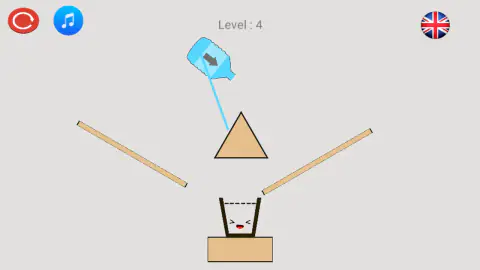
The inclined plane turns up first, as a long ramp crossing the screen: it does not stop the water, it converts a drop into a slide and carries it sideways. Then the wedge: a triangle sitting directly under the bottle, point up, which splits a single stream into two thinner ones that run down opposite faces. Hit the point dead centre and you lose half your water to each side, which is the trap in that level, not the solution.
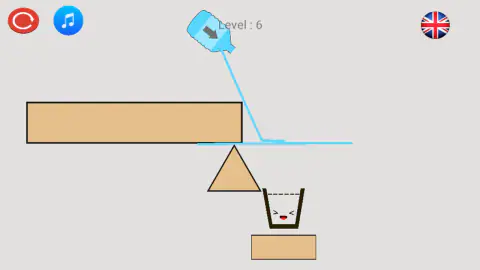
By the sixth level you get a lever. A long beam rests on a triangle, the triangle sits off-centre under it, and the glass waits underneath the short end. Anyone who has sat on a see-saw knows the rest: a load that lands far from the pivot does far more than the same load landing close to it. This is the principle Archimedes is remembered for boasting about, and here it is in a browser puzzle with a smiling glass in it.
Knowing which machine you are looking at tells you where to draw. Against a ramp, extend it. Against a wedge, pick a side and commit to it. Against a lever, think about which end of the beam the water should arrive at.
What the screen tells you, and what it leaves out
Three controls, and that is the entire interface: a red circle that restarts the level, a blue note that mutes the music, and a small Union Jack in the far corner that opens the language list. The only readout is the level number, centred at the top, written as Level : 1.
There is no score. No timer. No lives, no stroke counter, no ink meter, no star rating at the end of a level to tell you that your solution was merely adequate. You cannot lose, only spill, and spilling costs you nothing but the second it takes to press the red button.
The glass has a face throughout — eyes squeezed shut, a small red mouth — and in every level we photographed it is the same face. We never saw it change, so we will not tell you it does. The reward for clearing a level is a card reading "Level: 1 Complete !", coloured star confetti, a green arrow to go on and a red reload arrow underneath it to play the same level again.
Once, that victory card arrived with a dark strip across the top reading Click to keep playing. One click cleared it and the green arrow behaved normally afterwards.
Where it stopped being easy
The first five levels went down in one sitting. The sixth did not, and it is worth saying why, because it is where the game shows its teeth: the beam, the pivot and the glass are lined up so that the obvious line — bottle to glass, straight through — is blocked by the beam itself, and every stroke we drew along the top of the beam just pooled there. We left it unsolved.
That is the shape of the difficulty curve here. Nothing gets faster, nothing gets twitchier, and there is no point at which reflexes start to matter. What changes is how many things the water has to touch on the way down. If you like a puzzle you can sit with, this is one. If you want to be chased by a clock, it is not.
More puzzles that work like this one
If the drawing is the part you enjoyed, Save The Pets: Draw to Save uses the same one-stroke idea defensively: you draw to block things rather than to guide them. If it is the liquid, Dig & Flow - Save Water sends water, lava and steam through dug-out labyrinths and gives each one different behaviour, and Liquid Sort Puzzle swaps physics for pure logic with a row of glasses and a pouring rule.
Lazy GameDev's other game in our catalogue is Dino funny digging, a slower, kinder thing about brushing fossils out of the ground — the same unhurried temperament, no timer in sight.
More of this kind in our puzzle games section.
Screenshots
How to play Make the Glass Happy
- Let the water fall once before you touch anything. The pour starts on its own when the level loads, so your first run is free information: watch where the stream actually lands, which is rarely where the bottle seems to be aiming.
- Press and drag to draw. Hold the left mouse button, or a finger on a touchscreen, and pull. A click on its own produces nothing; the game needs a start and an end.
- Draw a slope, not a wall. Water that meets a flat surface spreads and stops. Water that meets a tilted one keeps its speed and arrives in the glass, which is why almost every solved level ends up looking like a slide.
- Fill to the dashed line. That mark, not the brim, is the finish. The level ends the instant the water reaches it, with star confetti and a green arrow to carry on.
- Use the red button early. The round red button at the top left puts the water back in the bottle and clears your lines. There is no undo in this game, so restarting is the undo.
Tips from the levels we played. Start your line under the stream, not at the bottle's lip: the water needs a run-up before it will follow a surface, and a line drawn too close to the neck just gets splashed over. Aim ahead of the glass rather than at it, because a falling stream curves and always lands further out than it looks. And watch the colours: your line and the water are the same blue and almost the same width, so when the screen fills with blue, the way to tell them apart is where the line begins. Anything starting at the bottle's mouth is water. Anything with two sharp ends in open air is yours.
Controls
| Press and drag (left mouse button) | Draws a line. The line appears where you drag and becomes a solid surface the water can run along. This is the whole game: there is no other way to affect anything |
|---|---|
| Touch and drag | The same thing on a phone or tablet. The game is laid out wide, so a tablet held in landscape is far easier to aim on than a phone held upright |
| Red round button, top left | Restarts the level with the water back in the bottle and your lines gone. There is no undo, so this is also your undo |
| Blue note button, top left | Turns the music on and off |
| Union Jack, top right | Opens the language picker. English is what you get by default |
| Keyboard | We pressed Enter and Escape mid-level and nothing we could see or hear changed. We cannot say the keys are dead, only that nothing answered |
Features
- The pour has already started when the level loads: there is no go button, and the falling water is your clock
- Lines you draw ignore gravity — they stay exactly where you put them, with or without anything underneath
- A dashed line near the rim of the glass is the target, so you are filling to a mark rather than filling it up
- A grey arrow inside the bottle shows which way the stream will go, and it is the only hint the game gives
- Wooden furniture doing real mechanical work: columns, a ramp, an L-shaped wall, a wedge between two planks, and a beam balanced on a triangle
- No score, no timer, no lives, no stroke limit and no star rating — the only readout on screen is the level number
- A victory card with star confetti, a green arrow to go on and a red reload button to replay the level you just cleared
Game details
- Developer
- Lazy GameDev
- Release date
- June 2025
- Last updated
- August 10, 2026
- Added here
- June 2025
- Technology
- HTML5 (Unity WebGL, 2D liquid physics)
- Platforms
- Browser (desktop), Browser (mobile & tablet, touch)
- Classification
- Puzzle
- Saved progress
- Saving, when available, is managed by this game. Mava cannot confirm your level.
FAQ
What do you do in Make the Glass Happy?
A bottle at the top of the screen pours water, a glass at the bottom waits to be filled to a dashed line near its rim, and wooden obstacles stand between them so the stream misses. You draw lines with the mouse or your finger, and the water runs along whatever you draw. Fill the glass to the mark and the level is cleared.
How do you draw in Make the Glass Happy?
Hold the left mouse button down and drag; on a phone or tablet, press and drag with one finger. A single click does nothing, because the game needs a start point and an end point to make a line. There is no pen, colour or thickness to choose.
Does the line you draw fall down?
No, and that is the rule most players take longest to trust. A line stays exactly where you drew it even with empty air underneath, so you can build a shelf or a chute in mid-air and the water will run along it. Nothing you draw sags, tips or slides.
How do you know when the glass is full enough?
Look for the dashed line drawn across the glass just below the rim. That mark, not the top of the glass, is the target, and the level ends the moment the water reaches it. A card reading Level Complete appears with star confetti and a green arrow to continue.
Who made Make the Glass Happy?
The game was published in June 2025 and last updated in August 2026, and players on the platform.
How many levels does Make the Glass Happy have?
We cannot give a number honestly. We cleared the first five in one sitting and got stuck on the sixth, and the counter at the top of the screen simply carried on to the next number each time, with no map, no chapter screen and no end in sight.
Is Make the Glass Happy free, and does it work on a phone?
It is free to play in a browser with nothing to install, and it works on phones and tablets as well as on a desktop. Because the puzzles are laid out wide, a tablet in landscape gives you far more room to aim than a phone held upright.
Is Make the Glass Happy good for children?
It suits children well. There is nothing to read beyond a level number, no timer counting down, no lives to lose and no way to fail permanently — a miss just means pressing the red button and trying another line. The physics it quietly teaches, ramps, wedges and levers, is the same set schools call the simple machines.