








About Dig & Flow - Save Water
Almost every puzzle about liquid hands you something to open. A tap, a valve, a length of pipe, a plank to swing into place. The verb is add: you put a thing where it was not, and if it was wrong you take it out again.
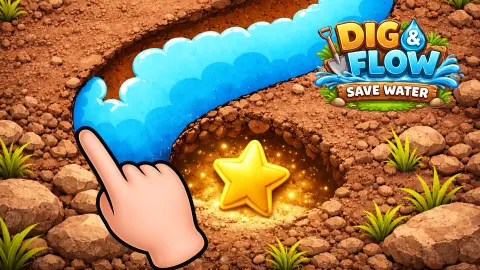
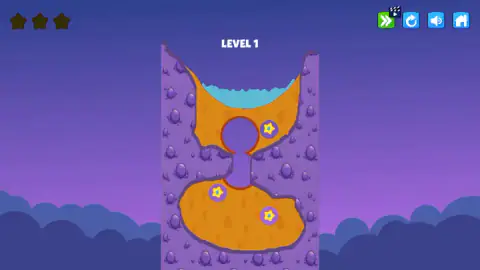
This game takes the opposite half of the idea. There is nothing to add and nothing to place. A tall slab of bumpy purple rock stands against a night sky, and packed inside it is one mass of orange sand shaped like an hourglass, with a shallow bowl scooped out of the top. Water arrives in that bowl and stops there. Three stars are buried in the sand below, each a yellow star with a blue water drop in its middle. You hold the mouse button down and you drag, and wherever you drag, the sand is gone. The water needs no help after that. It only needs the sand to stop being in the way.
Which means the thing nobody warns you about is that you cannot take a hole back. Add the wrong plank and you remove it. Cut the wrong channel and you have changed the level for good. The circular arrow in the top-right corner starts the level over, and in a game made entirely of subtraction it does the work an undo does anywhere else.
It is by Mirra Games. This one went up in April 2026.
Our own session is the honest part. Ten minutes on level 1, several attempts, a best run of two stars out of three, and we finished on one. We never completed the level, and that failure is the clearest lesson the game has to teach, so most of this page is about it.
Real sand would have collapsed on your first stroke
Pour dry sand onto a table and it does not make a tower. It makes a cone, and that cone comes out at the same slope every time — around thirty to thirty-five degrees for ordinary dry sand. Push a face past that angle and it gives way, grains run down it, and the pile settles back. Engineers call that limit the angle of repose, and it is why a sandcastle needs water.
The sand in this game does not have one. Cut a channel through it and the two faces you just made stand there, near enough vertical, holding. Carve the middle out and the sides stay stuck to the rock as a pair of wings with open air underneath and a star hanging off one tip. Nothing trickles into the gap. Nothing slumps.
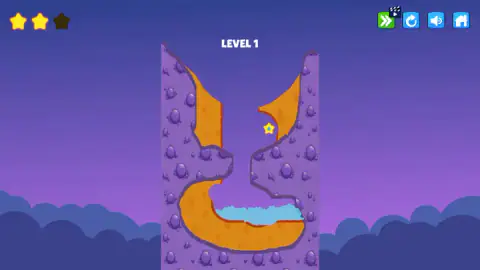
It is not indestructible, though, and that is the part that caught us out. This sand behaves like a solid rather than a heap, and solids break. Cut a strip of it free of the rock at both ends and it stops being a wall and becomes an object: it drops whole, keeps its shape, and lands where it lands. We watched a crescent that was holding a pool snap into two slabs, slide down and pen the water in between them. Grains would have run and spread. This fell like a dropped tile.
So every stroke is two decisions at once: a drawing, because the shape you cut is the shape the water will get, and a structural choice about what is still holding what up. That is also where the missing undo comes from. In a game of avalanches a bad cut gets buried by the next collapse. Here nothing ever fills back in.
Water only goes down, and that is the entire difficulty
Everything else here is yours to decide. The water is not. It has one behaviour, no memory, and it will not wait while you work out what you meant to do.
Here is the shape of our best attempt. First, nothing touched: the bowl full, the sand solid, three stars buried, three dark markers. Then one gold, with a thin slot cut down past the highest star. Then two gold, the sand hollowed to a crescent and the water lying in it. Then the end of it — the crescent broken, the water flat on the floor of the rock, and the third star high on the right with clear air between it and anything wet.
Nothing went wrong in that last step. No cut failed. We opened the route to the two easy stars first, and by the time the third needed water there was none left above it. The level was over several cuts before we noticed, which is what makes towers fall and dominoes stop halfway: the move that loses it is rarely the move you are making.
Our last attempt lost it the other way round. Two shafts went straight down through the waist of the sand, the water drained into a pocket halfway and settled there, and the two remaining stars sat a finger's width either side of a channel it had already finished with. So the real skill is not drawing well, it is ordering. Find the highest star and work out what has to be true for water to pass it. Everything below that can be solved on the way down; nothing above it can be solved at all.
What we reached, and what we did not
We never got past level 1, so this page will not pretend to know how deep the game goes. We never saw the screen that announces a completed level, and we do not know how many levels there are.
Nor did we press the green button in the top-right corner, the one control we cannot explain. It is a double arrow with a small film clapper badged onto it — the mark that normally means watch a video and skip ahead. Normally is not always, and we did not touch it.
Water was the only thing we were ever handed. If other liquids turn up with other behaviours, they arrive past the point we reached, and we would rather say so than describe something we have not watched. The same goes for anything that opens or switches: we never saw one work. One practical note — the game does not begin the instant the page loads. There is a cover with the title art and a Let's Play button, then a short loading bar, then level 1.
What the game never does is hide anything that matters. The stars are visible from the first second, so is the sand in the way, so is the water. When you fail, you fail at something you could see the whole time and judged wrong. That is a decent definition of a puzzle.
More digging, and more water that will not cooperate
Loot Island - Treasure Digger is by the same studio and also about what you find once the ground is out of the way, though it rewards a full excavation rather than a surgical one. Tap Away Block Puzzle 3D, also from Mirra Games, is their other game built on removal: you win by taking pieces out in the right order. Sand Fall is the opposite experiment, a game in which the sand does slump and settle the way the real stuff does. And Power Water Clean Rush keeps the business of getting water somewhere it does not want to go. The rest live in puzzle games.
Screenshots
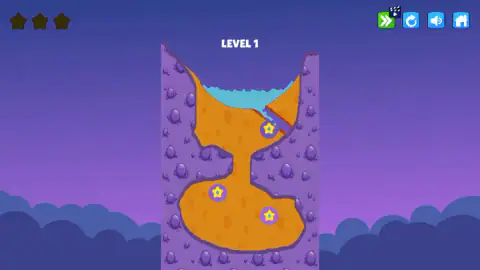
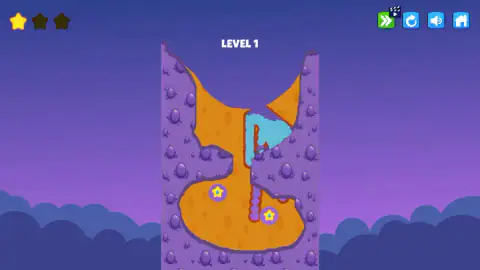
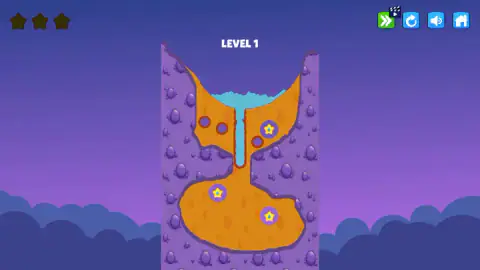
How to play Dig & Flow - Save Water
- Hold the left mouse button and drag across the orange sand. On a touch screen, swipe. There is no clicking and no keyboard: arrow keys, space bar, Enter and Escape all did nothing for us.
- Draw long, not short. A short stroke is not harmless, it is wasted. The tool cuts a circle as it travels, so a stroke that reaches nothing punches a clean round pocket joined to nothing. Three of ours sat there for the rest of the run.
- Cut the plug under the water first. The sand directly beneath the bowl holds everything up. While it is intact, nothing else on the board moves, however elegant your cuts.
- Then stand back. The water falls on its own, follows the channel and settles. It will not wait for you and it will not go back up.
- Read the corner. Three dark stars sit in the top-left and fill gold one at a time: as the water reaches a buried star, the star swells, bursts into sparks, and its marker lights.
What our session taught us:
- Plan the highest star first. Water that has reached the floor is spent. Anything you needed it to touch, it had to touch on the way down.
- The width of a cut decides what arrives. Our narrow shafts delivered a dotted trail of droplets and little else. A wide cut sends the whole bowl at once. Two different tools, not a good and a bad version of one.
- Cutting a star loose does not collect it. Take the sand out from under one and it hangs in mid-air while the water runs past underneath.
- Watch what you are undermining. Free a strip of sand at both ends and it stops being a wall.
- Restarting is not defeat. With no undo, it is the normal cost of finding out what a cut does.
- Expect an interruption. Ten minutes in, the board dimmed and a card reading the ad covered it. The level was still there afterwards.
Controls
| Hold the left mouse button and drag | Carves a channel through the orange sand along the line you draw. This is the only thing you do in the game |
|---|---|
| Swipe (touch screens) | The same cut, drawn with a finger. The board is laid out upright for a phone, though both our sessions were on a desktop with a mouse |
| A stroke that is too short | Digs a round pocket and no more. The tool cuts a circle, so a stroke that does not reach anything leaves a hole joined to nothing, and the water never finds it |
| Circular arrow, top right | Reads as restart, and with no undo it is the button a bad cut calls for. We got out of our own tangles by reloading the page instead, so we cannot swear to it |
| Speaker icon, top right | Sound on and off |
| House icon, top right | Leaves the level |
| Green button, top right | A double arrow with a small film clapper badged on its corner, the mark that usually means watch a video and skip ahead. We left it alone, so we cannot tell you what it does here |
| Arrow keys, space bar, Enter and Escape | No response. This is a pointer game from start to finish |
Features
- Three stars buried in the sand of every level, each a yellow star with a blue water drop in its middle, matched by three dark stars in the corner that fill gold as the water arrives
- Sand that is removed rather than moved: you never push the water, you only take away what is holding it up
- Sand that holds vertical faces and wide overhangs while it is attached, and drops as one rigid slab when you cut it free at both ends
- A round digging tool, so a stroke too short to join anything leaves a dead pocket in the sand for the rest of the level
- No undo button, because a hole is not a move you can take back — only a full restart
- Water that obeys one rule, which is that it goes down: a trail of droplets through a narrow shaft, the whole pool at once through a wide cut
- Laid out upright at 720 by 1280, the shape of a phone held vertically, by Mirra Games
Game details
- Developer
- Mirra Games
- Release date
- April 2026
- Last updated
- August 10, 2026
- Added here
- February 2026
- Technology
- HTML5 (2D physics)
- Platforms
- Browser (desktop), Browser (mobile & tablet, touch)
- Classification
- Puzzle
- Saved progress
- Saving, when available, is managed by this game. Mava cannot confirm your level.
FAQ
What is Dig & Flow - Save Water?
It is a browser puzzle game in which a pool of water sits in a bowl at the top of a mass of orange sand and three stars are buried in the sand below it. You hold the mouse button and drag to carve channels through that sand. The water falls through whatever gap you open, and a star lights up when the water reaches it. Clearing all three finishes the level.
How do you dig in Dig & Flow - Save Water?
Hold the left mouse button down and drag across the orange sand, or swipe with a finger on a touch screen. The length of the stroke is what matters. The tool cuts a circle as it travels, so a stroke too short to reach anything just punches a round pocket through the sand that joins nothing and that the water will never find. The keyboard is not used at all.
How many stars are there in each level?
Three. They sit inside the sand, each one a yellow star with a blue water drop in its middle, and there is a row of three dark stars in the top-left corner that fill in gold as you collect them. The count is easy to check as you play, because the lit markers in the corner and the stars still visible in the sand always add up to three.
Why did my water stop before it reached the last star?
Because water only goes down. Once it has run to the floor, or settled into a pocket lower than the star you still need, anything above that level is out of reach for the rest of the level. That is what happened to us twice: our best attempt took two stars and left the third hanging high on the right-hand wall with nothing left to send at it. The order of your cuts matters more than their shape.
Is there an undo in Dig & Flow - Save Water?
We did not find one, and it would be strange if there were. The whole game is removing material, and removed sand does not come back: the walls you cut stay cut, and a slab you cut loose falls and stays where it falls. The circular arrow in the top-right corner reads as a level restart, which is the only way back we saw from a bad cut.
Does Dig & Flow - Save Water have ads?
Yes. About ten minutes into our session the board dimmed and a card reading the ad covered it mid-level. The level was still there underneath when it finished. There is also a cover screen with a Let's Play button and a short loading bar before level 1 begins, so the game does not start the instant the page loads.
Can you play Dig & Flow - Save Water on a phone?
It is built for it. The board is served upright at 720 by 1280, which is the shape of a phone held vertically rather than a desktop window, and it is listed for mobile and tablet as well as desktop. Both of our sessions were on a desktop with a mouse, so we cannot tell you how precisely a thumb draws a channel compared with a cursor.
Who made Dig & Flow - Save Water?
It was published in April 2026. The same studio made Loot Island - Treasure Digger and Tap Away Block Puzzle 3D, both of which are in our catalogue.