










About Mole In The Hole
The mole in this game carries a shovel. It also carries a pickaxe, swaps between the two, wears a yellow miner's helmet, and works by the light of a lamp, because once you are under the sand everything outside one circle of light is black. A real mole carries none of that. Its hands are the shovel. Its nose does most of the seeing. It has never needed a lamp in its life.
Getting the animal wrong is the whole design, and the design is good. You begin above ground under a blue sky, on a floor of pale sand tiles flecked with gold. You dig into that floor and keep going down. The second card the game shows you states the rule plainly: each block grants points, which contribute to your final score.
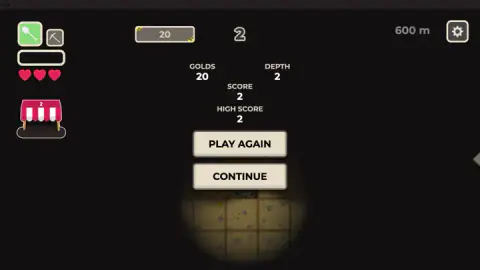
Then the run ends, and a panel counts up what you did — GOLDS, DEPTH, SCORE, HIGH SCORE — with two buttons under it. Our first run finished on twenty gold and a score of two. Our second finished on eighty gold and a score of six. That gap, built in a few minutes, is the hook.
Zadzin made it. It was published in June 2025. We played it for about four minutes: two complete runs, several more started, a long look inside the shop, and not one advert.
The shop takes points, not gold
This is the thing nobody tells you, and it changes how you play from the first minute.
Two counters sit across the top: a bar with a gold nugget on it, and a bare numeral in a circle, which is your score. A third, smaller badge sits on the roof of the shop stall, and it does not follow the gold. It followed our score exactly: zero on the surface, then two, then three, then six. The badge is telling you how much you can spend.
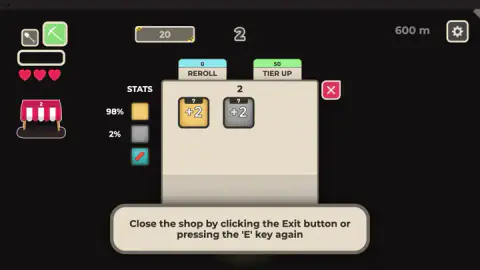
Open the shop and the same figure sits at the top of the panel, over two upgrade cards. Both of ours read +2, and both were priced at 7. Above them are the two buttons that run the place: REROLL, which costs nothing and swaps the pair of cards for a different pair, and TIER UP at 50, which is where the serious money goes.
So the economy rests on an awkward truth. Points are what you spend, and points come from breaking blocks. Gold piles up quietly and buys nothing we ever found. We never managed a purchase: our best score was six and the cheapest card was seven. One block short.
Down the left of the panel is a column labelled STATS, and it is the most useful thing in the game: 98 per cent against a sand-coloured swatch, 2 per cent against a grey one. That is the ground you are standing in, which is why the pickaxe spends the early game doing nothing. Under them is a third swatch, teal, with a red stick on it and no number at all. We never found out what it was.
Dying is the point, and the gold proves it
Roguelikes are built on a trade: the run is thrown away, something else is kept. Here the thing kept is gold, and you can watch the arithmetic happen.
The main menu — PLAY, SHOP, SETTINGS, with the mole leaning on his shovel in the corner — carries a gold total of its own. Ours read 100. We went back in, dug until the panel came up on eighty gold, returned to the menu, and the total read 180. The run's gold is added to a bank; your score and your depth are not.
The panel separates the two ideas neatly. SCORE is what this run was worth, HIGH SCORE is the best you have managed, DEPTH is how far down you got — and they do not move together. Our second run reached depth three with a score of six. Going down fast through empty ground earns you nothing; breaking numbered blocks does.
The two buttons underneath are PLAY AGAIN and CONTINUE. PLAY AGAIN puts you back on the surface. CONTINUE did not behave the same way twice for us: once it dropped us into a tunnel, once it returned us to the main menu, and we are not going to invent a rule we did not see.
What we could not work out
Three things beat us, and a page that pretends otherwise is not worth reading.
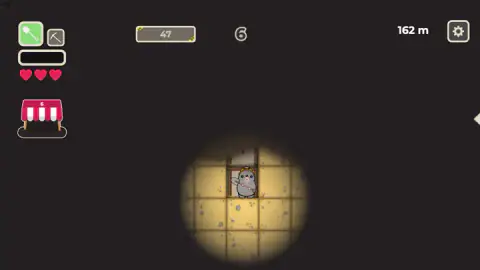
The metre reading in the top right corner is the big one. Every run opens at 600 m while you are still standing in the sunshine. Dig one block straight down and it reads 599, which looks like a simple countdown. But deep in one run it was down at 162, and in a later run it sat at 742 — higher than the figure that run started on. The game never explains it, and there is no key for climbing that would explain a number going back up.
Second, we never lost a heart. Three red hearts sit under the tool slots and they were still full on the end-of-run panel, both times.
Third, one tutorial card begins "Watch out for f…" and the rest of the sentence never fitted on screen. Something down there is worth watching out for. We did not get far enough to meet it.
What a real mole digs with
The joke in the title art is the shovel, and it is a good one, because a mole's hands already are shovels and biologists spent years arguing about how.
A mole's forepaw looks like it has a thumb. It does not. The extra digit is an enlarged wrist bone, the radial sesamoid, and a team at the University of Zurich showed in 2011 that it grows late, after the five real fingers have already formed in the embryo. It has no joints. It cannot bend. What it does is make the palm wider and stiffer, which is exactly what you want in a spade, and the clincher is comparative: mole species that tunnel less have smaller ones.
The lamp is the bigger invention. A European mole has eyes, buried in its fur and barely useful; it reads the soil with its snout. The surface of that snout is covered in Eimer's organs, tight bundles of nerve endings first described in 1871, and they turn the nose into something closer to a fingertip than a face. Light is the one resource a mole has no use for. This game hands it a headlamp and then takes the light away as the only real punishment it has.
And the shape is wrong too, in the most interesting way. This mole digs down, because down is where the score is. A real mole digs sideways. It builds a network of shallow runs and then patrols them, because the tunnels work as traps: worms fall in, and the mole collects. When it finds more than it can eat, it bites the worm so it cannot crawl away and stores it, and a single larder can hold hundreds of them.
Which makes the gold counter in this game the most mole-like thing in it. A hoard, underground, that the animal has no immediate use for, growing run after run while the digging goes on above it.
More games to dig into
Two of Zadzin's other browser games sit in our catalogue, and neither of them involves a shovel: Flag Learn and Spinner Clicker 2D. For the same downward pull with the effort taken out, Deep Drill bores through the ground on its own while you buy better bits, and HoleMart sends a hole instead of a mole. The rest of the shelf is in kids games.
Screenshots
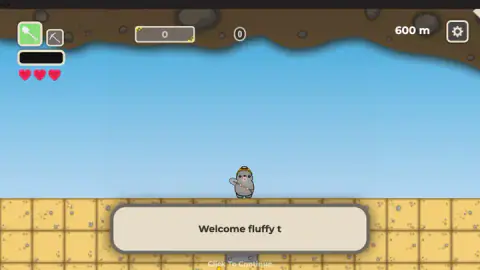
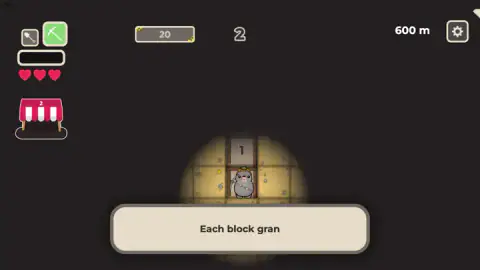
Taken by opening the game ourselves and letting it run — not supplied by the publisher, and not the same picture every other site shows.
How to play Mole In The Hole
- Click once to start, then click the welcome card away. You are standing on the sand with nothing under you but blocks.
- Hold a direction to dig. The game's instructions list left, right and down, on the arrow keys or on W, A and S. There is no key for up, and the mole never climbed for us.
- Press the spacebar or Q to swap between the shovel and the pickaxe. The live one is the slot outlined in green at the top left.
- Press E, or click the little striped stall on the left, to open the shop. Press E again or click the red cross to close it; the game puts that instruction on a card of its own.
- When the panel appears, read your depth and score, then choose PLAY AGAIN or CONTINUE.
Things worth knowing before your first run:
- A tutorial card freezes the mole. We held the arrow keys for several seconds and nothing moved, because a card was still on screen. Click the card away, then dig. Every one of them ends with "Click To Continue".
- The numbers on blocks are what they pay. Some blocks sit in a wooden frame with a figure stamped on them. A block marked 1 is one point.
- The pickaxe will sit idle for a while. The ground near the top is almost entirely sand, and sand is the shovel's job.
- The dark is the difficulty. Underground you see one circle of lamplight. You are always digging into something you have not seen.
Controls
| Arrow keys, or W, A and S | Move and dig. The game's instructions list left, right and down only; there is no key for going up |
|---|---|
| Spacebar or Q | Swap between the shovel and the pickaxe |
| E, or click the striped stall on the left | Open the shop; press E again or click the red cross to close it |
| Click a tutorial card | Dismiss it. The mole will not move while one is on screen |
| Click PLAY AGAIN or CONTINUE | Choose what happens after a run ends |
| Gear icon, top right | Settings |
| Tap | On phones and tablets the same controls are tapped, according to the game's own listing |
Features
- Each block you break grants points, and the game says so on the second card it shows you
- The shop spends points, not gold: the badge over the stall tracked our score the whole way, 0 then 2 then 3 then 6
- Two upgrade cards at a time, 7 points each, with REROLL free and TIER UP at 50
- The shop's own readout called the opening ground 98 percent sand against 2 percent stone, which is why the pickaxe stays in its slot early on
- Three hearts, a gold bar, a score counter and a metre reading that opens every run at 600 m; below the surface you see only a circle of lamplight
- Gold banks and score does not: finishing a run on 80 gold took the main menu total from 100 to 180
- No advert interrupted us in roughly four minutes of play
Game details
- Developer
- Zadzin
- Release date
- June 2025
- Last updated
- October 23, 2026
- Added here
- June 2025
- Technology
- HTML5 (2D)
- Platforms
- Browser (desktop), Browser (mobile & tablet, touch)
- Classification
- Arcade
- Saved progress
- Saving, when available, is managed by this game. Mava cannot confirm your level.
FAQ
How do you play Mole In The Hole?
You start on the surface and dig into the sand below you, holding a direction to break blocks. Every block grants points towards your score, and those points are what the shop on the left takes in exchange for upgrades. A run ends with a panel showing your gold, your depth and your score, and you choose between PLAY AGAIN and CONTINUE.
What do the points do in Mole In The Hole?
They are the shop's currency. The shop offers two upgrade cards at a time, each one priced at 7 points, with a free REROLL to change the pair and a TIER UP at 50. The number in the badge over the little striped stall is how many points you are carrying, so you can tell at a glance whether anything in there is affordable.
Is Mole In The Hole a roguelike?
It is built on the roguelike loop: short runs, an ending you cannot undo, and a shop between attempts. The part that carries over is gold. Your score, your depth and your position in the ground all go back to zero, and the main menu keeps a separate high score so you can see the best run you have had.
What is the difference between the shovel and the pickaxe in Mole In The Hole?
The shovel is for sand and the pickaxe for stone, and you swap between them with the spacebar or the Q key. Which one is live is shown by the slot outlined in green at the top left. Near the surface the choice barely matters: the shop's own readout put the opening ground at 98 percent sand.
Does your gold carry over between runs in Mole In The Hole?
Yes. The end-of-run panel shows what that single run earned, and the total on the main menu adds it on. We watched a run finish on 80 gold and the menu total move from 100 to 180. Score behaves the opposite way: it resets, and only the high score is remembered.
Does Mole In The Hole have ads?
We did not see one. Across roughly four minutes of play, two complete runs, several trips into the shop and four returns to the main menu, nothing interrupted us. That is a short sample rather than a guarantee, but nothing in the game asked us to watch a video to carry on.
Who made Mole In The Hole?
Zadzin, a developer with a handful of other browser games to their name, including Flag Learn and Spinner Clicker 2D. Mole In The Hole was published on 8 June 2025, checked in October 2026.
Can you play Mole In The Hole on a phone?
The game is listed for desktop, Android and iOS, in landscape, and the controls map onto taps. We played it on a desktop with a keyboard and a mouse, so we cannot tell you how the digging feels under a thumb.