
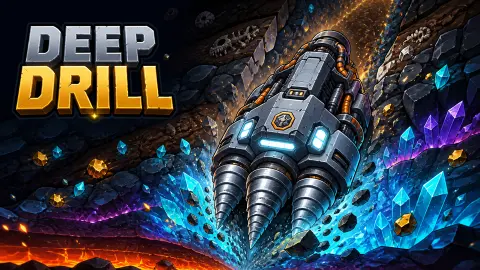









About Deep Drill
Most mining games put a pickaxe in your hand and make you swing it. Deep Drill takes the pickaxe away. The drill is already turning when the page loads, it goes down on its own, and nothing you do will steer it.
What you control is the money. Every metre the drill cuts pays ore, and ore is spent on the rig: a sharper bit, a taller mast, a winch, coolant. Your job is to decide what to buy and when, and then to watch the depth counter tell you whether you chose well.
That makes it an idle game in the strict sense. Deep Drill is made by ikonode, the studio behind the puzzle Color Sorting, and was published in August 2026.
Our 147 metres: how the drill speeds up
When we first looked at the counters the drill was at 216 m in Limestone. Four minutes later it was at 363 m, and the RATE counter had gone from 2 to 9.
All of that difference came from one row. We bought the Drill bit over and over and nothing else. The price climbed slowly, from 12 ore to 62, while the speed bonus reached +330%.
The effect is easy to feel. In our first minute the drill went down about 18 metres. In our last, it covered about 60 in under a minute, so roughly three times faster for a total spend of a few hundred ore.
Ore did not grow as neatly. It crept from 1.65K to about 2.6K, then jumped past 4.8K within a few metres, and we did not see what caused the jump. After that it barely moved, because the deeper rock pays less.
The 2 h away chip tells the clearest story. It started at 11.5K and finished at 39.5K, more than three times higher, which is the game telling you how much an upgraded rig earns while you are away.
The rig: four parts we saw, and what each one does
The RIG list is longer than one screen. These are the four rows we could read at the top of it:
| Part | First price | What the row says at level 0 |
|---|---|---|
| Drill bit | 12 | speed +0%, then +30% per level |
| Derrick mast | 400 | speed +0% a band |
| Cable winch | 220 | no sprint |
| Coolant | 45 | hardness ÷1.00 |
The game's instructions say there are twelve parts in all, including a bigger hopper for richer ore and a night shift that pays more for coming back later. We did not scroll down to see them.
Under the drill sits a bar reading HOLD ×1.35 and a percentage. It stayed at 0% in every screen we saw. The Cable winch row next to it read "no sprint" because we never bought the winch, so our reading is that the winch is what turns that bar into a speed boost. We did not test it.
The Fossil bed at 420 m, and why going deeper gets slower
Deep Drill shows the next layer before you reach it. Through our whole run the bar at the bottom read "Fossil bed at 420 m", and near the end the ruler scrolled far enough to show its label and the first shells drawn in the rock below.
We stopped at 363 m, so we did not cross into it. The game's instructions say there are eight layers, and that each is harder and pays less ore per metre than the one above.
That is the design. Ore is paid per metre, not per second, so a hard layer is slower and poorer at the same time. Sooner or later the drill crawls, and the right move is to seal the well: depth, ore and rig all go back to zero, and the deepest point you reached pays out in cores. According to the game, cores buy permanent upgrades, including one that skips the shallow layers you have already drilled.
What "deep drill" means outside the game
Real deep drilling has the same problem as the game, only worse. The deepest hole ever drilled is the Kola Superdeep Borehole, on the Kola Peninsula in the far north-west of Russia. Soviet scientists started it in 1970 and reached 12,262 metres in 1989, a little over twelve kilometres.
They did not stop for lack of will. The deeper they went, the hotter it got. At the bottom the rock was close to 180 degrees Celsius, far above what had been predicted, and so soft from the heat that it kept closing in around the hole. Every metre took longer than the one before.
The drillers also found fossils, as the game does. Microscopic remains of plankton turned up in rock about six kilometres down, much deeper than anyone expected them to survive.
That is why the Coolant row matters. In Deep Drill, as in the real thing, the limit is the rock, not the drill.
Who it is for
Deep Drill suits anyone who likes watching numbers climb and planning the next purchase, and players who want a game that keeps working in a background tab. A child can play it: the only skill is reading a price and clicking it.
It is not an action game. Nothing happens to you, nothing chases you, and there is no way to lose. If you want to dig with your own hands, look at the games below instead.
More digging and idle games
OIL RIG Driller is the closest relative, an idle tycoon about sinking rigs and selling what comes up. Miner, Dig It All hands you the drill directly and asks how deep one tank of fuel can take you, and Mystery Digger puts a spiked drilling disc in a tunnel and lets you fire rockets at the ore. From the same studio, Color Sorting is a quiet colour puzzle. More games that play themselves are in our clicker category.
Screenshots
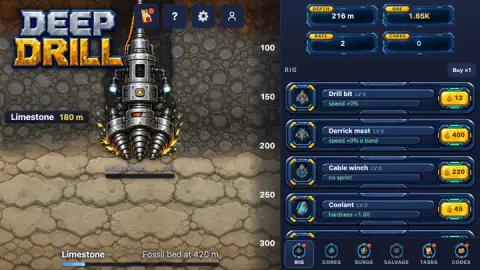
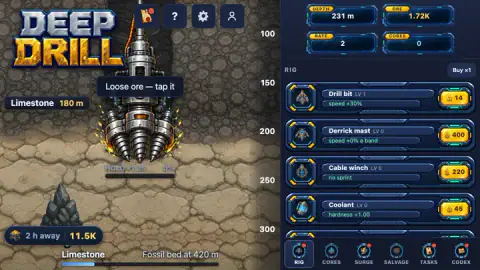
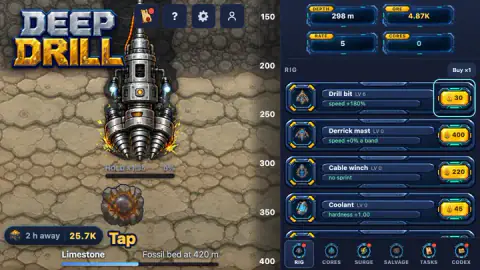
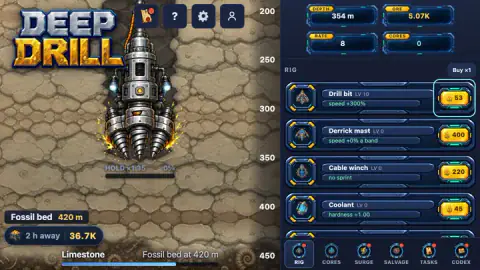
Taken by opening the game ourselves and letting it run — not supplied by the publisher, and not the same picture every other site shows.
How to play Deep Drill
- Let it run. The drill is cutting from the first second, and the four counters at the top right show DEPTH, ORE, RATE and CORES.
- Open the RIG panel and buy. Each row is one part of the drill, with its level, what it does, and a yellow price button. One click buys one level.
- Tap the loose ore. A note reading "Loose ore — tap it" points at a rock beside the drill, later marked simply Tap.
- Watch the ruler. Numbers down the middle mark the depth, a label on the left names the layer you are in, and a bar at the bottom counts down to the next one.
- When progress gets too slow, seal the well from the SALVAGE tab. The game's instructions say that resets the run and pays cores for permanent upgrades.
Tips from our session:
- The Drill bit is cheap, so start there. Level one cost 12 ore while we already had more than 1,600 in hand, and every level adds the same 30% speed.
- Do not stop at the Drill bit. We did, and finished with over 5,000 ore unspent. The Coolant row cost only 45 and divides the rock's hardness, which is the thing that slows every deeper layer.
- Use the 2 h away chip as a scoreboard. It shows what the rig would earn in two hours without you. If an upgrade does not move that number, it was not worth buying yet.
- Keep an eye on the bottom left. The loose ore rock appears there and is easy to miss while you are reading the RIG list.
- The keyboard did nothing for us. Everything is clicks or taps on the buttons themselves.
Controls
| Nothing | The drill goes down on its own from the moment the page loads |
|---|---|
| Click or tap a price button in the RIG panel | Buy one level of that part of the rig |
| Buy ×1 button (top of the RIG panel) | Switch between buying one level and, according to the game's instructions, the most you can afford |
| Click or tap the rock marked Tap | Collect the loose ore that turns up beside the drill |
| Tabs along the bottom | RIG, CORES, SURGE, SALVAGE, TASKS and CODEX |
Features
- A drill that never stops, so every click you make is a purchase, not a move
- A Drill bit upgrade that adds 30% speed per level and starts at 12 ore
- A depth ruler and layer names, with Limestone from 180 m and a Fossil bed waiting at 420 m
- A "2 h away" counter that shows how much ore the rig would earn while you are gone
- Loose ore that appears beside the drill and pays out when you tap it
- A reset, called sealing the well, that trades your depth for permanent cores, according to the game's page
Game details
- Developer
- ikonode
- Release date
- August 2026
- Last updated
- August 31, 2026
- Added here
- August 2026
- Technology
- HTML5 (2D)
- Platforms
- Browser (desktop, mouse), Browser (mobile & tablet, touch)
- Classification
- Clicker
- Download size
- 1.8 MB
- Ad requests
- 5 (some)
- Has a save
- Yes
- Saved progress
- Saving, when available, is managed by this game. Mava cannot confirm your level.
Measured by opening the game ourselves on 2026-09-11, not taken from the feed. Twelve seconds on a phone-sized screen, with ad requests counted and blocked rather than loaded.
FAQ
What is Deep Drill?
Deep Drill is a free idle mining game by ikonode, published in August 2026. A drill digs straight down on its own, every metre pays ore, and you spend that ore on parts that make it dig faster. The game is about how deep you can get before the rock becomes too slow to be worth it.
How do you play Deep Drill?
You do not steer anything. The drill descends by itself, and you click the price buttons in the RIG panel on the right to buy levels of the Drill bit, Derrick mast, Cable winch, Coolant and the other parts. You also tap the loose ore that appears beside the drill. Depth, ore, rate and cores are shown at the top right.
Can you lose in Deep Drill?
No. The game's instructions say there is no timer and no way to lose, and in our session the drill never ran out of anything. The only pressure is that each layer is harder than the last, so progress slows down until a reset is the better choice.
What does sealing the well do in Deep Drill?
According to the game's instructions, sealing the well (the SALVAGE tab) sets your depth, ore and rig levels back to zero and pays you cores based on the deepest point you reached. Cores buy permanent upgrades that survive every future reset. We did not seal a well in our session, so we have not seen the payout ourselves.
Does Deep Drill keep earning when you close the tab?
The game says it does, within a time window that grows with the night shift upgrade. While we played, a chip in the corner kept a running estimate of what two hours away would pay, and it climbed from 11.5K to 39.5K ore as we upgraded the drill bit.
What is the hold bar under the drill?
A bar under the drill reads HOLD ×1.35 and a percentage. It stayed at 0% for our whole run, and the Cable winch row read "no sprint" because we never bought it. Our reading is that the winch is what turns the hold into a speed boost, but we did not test it.
What is the deepest hole ever drilled in real life?
The Kola Superdeep Borehole in northern Russia, which reached 12,262 metres in 1989. Its drillers stopped because the rock at the bottom was far hotter than predicted, close to 180 degrees Celsius, and kept closing in on the hole.
Is Deep Drill free and does it work on phones?
Yes. It is free in the browser with no download, and the game's page lists Android and iOS in both landscape and portrait. Every action is a click or a tap, so it plays the same on a touch screen.