








About Planet Destroy Idle
Most idle games hand you a number and ask you to make it bigger. Planet Destroy Idle hands you a planet and asks you to make it smaller.
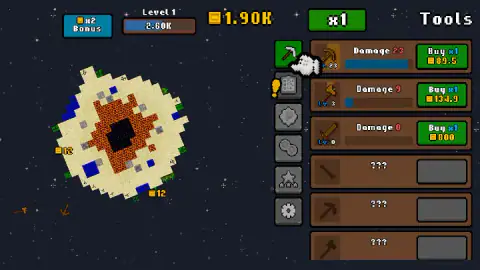
It sits in the middle of the screen, drawn like the cutaway diagram from a school book and turning slowly so you see every side of it. A rim of brown earth with grass and a tree standing in it. Grey stone underneath. A thick ring of orange magma. A black core shaped like a splash. On the right there is a shop. That is everything.
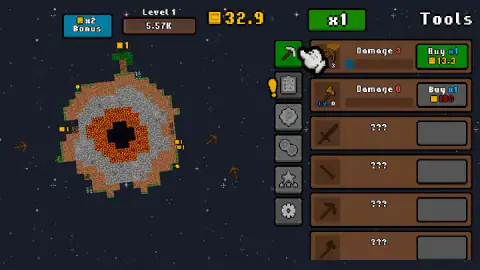
Here is the part the game never explains, and the part we had wrong when we first wrote this page: you do not click the planet. We spent ten minutes doing nothing but buying tool levels, and the gold counter climbed the whole time. The tools do the work. Small orange pickaxes drift in from the edges, chip at the surface, and knock loose little gold tags with numbers on them. In the first picture here those tags read 1. In the last they read 12.
The game is credited to Neko_puf. It went up in July 2026.
A word on what we did and did not see. Ten minutes, a desktop and a mouse, spent almost entirely on the top two rows of the shop. We opened none of the five round tabs down the left side, one of which had been flashing a yellow exclamation mark at us since the first second. This is a close account of the opening, and nothing more.
The money goes up as the planet comes down
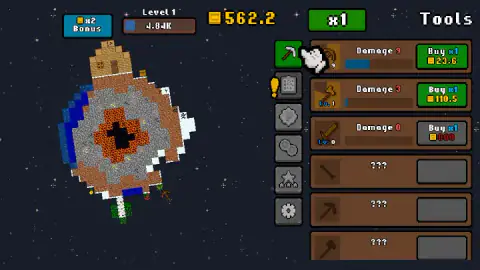
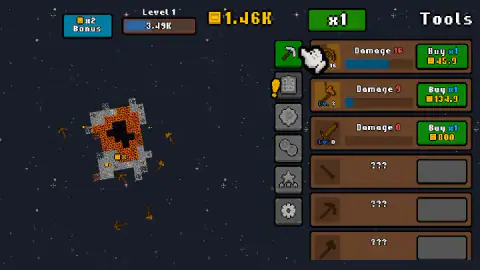
The four pictures on this page were taken minutes apart during one sitting. Read them as two counters moving in opposite directions and you have the whole loop.
| What the planet had left | Gold in hand |
|---|---|
| 5.57K | 32.9 |
| 4.84K | 562.2 |
| 3.49K | 1.46K |
| 2.60K | 1.90K |
More than half the planet in ten minutes, while the money went from loose change to nearly two thousand. Neither figure moved the wrong way.
What the pictures do not show is the planet steadily shrinking, and we are not going to pretend otherwise. It turns, and a broad face fills more of the frame than a narrow one, so a later shot can look larger than an earlier one. The counter is the honest measure; the outline is not.
What does change for good is the surface. In the first picture the brown crust runs right round the rim with grass and a tree in it. By the third there is no brown left anywhere — bare grey stone, a magma ring across most of the middle, and a black core grown from a small cross into a blob.
Every level costs a tenth more than the last
The pickaxe gains exactly one point of damage per level, and its price goes up by a tenth every single time. Those two sentences are the arithmetic of the whole game, and the pictures prove both.
| Pickaxe in the picture | Price of the next level |
|---|---|
| Damage 3 | 13.3 |
| Damage 9 | 23.6 |
| Damage 16 | 45.9 |
| Damage 23 | 89.5 |
For the first stretch you are winning. The four pictures above span twenty levels, and across them the damage grew by more than the price did. Then it turns over. The cheapest point of damage in the game arrives around the tenth level of a tool; from there, every extra point costs more than the one before it, and the gap widens with every purchase.
That is why the opening minutes feel generous and the later ones feel like work. Damage is addition. Price is multiplication. Multiplication wins, and quickly. The top row is not meant to be bought forever — it is meant to be abandoned at the right moment, and the game will not tell you when.
The shop opens one row at a time
Start the game and the panel shows a pickaxe, a hammer and four rows of question marks, drawn as a sword, a thin rod, another pickaxe and an axe. Those rows are not behind a paywall or a level gate. They are a queue. Buy your first hammer level and the sword appears below it, priced and ready, with three question marks still waiting underneath.
The hammer is the better tool and the harder purchase. It asks a flat hundred while the pickaxe is still asking for teens, and it pays three points of damage per level instead of one. The catch is that its flat price is flat exactly once. Buy a level and its ladder climbs too, a shade faster than the pickaxe's: by its third level it wanted 134.9.
So there is no safe harbour in that panel, no purchase that quietly gets cheaper while you save for it. Every row starts cheap and prices itself out, and the game is really about noticing which one is currently the bargain.
The brown layer is the thin one
The game draws its planet in the right order, and it gets the proportions roughly right too, which is the part worth knowing. The brown band — the only layer anything has ever lived on — is the thinnest thing in the picture, and the first thing to come off.
On Earth it is thinner still. All of the crust, continents included, is less than one per cent of the way to the middle. Everything that has ever happened has happened on the paint.
Nobody has been through it. The deepest hole ever made is on the Kola Peninsula in the far north-west of Russia. Drilling started there in 1970 and the deepest branch reached 12,262 metres. A later branch was stopped because the rock turned out to be around 180 °C, hotter than the plan had allowed for, and the project closed for lack of money. Twenty-two years of work got about a third of the way through the crust.
And here is the part that belongs on a page about a cutaway diagram: the diagram was wrong. Geologists expected a layer of basalt some kilometres down. It was not there. It was granite, and then more granite, and there was water circulating in rock the textbooks said would be dry.
So the one time anybody went to check the picture this game is drawing, the planet did not match it. Which is a decent reason to enjoy a version where a pickaxe gets you to the magma in ten minutes.
More from Neko_puf
Pickaxe Crusher Idle is this game's close cousin and the best place to go next: one pickaxe, chewing downwards instead of inwards, with the same shop of tool levels on the right. Gun Bounce Idle keeps the structure and throws away the mining, with guns tumbling round a walled arena and firing on their own. Sky Blocks Falling is the gentle one, where blocks come down out of a pixel sky and you catch them instead of smashing them. Crusher Block rounds out the set; we have not played it yet, so we will not tell you what is in it. The rest of the shelf is in clicker games.
Screenshots
How to play Planet Destroy Idle
- Watch the shop, not the planet. The tools hit on their own. Your only job is deciding what to buy, and when.
- Read the top row before you spend. It shows the tool, the damage it does now, and the price of its next level. Green means you can afford it; red means you cannot, and red goes green again on its own in seconds.
- Buy the top row early and often. The first level costs 11.0, and the first coins land within seconds of starting.
- Save a hundred for the second row. The hammer is the better tool, and buying it is also what reveals the row below it.
- Keep an eye on the figure beside Level. That is what is left of the planet in front of you. It only falls, and when it empties a bigger planet takes over.
What our session taught us:
- The cheapest damage in the game is in the middle, not at the start. Price multiplies, damage adds, and the two curves cross. Buying the top row forever is the obvious mistake, and nothing on screen warns you.
- A red price is not a broken button. It only means the coins are not there yet.
- No price in that panel stands still. We thought the hammer's flat hundred was fixed, because the first time we played we never managed to buy one. Own a level of it and it starts climbing like everything else.
- Buying is how you browse. Rows marked with question marks are not locked behind a level or a payment. They are a queue, and each purchase moves it.
- This idle game does not idle unattended. Look away and the gold counter is replaced by the words Click to keep playing, and it waits there until you do.
- The breaks come from the portal, not the game. Twice the screen dimmed and the words the ad appeared across the middle, with the planet still turning behind them. Nothing we had bought went away.
Controls
| Buy x1 on a tool row | Buys one level of that tool. The price shows in green when you can pay it and in red when you cannot |
|---|---|
| Left click on the planet | We clicked it and never caught it doing anything. The gold arrives whether you touch the planet or not |
| x2 Bonus (blue, top left) | Sits in the corner of every screen. We never pressed it, so we cannot tell you what it gives |
| x1 (green, above the tool rows) | A button rather than a label. Ours stayed on x1 for the whole session because we never pressed it |
| The round tabs down the left of the panel | Six of them, with the tool shop open and five closed, one carrying a yellow exclamation mark. We opened none of the five |
| Keyboard | We pressed the arrow keys and the space bar. Nothing we pressed produced a change we could confirm |
Features
- A planet drawn like a cutaway diagram, earth over stone over magma over core, that turns slowly while tools chip at it
- Two figures moving in opposite directions: across the four pictures here the planet falls from 5.57K to 2.60K while the gold climbs from 32.9 to 1.90K
- A pickaxe that gains one point of damage a level and costs a tenth more each time: 13.3 at Damage 3, 89.5 at Damage 23
- A hammer that opens at a flat 100 and then starts multiplying too, paying three points of damage a level instead of one
- Six shop rows that reveal themselves one at a time: buying the hammer is what puts a sword on the list
- Coins that pop off the surface marked 1 in the first minute and marked 12 ten minutes later
- Free in the browser with nothing to install, credited to Neko_puf
Game details
- Developer
- Neko_puf
- Release date
- July 2026
- Last updated
- July 17, 2026
- Added here
- June 2026
- Technology
- HTML5 (2D)
- Platforms
- Browser (desktop, mouse), Browser (mobile & tablet)
- Classification
- Clicker
- Saved progress
- Saving, when available, is managed by this game. Mava cannot confirm your level.
FAQ
How do you play Planet Destroy Idle?
A planet turns in the middle of the screen and tools you buy chip it apart for you. The whole game is the panel on the right: pick a row, press Buy x1, watch the damage figure go up. Every hit knocks a small gold coin loose, and the coins pay for the next level. The number beside Level at the top is what is left of the planet, and it only goes down.
Do you have to click the planet in Planet Destroy Idle?
No. We played a ten-minute session in which every click but one landed on a buy button, never on the planet, and the gold counter climbed the whole time. We did click the planet on other occasions and could not catch it doing anything. The tools are what does the damage, which is what makes this an idle game rather than a clicker.
What does the number next to Level mean in Planet Destroy Idle?
It is the planet, counted down. Our first one opened at 1.00K and was gone inside a minute; the one that replaced it started at 5.57K and took most of ten minutes to reach 2.60K. When a planet runs out, the level number goes up and a bigger one takes its place. The blue bar behind the figure fills as the figure falls.
Why does each upgrade cost more in Planet Destroy Idle?
Because the price is multiplied, not added to. Every level of the pickaxe costs a tenth more than the level before it: 13.3 when it was doing 3 damage, 89.5 when it was doing 23. The damage only goes up by one each time. Early on that trade is in your favour; past roughly the tenth level it stops being so.
What is the second tool in the Tools panel?
A hammer. It opens at a flat 100 while the pickaxe is still asking for teens, and it pays three points of damage per level instead of one. Its price is flat only until you own one: after the first purchase it starts multiplying like everything else, reaching 134.9 by its third level. Buying it is also what unlocks the sword row underneath.
How do you unlock the locked tools in Planet Destroy Idle?
By buying the tool above them. The shop starts with a pickaxe, a hammer and four rows of question marks drawn as a sword, a rod, another pickaxe and an axe. The sword stayed a row of question marks until we bought our first hammer level, at which point it appeared with a price of 800 on it. Three rows were still hidden when we stopped.
Are there ads in Planet Destroy Idle?
Yes, and they come from the portal rather than the game. Twice in ten minutes the screen dimmed and the words the ad appeared across the middle while the planet carried on turning behind them. Nothing we had bought disappeared and nothing was taken away for ignoring it. The game also stops and shows Click to keep playing if you look away.
Who made Planet Destroy Idle?
It is credited to Neko_puf, a handle rather than a name. It was published in July 2026. We found no studio website to confirm that against a second source, so it rests on the portal alone.