

About Planet Blast: Rockets
Most games about blowing things up hand you the trigger first. Planet Blast: Rockets hands you a build sheet. You set the rocket line by line, then turn a whole planet by hand until the place you want sits under a crosshair, and only then do you get a red button. The explosion is the last and shortest part of the turn.
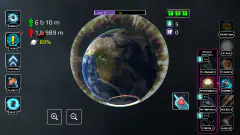
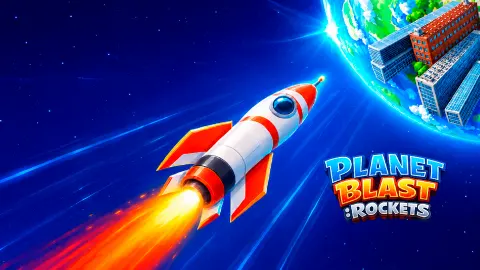
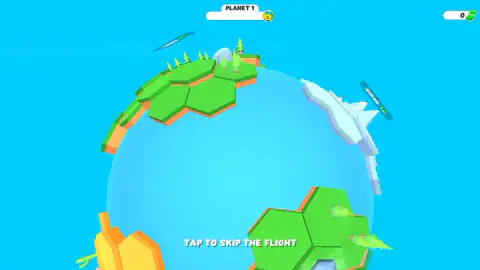
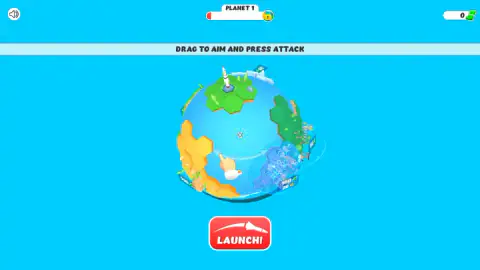
The planet is small enough to see whole and built from flat hexagons: a yellow desert with rocks and cactus-like plants, green continents with round trees and small striped buildings, a white ice cap, and a city of pale blue towers under a see-through dome. Your rocket stands on a pad on one of those green islands. It is aimed at the planet it is standing on.
We came back to it on 24 October and played for about ten minutes with a mouse: long enough to fire a run of rockets, to land one and see what landing does, and to read the launch pad properly, which is a bigger screen than we had credited it with. We never left the first planet, and this page is honest about where we stopped.
The game is credited to Prime Web Publish. It has been available since September.
Three decisions, and then nothing left to do
Every shot runs in the same order: build, aim, flight. The first two are yours. The third is not, and the game says so itself, because as soon as the rocket leaves the pad a line appears along the bottom of the screen: "TAP TO SKIP THE FLIGHT".
That offer tells you where the game is. We found nothing to steer once the rocket was up. The planet grows until its hexagons fill the screen, and the controls stay deaf until it lands. Whatever was going to happen had been settled before.
Real long-range rockets work the same way, and it is the reason they are called ballistic. The engines burn for only the first few minutes of a flight that can last about half an hour. After that the rocket is a thrown stone: where it comes down was fixed by how fast it was going and which way it was pointing when the fuel ran out.
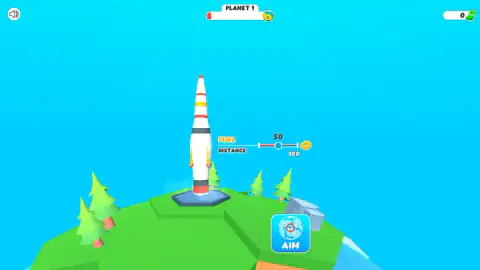
The pad is that idea made into a toy. FUEL has the word DISTANCE printed under it, so the game says plainly what it buys, and the rocket is drawn to match. With the slider down it is a slim white tube with red and yellow bands; by the halfway mark it has grown a pair of orange boosters at its base.
The launch pad is a build screen
Beside the rocket stand four lines, each an orange word over a grey one. AMMO has RADIUS under it and FUEL has DISTANCE, and those two carry a slider apiece, each marked to a hundred. The other two, RADAR over INCOME and ENGINE over TOTAL, have a yellow padlock where their slider should be. Half the rocket is locked away, and the game shows you the shape of the half you have not got.
Above the rocket a small card does the translating. It reads your settings back as plain figures: a blast radius in miles, a reach in miles, an income multiplier. With both knobs at the middle ours said 110 miles of radius and 674 of distance, which is where the sliders stop being abstract. You are not buying a number, you are buying how much of a small planet disappears.
Both knobs stuck at halfway for us, drag after drag, in every session, so every rocket we fired went out at half the reach the scale promises.
Gears are not money
Just past the right-hand end of each slider track sits a small orange gear. It turns up twice more at the foot of the screen, and the three uses together explain the economy.
A panel down there reads BUILD POWER with a counter beside that gear, which started at nought out of a hundred and stayed there for everything we did. Next to it an orange UPGRADE button promises twenty gears free, with a little film-strip symbol under the word: the game asking for a video in exchange. So gears are what upgrades cost, the meter is how many you hold, and watching something is one way to get them.
The green notes in the top right corner are a different currency, and that is the one strikes pay in. On an earlier run a string of launches took the counter to 47; through this session it read zero, including straight after a hit, so we still cannot tell you what one rocket earns. Some places on the planet carry a floating number on those same notes, 140 on the desert the clearest of them. They look like prices on targets, and we have never collected one.
What a hit looks like
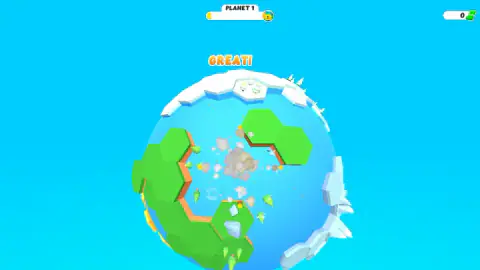
Land one and the game prints GREAT! in orange above the planet. Under the word sits a grey plume of smoke and dust, a scatter of debris turning in the sky, and a bite taken out of the ground: hexagons that were green are gone, and the ones left at the edge show raw orange rock down their sides, like a cliff where a lawn used to be.
Worth saying, because the planet turns and the camera moves, so it is easy to read any change as a trick of the view. This one is not: the damage stays on the globe.
What it does not do is hurry. Under the words "PLANET 1" runs a long white bar with a red stub at its left end and a globe wearing a padlock at its right. Ten minutes of launching left that stub a stub. We take the padlock to mean the next planet opens when the bar fills, and that a planet costs a great many rockets.
What we still have not seen
We have not finished Planet 1 or reached a second one, so we cannot say whether a planet can be failed, whether rockets run out, or what a miss costs beyond the wasted shot. We never filled the gear meter, never opened the RADAR or ENGINE padlocks, never saw the price of anything, and never hit the city under the dome. We played with a mouse on a desktop; the listing offers it on phones, which is its word, not ours.
Who it is for
Someone who likes setting things up and watching them go. The pleasure is in the choosing, and the flight is a reward you are invited to skip. A turn takes well under a minute once you know where AIM is. It is not an action game, whatever the rockets suggest: nothing shoots back and nothing hurries you.
The destruction is drawn as a cartoon. The planet is a toy of coloured tiles, a hit is a puff of smoke, and we saw no people on it. It is still a game about firing rockets at cities, and a parent may want to know that first.
More games about breaking things on purpose
Smash Master is another aim-first game, with a cannon and a stack of crates. Smash and Break drops the aiming and hands you a hammer. Planet Destroy Idle takes the same subject at an idle game's pace, and if it is the tiny planet you liked, Slime Planet Eater has you rolling round one and swallowing it piece by piece. Black Hole: Eat the Universe works up from atoms to planets. The rest are under strategy games.
Screenshots
How to play Planet Blast: Rockets
- The level opens with TAP TO START over the rocket. One click anywhere puts you on the launch pad.
- Hold the mouse button on the FUEL slider and drag it right. The number above the knob rises, and the rocket is redrawn while you drag.
- Click the blue AIM square in the bottom right, marked with a dotted globe and a crosshair. The camera pulls back until the whole planet is on screen.
- Hold the mouse button on the planet and drag. The planet turns; the crosshair stays in the middle. With land under it, click the red LAUNCH! button.
- Watch the planet swell as the rocket comes down, or click to skip the flight. A verdict appears, and you are back at the pad with the next rocket.
What our launches taught us:
- The banner and the button disagree. The strip across the top says "DRAG TO AIM AND PRESS ATTACK". There is no button called ATTACK. The one you want is red and says "LAUNCH!".
- You move the planet, not the crosshair. It took us several drags to stop chasing it. It never leaves the centre.
- Aim with the ring, not the dot. The crosshair is a small red target inside a much wider circle of white dots, and the wide circle is the part that counts. Line that up over land and a shot that looks off-centre still bites.
- Water is a miss. Most of the surface is sea, and a rocket that lands in it is answered with "MISS!" in red.
- Nothing answers while a rocket is up. We lost whole stretches hauling at sliders mid-flight. The pad only listens once it has landed.
- AIM is easy to overlook. The sliders feel like the game, and nothing flies until you press that blue square.
Controls
| Click anywhere on the TAP TO START screen | Starts the level and puts you on the launch pad |
|---|---|
| Hold the left mouse button on a slider and drag | Builds the rocket. FUEL is labelled DISTANCE, and AMMO, which appears after your first launch, is labelled RADIUS |
| Click the blue AIM button | Leaves the launch pad and pulls the camera back until the whole planet is on screen, with a dotted crosshair in the middle |
| Hold the left mouse button on the planet and drag | Turns the planet. The crosshair stays where it is, so you bring the target to it |
| Click the red LAUNCH! button | Fires the rocket at whatever is under the crosshair. Nothing on the pad screen answers again until it lands |
| Click during the flight | The game offers this as a way to skip the flight and go straight to the result |
Features
- Three steps per shot, always in the same order, which are building the rocket, aiming and watching the flight
- A launch pad that is really a workshop, with four lines on the rocket: two sliders you can move and two behind a padlock
- A card that turns your settings into plain numbers, so a rocket reads as a blast radius and a reach in miles
- Gears, a second currency separate from the money, with a BUILD POWER meter that fills as you collect them
- A fixed crosshair drawn as a wide ring of dots, and a planet you turn by hand underneath it
- Strikes that take hexagons off the planet and leave the raw orange rock showing where the ground was
- A progress bar for each planet with a padlocked globe at its end
Game details
- Developer
- Prime Web Publish
- Release date
- September 2026
- Added here
- August 2026
- Technology
- HTML5
- Platforms
- Browser (desktop)
- Saved progress
- Saving, when available, is managed by this game. Mava cannot confirm your level.
FAQ
What is Planet Blast Rockets?
It is a 3D browser game credited to Prime Web Publish in which you fire rockets at a small cartoon planet. Each shot has three steps. You build the rocket on a launch pad screen, you turn the planet until your target sits under a crosshair, and you launch. A hit takes ground off the planet and moves its progress bar.
How do you play Planet Blast Rockets?
Click once on the TAP TO START screen, then drag the FUEL slider on the launch pad and click the blue AIM button. Drag the planet until the dotted crosshair in the middle of the screen covers land, and click the red LAUNCH! button. The rocket flies on its own, and a click during the flight is offered as a way to skip to the result.
Why does it say MISS in Planet Blast Rockets?
Because the rocket came down on open water, which is most of the planet's surface. The crosshair never moves, so the planet has to be turned until land sits under it before you press LAUNCH!. When we did that, the game answered with "GREAT!" instead and a piece of the planet came away.
What do the FUEL and AMMO sliders do?
The game labels them itself. FUEL carries the word DISTANCE and buys how far the rocket reaches, while AMMO carries the word RADIUS and sets how wide the crosshair's dotted ring is. AMMO only shows up after your first launch. Both are marked from 0 to 100, and neither knob ever went past the middle for us.
What are the gears for in Planet Blast Rockets?
Gears are the game's upgrade currency, and they are not the same as the green notes in the top right corner. One sits past the end of each slider track, and a panel at the foot of the launch pad reads BUILD POWER with a gear count beside it. Ours stayed at nought out of a hundred, so the two padlocked lines on that screen, RADAR and ENGINE, never opened for us.
How do you finish a planet in Planet Blast Rockets?
We have not finished one, so we can only tell you what the screen shows. A bar under the words "PLANET 1" starts as a short red stub and has a globe with a padlock at its far end. Ten minutes of launching barely moved it, which suggests a planet takes a great many strikes.
Does Planet Blast Rockets have ads?
The game offers them rather than forcing them. A button at the foot of the launch pad reads UPGRADE and promises twenty gears free beside a small film-strip symbol, and on an earlier run a card headed "TOTAL REWARD" offered to multiply a payout, with a "NO, THANKS" line at the bottom. Declining carried on as normal.
Who made Planet Blast Rockets?
The game's listing credits Prime Web Publish. The game was published in September 2026, and a month later. The same name is on other games in that catalogue.