












About Slime Planet Eater
The title promises a planet, and the first thing you eat is a flower. That gap is the game. Slime Planet Eater starts you as a green, see-through blob about the height of a sheep, on a world so small that the horizon bends away a few steps from where you stand, and asks you to work your way up the menu.
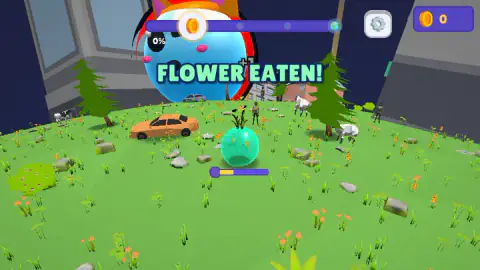
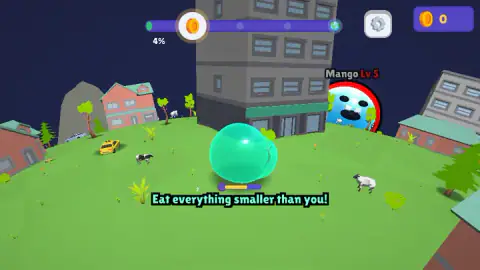
The rule fits in one line, and the game prints it on screen: "Eat everything smaller than you!" Roll into a flower and it is gone, with a banner to confirm it. A car is not on the menu yet at that size; the game's description says that things too big for you push you aside. A short bar under the slime fills as you eat, a number beside it is your level, and each new level moves the line between food and furniture a little further out.
The game is credited to a developer listed as d954mas. It was published in September 2026, which makes it a new arrival with a small audience so far.
A word on how much of it we saw. We played for a little over four minutes on a desktop computer, with keyboard and mouse. In that time we went from level 1 to level 3 and ate 6% of the first planet. We never finished it, so the galaxy map and the hats, trails and skins that the game's description mentions are outside this page.
Two bars, two different questions
It took us a couple of minutes to see that the screen is measuring two things at once.
The bar under the slime answers "how big am I". It is short, purple, fills with yellow, and has a round badge at its left end with your level in it. Ours read 1, then 2, then 3. When it rolled over to 3, a "LEVEL UP" banner covered the middle of the screen for a moment.
The long bar at the top answers "how much planet is left". It starts with a green dot, carries a coin badge and two more dots along its length, and ends in a small drawing of a planet. The percentage under it went from 0 to 6 while we played. We never reached the coin badge, and the coin counter in the corner read 0 from start to finish, so we cannot tell you what the bar pays or where coins are spent.
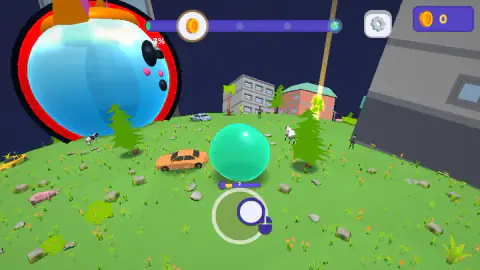
One more thing we could not explain. A column of yellow light stood over one bush for most of the session, the way games usually mark a target. We did not reach it.
You are not alone on the planet
The game's description says there are no enemies. What the screen shows is company. From the first second a blue slime many times our size, with a face, a red outline and an orange cat-ear hat, was rolling around the far side of the world, large enough to be seen over the horizon.
Others turned up with labels. Mango and Bloop were both level 5 while we were at 2 and 3, and a fainter label further off read Peanut, level 12. They eat as you do: +1 and +2 marks floated over them as they went. The game does not say whether these are other players or run by the computer, so neither do we.
Twice one of the big ones rolled straight over us. The view filled with blue, a red bar appeared beside our slime and the ground turned orange. Both times we came out the other side at the same level, with nothing visibly lost. That is all we can say about it. We do not know what the red bar measures, and four minutes is not enough to promise that a larger slime can never hurt you.
What the others clearly do is compete for the same food. Every bush Mango eats is a bush you will not.
A sticky ball from 2004 worked out this rule
The idea of growing by eating, with size as the only lock on the door, has a well-known ancestor. Katamari Damacy, directed by Keita Takahashi and released by Namco for the PlayStation 2 in 2004, has you roll a sticky ball called a katamari. According to Wikipedia, objects smaller than the ball stick to it, and as it grows, larger ones become collectable. Its hero starts five centimetres tall among thumbtacks and ants and ends up rolling buildings and mountains.
Browser games took the same rule and added rivals. Agar.io, released in April 2015 by a 19-year-old Brazilian developer, Matheus Valadares, makes you a cell that eats pellets and smaller cells while avoiding larger ones. Hole.io, published by Voodoo in 2018, swaps the cell for a hole in a city street and fits each round into two minutes.
Slime Planet Eater has no link to any of them, but knowing the family tells you how to play it. The Katamari half is the ladder of sizes: the fun is going back to the car that ignored you. The Agar.io half is the labels over other slimes' heads. What this game adds is the shape of the map. A level in those games has edges. Here the ground is a ball, so there is no corner to clear and no wall to follow; you keep circling, and the same houses come round again, slightly smaller each time.
Who it is for
It suits players who want something to steer without a clock running. Nothing timed us and nothing ended our session. The early game is gentle to the point of slow, which will please some and bore others.
It is not a competitive arena game in the sense that Agar.io is, at least not in the part we played: nobody knocked us out. And if you want a short game, be warned that four minutes bought us 6% of one planet.
More games to try next
Black Hole: Eat the Universe takes the same appetite and removes the steering: you tap, buy upgrades and start again. Cube Snake 2048 keeps the rule about only eating what is not bigger than you, with numbered cubes in an arena. Snake 2077: Glitch War is the grow-by-eating idea with a live leaderboard. If it was the slime that brought you here, Grow Slime is a farming game where you raise them from eggs. The rest are under arcade games.
Screenshots
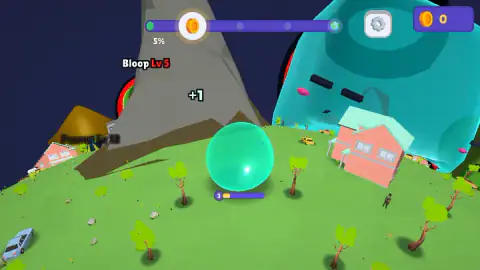
Taken by opening the game ourselves and letting it run — not supplied by the publisher, and not the same picture every other site shows.
How to play Slime Planet Eater
- Move. Hold W, A, S or D, or hold the left mouse button and drag. With the mouse, a round on-screen stick appears and the slime follows it.
- Touch small things. Grass, flowers and bushes first. There is no eat button; contact is enough.
- Watch the bar under the slime. It fills as you eat. When it is full you level up.
- Come back for what refused you. After a level, try again the things you bounced off before.
- Empty the planet. The bar at the top counts the world down in per cent.
What our session taught us:
- The banner is your receipt. "FLOWER EATEN!" and "BUSH EATEN!" appeared the moment each one went in. If you roll into something and no banner comes up, treat it as too big for now.
- The first levels are slow, and that is by design. We spent most of four minutes on flowers and bushes, each worth a +1, and reached level 3. The planet bar moved about one point every forty seconds.
- Watch for the +3. Our jump to level 3 came with a +3 on screen and a human figure standing on top of the slime. It was the largest single gain we saw, so bigger meals look worth more than another round of flowers.
- A level changes the camera, not just the number. At level 3 the view pulled back far enough to show a mountain and more of the houses. That is the signal to look for new targets.
- Read the labels on the other slimes. Each carries a level. Yours is the number under your own slime, and it is the quickest comparison the screen gives you.
Controls
| W, A, S, D | Roll the slime; the opening card draws these four keys under the words MOVE TO EAT |
|---|---|
| Hold the left mouse button and drag | A round on-screen stick appears and the slime rolls the way you pull it |
| Touch something smaller than you | It is swallowed without a button press and a banner names what you ate |
| Gear (top right) | Settings; the game's instructions list sound, language and a wardrobe there (we did not open it) |
Features
- A whole planet small enough that the horizon curves a few steps from where you start
- One rule, printed on screen: eat everything smaller than you
- A level badge under your slime that went from 1 to 3 in our four minutes
- A planet bar across the top that counts how much of the world is gone, in per cent
- Other slimes with names and levels on the same planet, such as Mango and Bloop at level 5
- Flowers, bushes, sheep, cows, pigs, people, cars, houses, office blocks and a mountain, all at their own size
- Made by d954mas
Game details
- Developer
- d954mas
- Release date
- September 2026
- Last updated
- September 16, 2026
- Added here
- September 2026
- Technology
- HTML5 (3D)
- Platforms
- Browser (desktop, keyboard or mouse), Browser (mobile & tablet, touch)
- Classification
- Arcade , Casual , .io , Multiplayer
- Saved progress
- Saving, when available, is managed by this game. Mava cannot confirm your level.
FAQ
How do you play Slime Planet Eater?
You steer a green, see-through slime around a very small planet. Anything smaller than the slime is swallowed when you touch it, and each thing you swallow fills a short bar under you. When the bar is full you go up a level, the camera pulls back and bigger objects come within reach. A bar at the top of the screen shows how much of the planet you have eaten.
What are the controls in Slime Planet Eater?
On a computer you can roll with W, A, S and D, or hold the left mouse button and drag, which brings up a round on-screen stick. There is no button for eating: touching something small enough is all it takes. The game's instructions also list the arrow keys and dragging a finger on a phone; we played with keyboard and mouse only.
Can you lose in Slime Planet Eater?
We did not lose anything in four minutes of play. Twice a much larger slime rolled over us; a red bar appeared and the ground turned orange, and both times we came out at the same level. The game's description says there is nothing to fail. We did not play long enough to confirm that for the whole game.
Who are Mango, Bloop and Peanut?
They are other slimes on the same planet. Each one carries a label with a name and a level, and they eat scenery just as you do. We saw Mango and Bloop at level 5 and Peanut at level 12 while we were at level 2 and 3. The game does not say whether they are other players or run by the computer.
What does the percentage at the top of the screen mean?
It is the planet's progress bar, with a small planet drawn at its far end. It moved from 0% to 6% during our session, roughly one point every forty seconds at the size we were. It is separate from the level badge under your slime, which measures you and not the world.
How long does it take to finish a planet?
We cannot give a time. After a little over four minutes we were at level 3 with 6% of the first planet eaten, and we were playing slowly. Growth speeds up as larger objects become edible, so the early minutes are not a fair guide to the rest.
Who made Slime Planet Eater?
It is credited to a developer listed as d954mas. It was published on 15 September 2026. It is listed for PC, Android and iOS; we played it on a desktop computer.
Is Slime Planet Eater related to Katamari Damacy or Agar.io?
No. It shares their central idea, which is that you can only take in what is smaller than you and that growing changes what counts as small. Katamari Damacy did it with a sticky ball in 2004 and Agar.io with cells in 2015. Slime Planet Eater is a separate game with no stated link to either.