




About Roll King
Roll King never tells you how big you are. The clock sits in a purple capsule at the top of the screen with a little hourglass beside it, the goals sit top left as cards, four round buttons sit along the bottom. Nowhere on that screen is there a number for the one thing the whole game turns on: the size of your ball against the size of the thing in front of it. You find that out by driving into things.
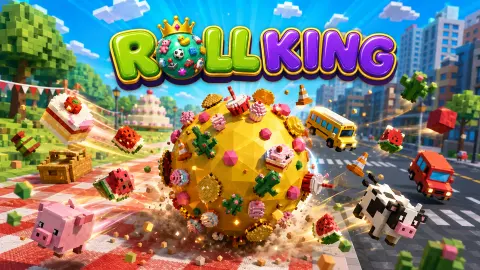
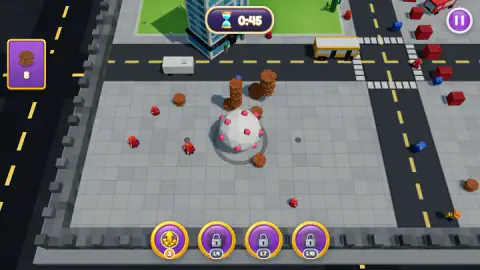
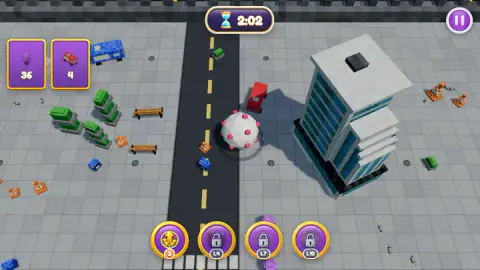
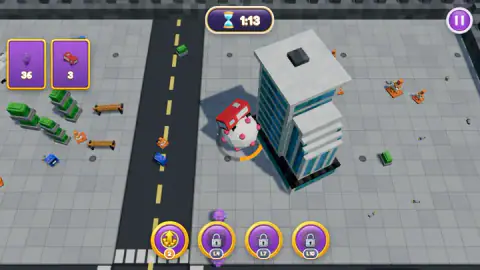
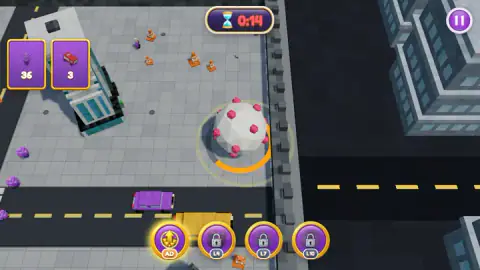
The ball is a white faceted sphere covered in pink studs, and it goes where you drag. Roll into something smaller and it sticks: in one of our pictures a red van lies across the top of the ball at an angle, wheels in the air, carried rather than crashed into. Roll into something bigger and you stop. We spent most of the second level alongside a white office tower with blue glass sides, and that tower is in exactly the same place at two minutes as it is at fourteen seconds. It was never going anywhere, and we kept finding that out.
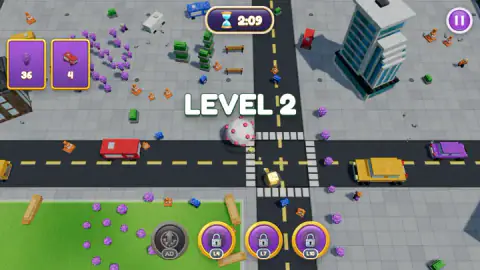
What the level wants from you is on those cards, and they count down rather than up. The first level showed one card: a stack of brown slabs with an 8 under it. The second showed two, a purple shrub marked 36 and a red van marked 4. We rolled up one van and the card became a 3. The shrub card never moved at all.
The game is credited to Golem Kin Games and dates the listing to July 2026.
Our own session ran about four minutes, and we will be precise about it, because the first four minutes are the part anyone can check. We cleared the first level. The second ran us out of time, we tried again, and the clock caught us the second time too.
The ball that swallows the city, and the one rule holding it up
The idea Roll King is built on is older than most of the people playing it, and knowing where it came from makes the board readable.
In 2004 Namco put out Katamari Damacy on the PlayStation 2, designed by Keita Takahashi: a prince pushes a sticky clump around a house, and anything smaller than the clump joins the clump. Start with drawing pins and sweets, end with cows, cars and eventually islands. The game was odd and cheap and it worked so well that the rule outlived it. A decade later the browser took the same arithmetic its own way, first with the swallow-what-is-smaller games of the mid-2010s and then with the hole games that eat a town from underneath. Roll King belongs to that family without being connected to any of its famous members.
What all of them actually run on is a size threshold: for every object on the map, the game asks one question, is this smaller than the player, and gives one of two answers. There is no damage, no health and no skill check in between.
That single comparison turns a space into a sequence. The city in front of you is not a map to explore, it is a staircase: crates, then benches, then cones, then the parked cars, then the vans, then — further on than we got — the things that are currently just scenery. An object changes category without changing at all, because the thing that changed is you.
It also explains why Roll King piles its small stuff in heaps instead of spreading it evenly. A heap is a step you can climb in one pass. The level is not asking you to find things; it is asking you to find the right order to take them in, early, before the clock decides for you.
The ring on the floor is the only size meter you get
There is no size number anywhere on screen, and after a few minutes you stop wanting one. What you get instead is the ring: a flat circle drawn on the ground around the ball, working like a loading bar bent into a loop.
You can follow it across our pictures. Early in the second level the ring is plain grey and the ball is barely wider than the parked cars around it. By the time the van is stuck to the top of it, a thick orange arc has appeared along part of the ring. With seconds left the ring is almost a closed circle and the ball is big enough to make a truck look like a toy.
Putting the meter on the floor rather than in a corner of the screen is a small decision with a large effect, because it sits where your eyes already are. You are looking at the ball, so you are looking at how close you are to the next size, so you can tell at a glance whether that red bus is worth driving at yet or whether you need one more armful of crates first. Ignore it and you will spend half a level nudging the same immovable tower, which is exactly what we did.
Two counters, one clock, and the offer at zero
Three things are counting at once in Roll King and only one of them is in your favour.
The clock is the loud one. The second level gives you a little over two minutes, the digits sit in that hourglass capsule at the top of the screen, and they are white until the end is close, when they turn red. The goal cards are the quiet ones, and they are the actual win condition: clear both numbers and the level ends with LEVEL COMPLETE across the middle of the screen, which is how our first level finished.
When the clock reaches zero, a card comes up reading TIME'S UP and offers you another ninety seconds in exchange for watching a video. Under the offer sits a plain No thanks, and taking it is not a punishment: the card changes to two buttons, RETRY and HOME. We declined the video and retried, and the level restarted cleanly, clock back at the top and both goal cards back to the numbers they began with. The ad here is a shortcut past your own mistake rather than a toll gate, and nothing stops you playing without ever taking it.
One thing to know before you refuse it, though: a retry is a full restart, not a continue. Everything you rolled up is gone and the ball is small again. The ninety seconds are the only way to keep the ball you built.
More rolling and swallowing on Mava Games
If the size threshold is what hooked you, the purest version of it here is the hole genre, where you are the gap in the floor instead of the ball on it: Hole Eats All: Eat Them All and Attack Super Hole run on the same one-question rule from the opposite side. If it was the rolling, Neon Ball Slope keeps the ball and takes away the city, and Ninja Obby Speed Run keeps the clock and swaps the ball for a runner. We have not played those four down to a lost level the way we played this one, so take them as signposts. The rest of the shelf is in 3D games.
Screenshots
How to play Roll King
- Drag to roll. Press and drag with the mouse, or with a finger on a touch screen, and the ball rolls that way. That is the whole of the input.
- Go over things smaller than you. They stick, you get bigger, and the ring drawn on the floor around the ball fills a little further with orange.
- Watch the ring, not the ball. When the ring closes you have gone up a size, and a class of object that used to stop you is now yours.
- Work the goal cards. They are a list, not a score. Clear the numbers on both cards before the clock runs out and the level is done.
- Spend the booster early. The button in the bottom left starts with a small number on it, and that number goes down as you use it.
What we only learned by being there:
- Go where the small things are crowded, not where the big landmark is. This is the mistake that cost us the level, and it is visible in our own pictures: the shrub counter reads 36 at two minutes, 36 at one minute thirteen, and 36 with fourteen seconds left. We spent the whole level on the tower side of the road while the thing the level was asking for sat in a heap on the other side.
- Parking against something too big is worse than it looks. The ball does not bounce off, it jams, and you lose the seconds it takes to realise the drag is doing nothing.
- The booster is not free for long. Ours showed a 3 at the start of the level and a 2 after one use, and by the final minute the badge had stopped showing a number at all and read AD. Use it while it is still a number.
- The clock tells you when to panic. The digits are white for most of the level and turn red near the end. That is the moment to stop growing and bank whatever is closest.
Controls
| Drag with the mouse, or with a finger on a touch screen | Rolls the ball in the direction you drag. Every single move we made in our session was a drag of this kind |
|---|---|
| Roll into anything smaller than the ball | It sticks to the ball, the ball grows, and the ring drawn on the floor around it fills a little further with orange |
| Roll into anything bigger than the ball | Nothing happens. The ball stops dead against it and stays there until you drag it somewhere else |
| The button with the gold arrow, bottom left | A booster with a limited charge. Its badge read 3 at the start of the level, 2 after we used it, and by the final minute it had stopped showing a number at all and read AD instead |
| The three padlocked buttons marked L4, L7 and L10 | Locked. We never got past the second level, so we never saw any of the three open and we are not going to guess at what they do |
| The pause button, top right | Stops the level. Apart from the booster, it is the only thing on the screen that is not the ball itself |
| Keyboard | We played the whole session with pointer drags. One key was tried and nothing answered, which is not a test, so we claim nothing either way |
Features
- One rule decides everything: things smaller than the ball stick to it and make it bigger, things bigger than it simply stop you where you stand
- The goals are two cards in the top left corner and they count down as you collect, so a level is a shopping list rather than a score
- The only size meter is a ring drawn flat on the ground around the ball, which fills with orange as things stick to it
- Every level is on a clock, two minutes and change on the second one, and the digits turn red when the end is close
- The booster in the bottom left has a small number of uses and then changes its badge to AD, so it is worth spending while it is still free
- Three more booster slots sit padlocked beside it, labelled L4, L7 and L10 after the levels they appear to be waiting for
- A voxel city to take apart: brown crate stacks, purple shrubs, benches, traffic cones, parked cars, vans, buses, trucks and office towers that stay exactly where they are
Game details
- Developer
- Golem Kin Games
- Release date
- July 2026
- Last updated
- October 24, 2026
- Added here
- June 2026
- Technology
- HTML5
- Platforms
- Browser (desktop), Browser (mobile & tablet, touch)
- Classification
- Arcade , .io , Multiplayer
- Saved progress
- Saving, when available, is managed by this game. Mava cannot confirm your level.
FAQ
What kind of game is Roll King?
It is a free browser game in 3D where you roll a spiked ball around a small voxel city and collect it. Anything smaller than the ball sticks to the ball and makes it bigger; anything bigger stops you. Each level gives you a short clock and a shopping list of things to pick up, shown as cards in the top left corner, and you clear the level by filling that list before the time runs out.
How do you control the ball in Roll King?
You drag it. Press and drag with the mouse, or with a finger on a phone or tablet, and the ball rolls that way. There is no jump, no brake and no second button, and the only other things on the play screen are a pause button in the top right and the boosters along the bottom. We played an entire session with nothing but drags.
How do you make the ball bigger in Roll King?
By rolling over small things. Each object that sticks adds to the ball, and the ring drawn flat on the ground around the ball fills a little further with orange. When that ring closes, the ball steps up to a new size and a whole class of objects that used to block you becomes collectable. In our captures the ball went from roughly the size of a parked car to several times that in about a minute and a half.
What are the cards in the top left corner of the screen?
They are the level goals, and they count down rather than up. The first level we played showed one card with a brown crate stack on it and the number 8. The second showed two cards, a purple shrub with 36 under it and a red van with 4, and the van card dropped to 3 after we rolled one up. Starting the level again put both numbers back to where they began.
What happens when the timer runs out in Roll King?
The level stops and a card reading TIME'S UP appears over the frozen board. It offers you an extra ninety seconds in exchange for watching a video, with a plain No thanks under the offer. Decline it and the card changes to two buttons, RETRY and HOME, so the video is genuinely optional. Retrying puts the clock and both goal counters back to their starting values.
What do the locked L4, L7 and L10 buttons do?
We do not know, and we would rather say so. They are three booster slots along the bottom of the screen, each one wearing a padlock and a label reading L4, L7 or L10, which reads like the level each one opens at. We never got past the second level in our session, so all three stayed shut the whole time and nothing on this page describes them.
Is Roll King the same as Katamari Damacy?
No, and there is no connection between the two. What they share is an idea that Katamari Damacy made famous on the PlayStation 2 in 2004: a ball that grows by absorbing anything smaller than itself. Roll King is a short browser game built on the same arithmetic, with a clock, a goal list and a city instead of a story. It is one of a great many games that have borrowed that rule over the last twenty years.
Who made Roll King and how far did you get?
It is credited to Golem Kin Games. Our own session lasted about four minutes: we cleared the first level, started the second, ran out of time on it, tried again and were still inside it when we stopped. Nothing here describes anything past the second level.