




About Neon Ball Slope
The leaderboard on this game's own page is public, and on the day we played it carried 212 names. First place had 2115. Our best run finished on 2.
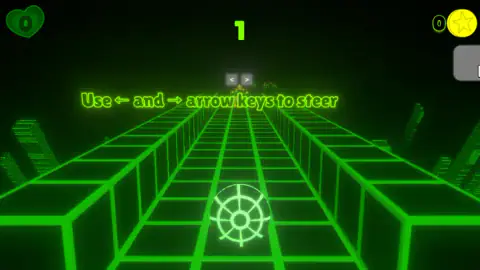
That gap is not a gap in understanding. There is nothing to understand. A glowing ball rolls down a slope made of green wireframe, you have the left arrow and the right arrow, and the ball never stops. The game writes the rule across the track before your first run and then gets out of the way: Use ← and → arrow keys to steer.
What makes two keys hard is that they steer something already leaving. You sit behind the ball, looking down a lane that narrows into the dark, and every correction arrives a fraction after the thing it was meant to fix. Hold a key down and you are off the side. Tap it and you may not have turned enough. The only resource in this game is the width of the lane, and you spend it on every mistake.
The game is credited to Ale, and that account carries exactly one game: this one. It went up in November 2025. We looked for a studio site, a store listing, another portal, anybody at all corroborating the credit, and found none, so treat it as a single source.
Here is the honest shape of what follows. One session on a desktop, four minutes, arrow keys and a mouse. We reached the slope over and over, collected seven coins in our best run, and ended every one of them by going over the edge. We never reached the card packs, the missions or the gem chests the game advertises around its edges, and we never touched it on a phone. What we can tell you is what each screen counts and why the first thirty seconds catch everybody.
The glow is a style now, but it used to be the only way to draw
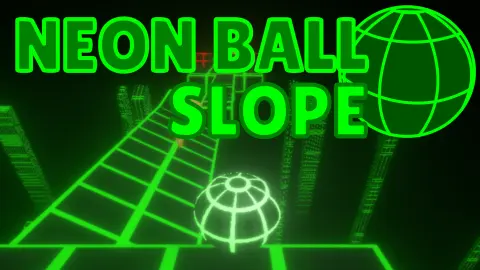
Everything on this screen is edges. The track is a grid of lines, the towers in the background are empty frames, and the ball is a sphere drawn as a cage rather than a surface. That looks like a filter applied on top of a normal game. It is not: it is a faithful copy of how a whole generation of arcade machines actually worked.
Those cabinets had vector displays. Rather than scanning the screen line by line, the machine steered its beam straight from one point to the next, drawing each line as a stroke: bright edges, and nothing that could be filled in. Atari's Battlezone put the player inside a wireframe battlefield for exactly that reason. The hollow look was not a style. It was the hardware being honest about what it could do.
Which is why the look fits this game so well. In a world made only of edges, the grid is the single thing telling you how far away anything is. Your eye reads depth from how fast the squares rush towards you and from how the two walls converge. Lose that and a wall looks the same whether it is three metres ahead or thirty. You are being asked to judge distance from a pattern rather than a shape, and that is why the first few runs feel unfair.
What the Game Over card is actually counting
The card is a tidy little accountant, and it is worth reading once, slowly.
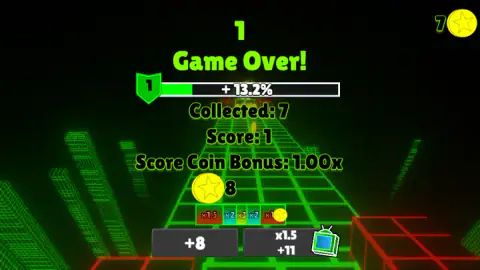
Collected is the stars you picked up, and it always matches the counter that was in the top right corner during the run. Score is the big number that sat at the top centre while you played. They are two separate currencies: you can finish a run having collected seven and still have a score of one, which is precisely what we did.
Score Coin Bonus is the multiplier on your payout, and it read 1.00x on every card we saw. Below it sits a strip of small tiles showing better rates, up to x3, with a coin marker sitting among them. We never found what moves that marker, and we are not going to pretend otherwise.
Above all that sits a bar with a shield on it. The shield held the number 1 throughout, while the bar gained a different slice after each run, and the size of that slice tracked neither our coins nor our score. What it does tell you is the pace: the second level is several runs away, not one.
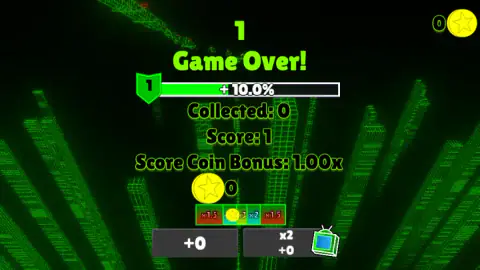
Then the two buttons. The left one is plain and hands over what you earned. The right one carries a small green television, which is the usual sign for a video, and multiplies the figure. After our best run those two read +8 and x1.5 +11. After a run where we collected nothing, they read plus zero and plus zero. Between runs the game also stops on a card asking you to press a button to continue: that is where the ad break lives.
What the leaderboard expects, and what we never reached
The distributor runs a daily board on the game's page, and it resets every day, which makes it a surprisingly good difficulty meter. On the day we looked, 212 players had posted a score, the top one was 2115, and ninth place was 390.
Our 2 would not have troubled the bottom of it.
So this is not a game that pays off in ten-second bursts, whatever your first three runs suggest. The intended shape is a long descent on a slope that steepens, which the game says it does, with the score piling up as the lane gets meaner.
Around that run sit a lot of promises we cannot verify: card packs bought with coins and gems, experience earned per run, missions handing out chests, and the daily board split into divisions. The title screen does show a trophy counter, a gem counter next to the coins, and three numbered tiles under the Play button, so the machinery is clearly there. We never got far enough to open any of it, and this page is not going to describe things it has not seen.
More games that only give you two directions
Dune Surfer 3d is the closest cousin: another ball, another endless slope, one button instead of two. Brazen Ball swaps the third dimension for a flat run where the problem is timing. Geometry Rash strips it to a single key and a beat. Skate Hooligans and Relic Runway are the three-lane version, where you dodge rather than steer. The rest is in 3D games.
Screenshots
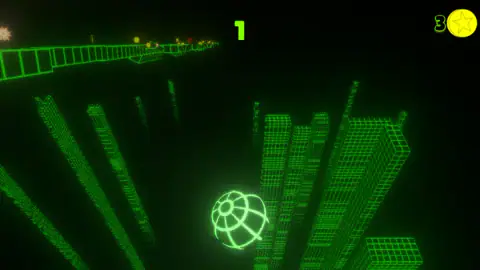
How to play Neon Ball Slope
- Press the green Play triangle on the right of the title screen. The trophy above it and the three numbered tiles below it open up later; the triangle is what starts a run now.
- Close the tutorial card with the small red OK in its corner. It repeats the two keys. Clicking the card itself does nothing, and neither does pressing the arrows while it is up.
- Steer in taps. Each press nudges the ball across the lane and it keeps going where you pointed it. We held a key down for a second at a time and went over the side every single time.
- Collect the stars as they come. The counter in the top right is this run's haul, and it is the same number the results card will call Collected. Going out of your way for one is almost always how a run ends.
- Take the payout to get back out. When the Game Over card appears, the two buttons along the bottom are the only live things on it. The plain one pays what you earned and returns you to the title screen.
What four minutes taught us:
- The grid is your speedometer. There is no dial anywhere on the screen. The only way to tell how fast you are going is how quickly the squares of the track pass under the ball, and that is the number you should be watching rather than the horizon.
- Nothing you press changes your speed. No brake, no boost. Every run ends because of where you were, not how fast you were going, which means the line you pick matters far more than your reflexes do.
- Red is not floor. The track is green. The game's own instructions name two ways to end a run: falling off, and hitting the red. The red structures sit below and outside the lane, which is a polite way of telling you where the edge is.
- Twice nothing is nothing. On a run where we collected zero, the multiplier offer on the results card read plus zero. The bonus is a percentage of your haul, so it is worth exactly as much as the run was.
- The score is meant to go higher than you think. Single digits are what a short run looks like. Ninth place on the day's board had 390, so a decent run lasts minutes, not seconds.
Controls
| Left arrow | Steer left. The game draws the two keys on screen before your first run and names no others |
|---|---|
| Right arrow | Steer right. Short taps, not long holds: the lane is narrower than it looks from behind the ball |
| Nothing for speed | There is no brake, no boost and no jump. The ball rolls on its own and you only choose the line |
| Mouse | Everything outside the run. Play on the title screen, OK on the tutorial card, and the payout buttons on the results card |
| The Game Over card itself | Not a button. Only the two payout buttons at the bottom of it do anything, which is worth knowing before you click the score four times like we did |
Features
- Two keys and nothing else: the on-screen hint names the left and right arrows, and no third control appeared all session
- Your score is the big number at the top of the screen, and it ticks over slowly: the day's leaderboard on the game's own page topped out at 2115, and our best run reached 2
- A star counter in the top right that matches the Collected line on the results card exactly, so you always know what the run is worth before it ends
- A results card that counts three things, Collected, Score and Score Coin Bonus, the last of which stayed at 1.00x for us
- A level bar that gains somewhere between ten and twenty per cent a run, with a shield badge that never moved off 1 in four minutes
- Two ways to be paid: a plain button that hands over what you earned, and one with a small television that multiplies it
- Credited to Ale, available since November 2025
Game details
- Developer
- Ale
- Release date
- November 2025
- Last updated
- August 10, 2026
- Added here
- October 2025
- Technology
- HTML5 (WebGL, 3D)
- Platforms
- Browser (desktop, keyboard), Browser (mobile & tablet, touch)
- Classification
- Arcade
- Download size
- 26.6 MB
- Ad requests
- 2 (few)
- Has a save
- Yes
- Saved progress
- Saving, when available, is managed by this game. Mava cannot confirm your level.
Measured by opening the game ourselves on 2026-09-11, not taken from the feed. Twelve seconds on a phone-sized screen, with ad requests counted and blocked rather than loaded.
FAQ
How do you play Neon Ball Slope?
You steer a rolling ball down a neon slope with the left and right arrow keys, and that is the whole control scheme. The ball never stops and there is no brake, so the game is about choosing a line early rather than reacting late. A run ends when you go over the side of the track or hit the red, and the card that follows counts your coins and your score.
What are the controls in Neon Ball Slope?
The left arrow and the right arrow. The game prints the line Use left and right arrow keys to steer across the track before your first run, and a tutorial card says the same thing again with an OK button to close it. Nothing we pressed made the ball faster or slower, and the mouse is only for the menus and the payout buttons.
How is the score counted in Neon Ball Slope?
The large number at the top centre of the screen during a run is your score, and the Score line on the Game Over card matches it. It climbs slowly, so single digits are what a short run looks like: our best reached 2. Coins are counted separately, by the star in the top right corner, which matches the Collected line on the same card.
What does Score Coin Bonus mean in Neon Ball Slope?
It is the multiplier applied to what your run pays out, printed on the Game Over card under Collected and Score. In every run we saw it read 1.00x, which is the base rate and means no bonus was in play. The small strip of tiles below it shows larger figures, x1.5, x2 and x3, so there is clearly a way to raise it that we never reached.
What is the button with the television on the Game Over screen?
It is the video offer, and it multiplies your payout rather than giving you a free one. On one run the plain button handed over 8 coins while the television button offered 11. On a run where we collected nothing, it offered twice nothing, which is written on the card as plus zero: there is no reason to take it after a bad run.
How do you restart after a Game Over in Neon Ball Slope?
Press one of the two payout buttons at the bottom of the card. The card itself, the score lines and the Game Over banner are decoration and do not respond to clicks. Taking the plain payout put us back on the main title screen both times we tried it, and from there the green Play button starts a fresh run.
Is Neon Ball Slope the same game as Slope?
No. They share a genre, a ball and a neon grid, but this is a separate title. Neon Ball Slope is credited to a developer called Ale and dates it to November 2025. We could find no studio site or second portal carrying it.
Can you play Neon Ball Slope on a phone?
It is listed for PC, Android and iOS, in landscape only, so it is meant to work under a thumb. We cannot vouch for it: our session was on a desktop, and the only control the game ever showed us was a pair of arrow keys, which a phone does not have. If you try it on a phone, expect the steering to be a tap on each side of the screen.