About Relic Runway
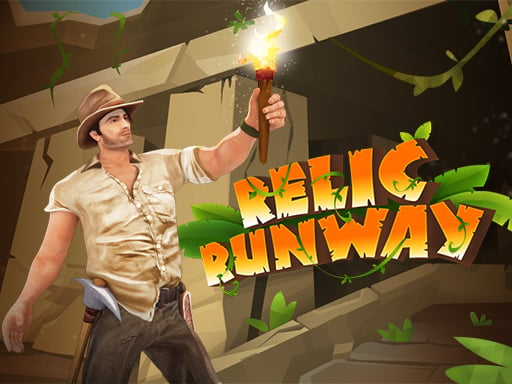
The opening two minutes of Raiders of the Lost Ark have been rebuilt as a video game more times than anyone has counted: a man in a hat takes something gold out of a temple, the temple objects, and he runs. Relic Runway does not pretend otherwise. Your starting character is Jim Tomson, described in his own unlock screen as a "professor of archeology, adventurer, and very cool guy". The first location is a set of Inca ruins. The thing chasing you is a stone golem, and it is faster than you.
What separates it from the hundred other temple runners is what happens between the runs. Every idol you grab gets smashed open on the menu screen, and inside are character cards and relic fragments. Complete a whole set of eight relics and a location opens — the Great Wall of China, then the Golden Sands of Egypt, pyramids included. Collect enough cards and you unlock a runner, at a price that climbs steeply: 10 cards for Lucy Hunt, 250 for Blackbeard, 500 for an alien relic hunter from the M35 galaxy.
Underneath that is an economy with real numbers in it: seven upgrades, six paid levels each, a total bill of 379,000 coins to finish the lot. Gemioli released the game on 31 August 2019 and was still patching the code in September 2025 — six years of updates for a browser game nobody had to keep alive. It sits at 8.4 out of 10 on Y8 across 2.49 million plays and 90% from 242 votes on Snokido. And it is not a Unity build, whatever some portals claim: the whole thing is one 833 KB JavaScript file on a hand-written WebGL renderer, which is why it starts in seconds on hardware that chokes on everything else in the genre.
The archaeologist who steals a relic and runs was invented in 1981
Raiders of the Lost Ark opens in Peru in 1936. Professor Henry "Indiana" Jones reaches a hidden antechamber, swaps a small golden statue for a bag of sand, guesses the weight wrong, and spends the next ninety seconds outrunning darts, a collapsing floor and a rolling stone ball. The statue has a name: the Chachapoyan Fertility Idol. The Chachapoya were real — a culture of northern Peru, active from roughly 800 to 1400 AD, absorbed by the Inca.
Thirty years later Imangi Studios — the husband-and-wife team of Keith Shepherd and Natalia Luckyanova — turned that ninety seconds into a loop that never ends. Temple Run shipped on iOS on 4 August 2011: you have stolen a golden idol, demonic monkeys want it back, and the run only stops when you make a mistake. In case anyone missed the reference, one of its unlockable characters is Montana Smith, "the second greatest explorer ever". By June 2014 the series had passed a billion downloads.
Relic Runway is the third link. It takes the premise back to Peru — Inca ruins, not the vaguely Aztec temple of Temple Run — and then does something its models never bothered with: it gets the mythology right. The Supay Mask is named for the god of the Inca underworld. Rainbow Inti is the sun god the Sapa Inca claimed descent from. Wiracocha Face is the creator deity. And one of the three characters you cannot buy with coins is Atahualpa, labelled "Great Ruler of Inca Empire" — a real man, the last Sapa Inca to rule independently, executed by Pizarro's men at Cajamarca on 26 July 1533. The Chinese and Egyptian sets get the same treatment, down to the kaginawa grappling hook and the ba figurine that stays in the tomb with a pharaoh's soul. It is a runner with footnotes.
The game quietly tunes its difficulty to you
Relic Runway keeps two hidden numbers on every player. The first is a rolling average of how far you run — not your best distance, your typical one, updated after every attempt with 30% weight on the run you just finished. The second is a difficulty threshold that starts at 400,000 distance units and never drops below 10,000.
After each run the game compares the two. Beat your own average and the threshold drops by 10,000. Fall short and it rises by 10,000. Then, during the next run, the chance that the next stretch of track is the harder variant is 90% × (distance so far ÷ your threshold). Early on you get gentle track; as you approach your personal threshold, hard segments become almost certain.
So the game never feels unfair and never feels safe. A first-timer gets an easy opening stretch because their threshold is enormous; someone ten hours in gets thrown at the difficult chunks almost immediately. Two people describing the same game will honestly disagree about how hard it is, and both will be right. It also explains the "one more go" pull: the run does not get harder because time passed, it gets harder because you got further than usual — exactly the moment you least want to stop.
Where 379,000 coins go: the seven upgrades
Each upgrade has a free starting level and six you pay for. Prices are fixed, not random.
| Upgrade | What it does | Level 0 → 6 | Total cost |
|---|---|---|---|
| Magnet | How long coins fly to you | 12s → 30s | 18,750 |
| Shield | How long you run as a ghost | 12s → 30s | 18,750 |
| Multiplier | How long the score x2 lasts | 12s → 30s | 43,500 |
| Glove | How long coins count double | 12s → 30s | 43,500 |
| Diamond | Coins per diamond picked up | 10 → 40 | 73,250 |
| Luck | Coins from smashing obstacles | x1 → x4 | 73,250 |
| ATV | How long the quad bike lasts | 20s → 50s | 108,000 |
The cheap pair is not a trap. Magnet and Shield cost a quarter of what Luck and Diamond do and matter more early, because the limiting resource here is coins, not survival time.
Twenty-three runners, and the three you cannot buy
Twelve come from character cards, which drop out of idols: Lucy Hunt at 10 cards, Seeker 10 at 20, Agent Skinner at 30, the zombie Dremor at 50, the orc Trog at 70, the stranded astronaut James Cooper at 100, the elf Anielle at 150, the raptor Rapty at 200, Edward Teach — Blackbeard himself — at 250, the ballerina Katrin at 350 and the alien Stich at 500.
Three cannot be bought at any price. Atahualpa needs the complete Chief Relics set, Yakimoto the complete Ninja Equipment, Amenhotep the complete Pharaoh's Gifts. Since each relic piece needs two to eight fragments and new pieces only appear on a timer, these are the long game.
The other eight arrive with the calendar: Salma, Julius Carlyle and Jacky from Halloween pumpkins; Piper Spark, Dancy and Santa from Christmas presents; Bite Bunny from Easter eggs; and, improbably, George Washington from Independence Day ballot boxes.
Playing Relic Runway unblocked at school
There is no download, no installer, no plugin, no login and no launcher. Relic Runway is one HTML page and one JavaScript file talking to WebGL, which is why it runs on the sort of managed Chromebook that refuses everything else. Press play at the top of this page and it starts here.
One honest note: the game is genuinely touch-capable — it ships a web app manifest with portrait screenshots and "tap to break" prompts — but the build embedded here is the 800×600 desktop one, so keyboard is the intended way to play it.
More games by Gemioli
Gemioli has been shipping 3D WebGL games since 2014, and the family resemblance shows after two of them. Skate Hooligans is the closest relative — the same runner skeleton with skateboards, coins and unlockable locations. Yeti Sensation swaps the temple for snow, sly snowmen and traps. The two Top Shootout games go the other way, into a fixed-camera shooting gallery in a Wild West saloon and on a pirate ship.
If it is the temple specifically that you came for, Temple Run is the game Relic Runway is answering, and Skate Hooligans is the same studio's answer to the city runner. Or browse the whole arcade category.
How to play Relic Runway
- Start running. There is no "go" key. The professor accelerates on his own and does not stop until something kills him.
- Lean, do not steer. Left and right slide you across the path. Hold the key to stay out on the edge; release it and the runner drifts back to the middle on his own. That auto-centring is the thing most new players fight against.
- Take the corners. At a crossroads the same two keys turn you a full 90 degrees. Miss the turn and you run into the wall.
- Jump and slide. Up clears snakes, turtles and gaps. Down slides you under beams and spikes. Rope descents and wall climbs happen automatically.
- Spend everything between runs. Break your idols, upgrade the stone ones to gold and the gold ones to diamond for a bigger payout, claim your finished tasks, and buy the next upgrade level.
Four things the game does not tell you:
- Buy the Magnet first, the Shield second. They are the two cheapest tracks — 18,750 coins each to max, against 43,500 for the score multiplier and 108,000 for the ATV. The Magnet is also the one that funds the other six.
- Every completed task raises your score multiplier permanently. Three tasks gets you to x2, seven to x3, twelve to x4. Tasks like "let the golem get right behind you" are worth going out of your way for, because the multiplier never resets.
- Reviving costs 500 coins times your current multiplier. So the better you get, the more expensive a second life becomes. There is a video option instead.
- The hour-long boosters from idols are the real jackpot. The Gold Cup adds +5 to your score multiplier, the Philosopher's Stone turns every stone idol on the path to gold, the Jeweler Dice triple your coins from diamonds, the King Crown adds 10 seconds to every bonus, the Can of Gasoline makes ATV rides free. Each lasts 60 minutes of real time, so break your idols when you are about to play, not when you are about to close the tab.
Controls
| ← / → | Lean out to the left or right of the path — hold to stay there, let go and you drift back to the middle |
|---|---|
| ← / → at a crossroads | Turn a full 90 degrees. Miss the turn and the run ends against a wall |
| ↑ | Jump over snakes, turtles, gaps and low barriers |
| ↓ | Slide under beams, spikes and hanging obstacles |
| Spacebar | Call in the ATV — 20 seconds of protected riding at level 0, 50 seconds fully upgraded |
| Swipe | On a touchscreen, swipe left, right, up and down for the same four moves |
Features
- Three locations built as full 3D levels — Inca Ruins, the Great Wall of China and the Golden Sands of Egypt, including runs inside the pyramids
- Seven separate upgrades with six paid levels each; maxing all of them costs exactly 379,000 coins
- 23 playable runners, unlocked with character cards found inside smashed idols — from 10 cards for Lucy Hunt to 500 for the alien Stich
- Five relic collections of seven or eight pieces each, and three characters (Atahualpa, Yakimoto, Amenhotep) that no amount of coins can buy
- A rolling three-task board that permanently raises your score multiplier — x2 after three tasks, x3 after seven, x4 after twelve
- A hidden difficulty number that rises when you fall short of your own average and falls when you beat it
- 8.4 out of 10 on Y8 across 2.49 million plays, and 90% from 242 votes on Snokido
Game details
- Developer
- Gemioli
- Release date
- August 2019
- Last updated
- September 5, 2025
- Added here
- March 2023
- Technology
- HTML5 (WebGL 3D, awe6/Haxe engine, no plugin)
- Platforms
- Browser (desktop), Browser (mobile & tablet, touch), Chromebook
FAQ
How do you play Relic Runway?
Left and right arrows move you across the path and take the 90-degree turns at crossroads, the up arrow jumps and the down arrow slides. The spacebar summons the ATV once you have one. On a phone or tablet you swipe in those four directions instead. The running is automatic and never stops.
How many characters are in Relic Runway?
Twenty-three. Twelve are bought with character cards found in idols, from Lucy Hunt at 10 cards up to Stich at 500. Three more — Atahualpa, Yakimoto and Amenhotep — are only unlocked by completing a full relic collection. The remaining eight are seasonal, for Halloween, Christmas, Easter and Independence Day.
Who made Relic Runway?
Gemioli, a small independent team that has been publishing 3D WebGL browser games since 2014. Their other titles include Skate Hooligans, Yeti Sensation, Kart Hooligans and the two Top Shootout games. Gemioli does not publish its location, so we do not state one.
What should I upgrade first in Relic Runway?
Magnet, then Shield. They are the two cheapest tracks in the game — 18,750 coins each to max out, against 43,500 for the score multiplier and 108,000 for the ATV. The Magnet pays for the rest of your shopping, so buying it first shortens everything that comes after.
How many coins does it take to max out Relic Runway?
379,000. Shield and Magnet cost 18,750 each, the score multiplier and the gold glove 43,500 each, the diamond and luck upgrades 73,250 each, and the ATV 108,000. Every one of the seven has six paid levels on top of a free starting level.
Can I play Relic Runway unblocked at school?
It is a single HTML5 page with no installer, no plugin and no account, so it runs on a locked-down Chromebook as long as the site itself is reachable. Press play on this page and it starts here.
Is Relic Runway the same as Temple Run?
No, but it is openly built on the same idea. Temple Run was made by Imangi Studios in 2011 and never had an official browser version. Relic Runway is Gemioli's own 2019 WebGL game, with a relic-collection layer, an ATV and three locations that Temple Run does not have.
What idol does Indiana Jones steal at the start of Raiders of the Lost Ark?
The Chachapoyan Fertility Idol, a small golden statue he swaps for a bag of sand in a Peruvian temple in 1936, setting off the darts, the collapsing floor and the rolling boulder. The Chachapoya were a real pre-Inca culture of northern Peru, active from roughly 800 to 1400 AD.