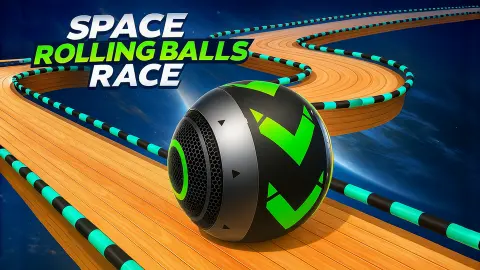




About Space Rolling Balls Race
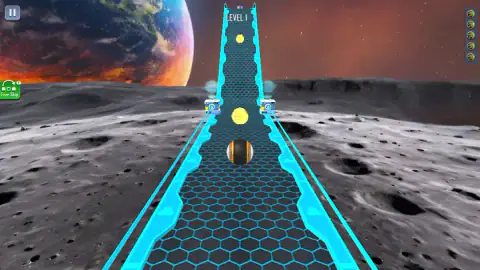
A lane of dark hexagon tiles, fenced by two rails of cyan light, runs out across the floor of a crater and is held up by nothing. Grey dust underneath. Craters the width of a car park on both sides. A horizon close enough that you can see it curve, and a planet sitting low over it, blue and brown and much too big. On the lane there is one striped ball, a line of gold coins, and no other information at all.
The game that comes with all that is almost rude in how little it asks. Keep the ball between the rails. Take the coins, which are laid down the middle, so for the first stretch the greedy line and the safe line are the same line. Then the lane bends over the lip of a crater and they stop being the same line, and that is the whole design.
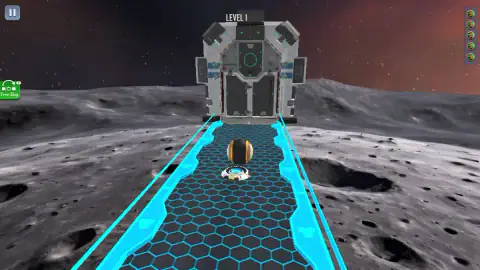
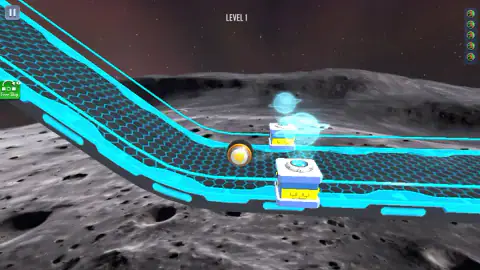
What stands in the way are machine blocks: white and blue, a yellow panel on the front, a pale blue orb hovering over each one. They come in pairs, one near each rail, and they pinch the gap exactly where you would like it wide. At the end of the first straight a grey metal gate stands across the track with its doors shut, a small white ring pad set in the tiles in front of it, and whatever is on the other side stays on the other side.
The game is credited to Square Games. It was published in November 2025 and had its last update in August 2026.
Now the part that is less comfortable. We played it on a desktop for four minutes, took thirty-two runs at it, and the heading at the top of the screen said LEVEL 1 for every one of them. The ball actually moved on eight of those thirty-two. Most of why is in the next section, and it is the single most useful thing on this page.
The moon under this track is scenery, not physics
The backdrop has clearly had work put into it. Dust in the right grey, craters at a believable spread of sizes, a horizon that curves because the moon is small, a planet low in the sky. Look at what the ball does, though, and none of that is switched on.
Start with the pull. The moon's gravity at the surface is about a sixth of Earth's — close to 1.6 metres per second squared, against our 9.8.
Then take away the air, because there is effectively none. That was the point David Scott was making at the end of the last Apollo 15 moonwalk, in 1971, when he dropped a hammer in one hand and a falcon feather in the other and they hit the dust together. No air means no drag on anything, ever.
Rolling adds a twist that even Earth-bound players feel without naming it. A solid ball on a slope does not accelerate at the full pull of gravity, because some of that energy has to go into making it spin instead of making it travel; for a solid sphere the figure works out at five sevenths of what a sliding block would get. It is why a ball always loses a race down a ramp to something that skids.
Put those together and a real ball on a real lunar lane would be a nightmare to drive. A gentle shove would still be rolling long after you wanted it stopped, since nothing is taking energy out of it. A hop off a ridge would hang in the air roughly six times longer than your hand expects. This ball does the opposite: push it, watch it travel a few lengths, watch it settle. It behaves like a heavy marble on a carpet in an ordinary room.
That is not a complaint so much as a translation. A game that modelled the real thing would be a floating, un-steerable mess. What the moon is doing here is giving you a lane with no walls and no ground under it, and then getting out of the way.
The lane is the entire level
Strip the scenery off and what is left is a ribbon about three balls wide with a light down each side. There is no map, no timer, no visible score, no lives counter. The only numbers on screen are the word LEVEL and a one.
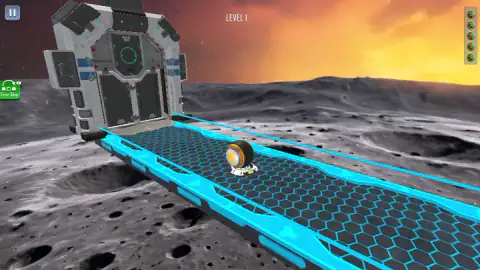
That emptiness puts all the weight on the shape of the track, and the track does three things with it. It runs dead straight long enough to teach you that straight is easy. It narrows, by parking two machine blocks where the rails already are, so the error you can afford shrinks without the lane itself changing width. Then it bends over the edge of a crater, at which point the coin line and the safe line part company and you have to choose one.
The rails deserve a word, because they are the one genuinely kind thing in the design. They glow, they are raised a little, and they are the only reference you have for where the middle is on a surface made of identical hexagons. Take them away and this lane would be unplayable, not harder.
What we could not answer
Four minutes is not long, and some of this page has holes in it that we would rather point at than paper over.
We do not know how many levels there are, because we never saw a second one. We do not know what is behind the metal gate, because the doors stayed shut. We do not know what the small white ring pad in the tiles in front of it is for, although it sits exactly where a checkpoint would.
Pinned to the right edge of every screen is a translucent strip holding five small badges, green and orange. Blown up they are still unreadable, and nothing we did changed their number. Lives, power-ups, stages of a level: all plausible, none confirmed.
And we never pressed Free Skip. It is the one button the game puts in front of you unprompted, and we left it alone deliberately, so the honest answer about where it takes you and what it costs is that we do not have one.
More games by Square Games, and more balls to roll
The same studio made Robby: The Speed Maze, which swaps the open lane for walls on both sides and turns the pressure up by taking away the drop. Shape Transform is their other race, where the thing you are steering keeps changing what it is. Trash Master is as far from this as their catalogue goes: a recycling plant, no speed at all, and everything resting on sorting correctly.
For another lane and another ball, Rolling Balls 3D keeps the format and drops the moon, and TENKYU BALL makes the balance on narrow track the whole point rather than the backdrop. The rest of the shelf is in adventure games.
Screenshots
How to play Space Rolling Balls Race
- Click through the opening screens. Three clicks around the middle of the frame took us from the cover to a ball sitting on the lane. There is no control card and no tutorial text.
- Drag, do not type. Dragging the pointer along the lane is what rolled the ball for us. On a phone or tablet that gesture is a swipe.
- Expect to push again. One drag buys you a stretch of track and then the ball slows and settles. It does not coast. Getting up a rise means another drag, and a longer one.
- Take the coins early, not late. They sit on the centre line, which is also the line furthest from both edges — until the lane turns, when the inside of the bend stops being the middle of anything.
- Read the pairs, not the blocks. The machine blocks arrive two at a time with a gap between them. Line up on the gap while it is still far away; by the time one fills the screen you are already committed.
What our run actually taught us:
- The arrow keys are a dead end. We pressed all four, held them, and used them in combinations, over and over, and the ball never set off once. The space bar did nothing either. If you sit down expecting a keyboard game you will conclude the game is broken, and it is not.
- Standing still is a state, not a bug. A ball that has stopped stays stopped indefinitely. Nothing times out, nothing nudges you, nothing kills you for waiting.
- Free Skip is offered before you need it. The green panel on the left edge is there from the first second of the first level, which tells you something about who this game expects to be playing it.
- Nothing ever made a sound in our run. No reward noise when a coin went, no failure noise, nothing.
Controls
| Drag the pointer along the lane | What actually rolled the ball for us. Each drag sent it forward a stretch, and it stopped again shortly after |
|---|---|
| Swipe | The touch version of the same thing. The game is listed for phones and tablets; we did not play it on one |
| Arrow keys | Nothing we could get out of them. We pressed all four, held them, and combined them, and the ball never set off |
| Space | Also nothing for us |
| Pause (top left) | A translucent square with two white bars, on screen from the first second. We never opened it |
| Free Skip (green panel, left edge) | Offers to put you past where you are. We never pressed it, so we cannot tell you what it costs |
Features
- One lane of dark hexagon tiles with glowing cyan rails, floating clear of the lunar surface, with nothing at all underneath either side of it
- Gold coins strung along the centre line, so the greedy line and the safe line are the same line until the lane starts to bend
- White-and-blue machine blocks parked on the track in pairs, each with a pale blue orb hovering over it, pinching the lane where you would most like it wide
- A grey metal gate standing across the end of the first straight with its doors shut, and a small white ring pad set in the tiles in front of it
- A green Free Skip panel pinned to the left edge from the first second of play, before you have had a chance to need it
- A moon drawn with real care — craters, dust, a close horizon, a planet hanging over it — attached to a ball that does not behave as if it were there
- Published in November 2025 and last updated in August 2026
Game details
- Developer
- Square Games
- Release date
- November 2025
- Last updated
- August 10, 2026
- Added here
- September 2025
- Technology
- HTML5 (WebGL)
- Platforms
- Browser (desktop, mouse & keyboard), Browser (mobile & tablet, touch)
- Saved progress
- Saving, when available, is managed by this game. Mava cannot confirm your level.
FAQ
How do you play Space Rolling Balls Race?
You roll a ball along a narrow raised lane across the surface of the moon, picking up the gold coins strung down the middle of it and staying inside the two glowing rails. The lane is lifted clear of the ground and there is nothing on either side of it. Machine blocks are parked in pairs along the track and narrow the gap you have to roll through.
What are the controls in Space Rolling Balls Race?
Dragging the pointer along the lane is what moved the ball for us: each drag rolled it forward a stretch before it slowed and stopped. On a phone or tablet the same gesture is a swipe. The arrow keys and the space bar did nothing for us at all — we pressed and held all of them and the ball never set off — so treat this as a pointer game rather than a keyboard one.
How many levels does Space Rolling Balls Race have?
Nobody publishes the number and we never found out. The heading at the top of the screen read LEVEL 1 for the whole of our run, across four minutes and thirty-two attempts, and it never changed. There is a metal gate at the end of the first straight that we never got through, which is the likeliest place for a level to end.
What is the Free Skip button in Space Rolling Balls Race?
A green panel pinned to the left edge of the screen, just under the pause button, and it is there from the first second of the first level. It offers to move you past the point you are stuck at. We never pressed it, so we cannot tell you what it costs or where it drops you.
Is the moon in Space Rolling Balls Race realistic?
The scenery is: grey dust, craters, a close horizon and a planet low in the sky, which is roughly what the view looks like from the lunar surface. The physics is not. The moon pulls at about a sixth of Earth's strength and has no air to slow anything down, so a real ball would keep rolling far longer than this one does. Here it stops almost as soon as you stop pushing it.
What happens if you fall off the lane in Space Rolling Balls Race?
We cannot say, because we never fell. The lane is raised above the ground with open space on both sides and the rails are light rather than walls, so coming off it looks like the main way to lose, but no failure screen or failure sound ever came up in our run. Nothing we did produced a game over.
Does Space Rolling Balls Race work on a phone?
It is listed for Android and iOS as well as PC, and lists it as a portrait game. That is worth flagging, because every screen we played was wide and landscape, with the Free Skip panel on one edge and the badge strip on the other and nothing cut off. We only played it on a desktop, so how it reflows on a tall phone screen is something we have not checked.
Who made Space Rolling Balls Race?
Square Games, according to the game's listing. The game was published in November 2025 and was last updated in August 2026. We found no studio website to confirm the name against a second source, so it rests.