


About Rolling Balancer Ball
A line of grey capitals hangs over the bridge in Rolling Balancer Ball and never leaves: HOLD TO CHANGE ANGLE. Beside it a small white arrow points away, at a purple button in the corner with a camera on it. That is the entire tutorial. We have played this game twice now, and we still cannot tell you with any confidence what holding does.
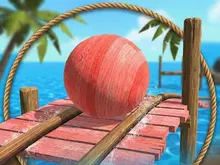
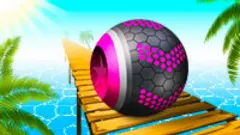
What we can tell you is what the game is. A ball striped in rainbow rings sits on a walkway of mossy planks a few balls wide, thrown across a canyon of red and orange rock. The view sits low and just behind the ball, so you read the route by looking down its length rather than from above. There is a pause button top left, a green button marked AD top right, and the camera button under it. Nothing else is on screen.
The first time we played it we cleared level 1 in about thirty seconds, reached level 2 and got stuck at its start. The second time went worse: ten minutes, two falls, and LEVEL 1 on screen from the first frame to the last. We will be specific about both runs, because between them they showed things neither showed alone.
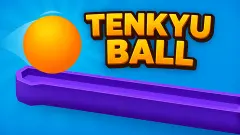
The game is credited to Drivix Games, the studio behind TENKYU BALL.
Three hearts, and what it looks like to lose one
Three hearts sit under the level number. They do not vanish when you lose one. The heart stays exactly where it was and turns blue — drained, still in the row — which is a quiet way to tell a player something has gone wrong, and easy to miss when your eyes are on the planks.
We caught a whole fall in three photographs a second and a half apart. In the first, the ball is still rolling, out near the right edge of a long bend to the left, with a trail of sparks behind it and three red hearts above. In the second, the ball is gone from the frame, the view has swung round to a side-on shot of the walkway, and a scatter of red specks falls under the hearts, the third of which is now blue. In the third, the whole screen has washed to white and the ball is back at the near end of the bridge, in exactly the spot where it began, the third heart still blue.
Three seconds, start to finish. A fall does not just cost you a heart, it costs you the whole crossing: you go back to the beginning of the level, not to where you went over. On a short level 1 that is cheap. On a long bridge it is the difference between a near miss and starting again.
It happened to us twice, in the same place, and we never emptied the row, so we still cannot tell you what the game does when the third heart goes.
The planks bend, and that is the whole problem
Looked at from the start, level 1 is a straight run to the horizon. It is not. Some way along, the walkway swings left, and because the view stays behind the ball the turn arrives looking like a wall of rock sliding in from the right.
The ball holds its line. That is the mechanic under all the signage: you are not steering a vehicle, you are nudging a heavy sphere that keeps whatever direction you last gave it. On the straight, that feels generous. On the bend, it is why the planks run out from under you, and in both of our falls the ball was hugging the right-hand edge seconds before it left.
So the useful habit is to look past the ball. From the bend you can see the far end of the level, a raised wooden platform above the planks, and knowing it is over there is worth more than any nudging once the edge is close.
The finish is a box, and the coins come after it
This part comes from the run that got there. When the ball drops into the box at the end of the planks, the camera rises above it and a blue ribbon reads LEVEL COMPLETED. A shower of gold coins bursts over the word COLLECTED, covering the number, so we could not read what the level paid. A coin counter appears in the corner of that screen, and ours read zero while the coins were still in the air.
Below the ribbon are two ways out. The large green CLAIM 2X button carries a video icon and the word AD: watch an advert and the coins double. Under it, in plain grey letters, NEXT LEVEL. That one costs nothing, and it is set in type so modest it reads as a caption.
Level 2 opens on the same canyon with a different route. The planks turn at right angles, some stretches are narrower and raised, and yellow arrows mark the turns — this is where steering stops being optional. It is also as far as we have ever got. On that first run the ball would not leave the start of level 2 at all, through drag after drag, with all three hearts showing. We do not know why, and we have not had a second chance to find out.
Plank bridges over a drop are older than browser games
Ballance, made by the German studio Cyparade and released in Europe on 2 April 2004, was a Windows game built on this exact picture: a ball on narrow tracks above a void, plank bridges among them, and nothing to do but not roll off.
Ballance made the ball itself the puzzle. You swapped between a wooden ball, a stone one and a paper one; the stone one was heavy enough that crossing a plank bridge brought the bridge down behind it. Rolling Balancer Ball keeps the setting and drops the swapping. There is one ball, and nothing on the walkway reacted to its weight.
The sharper difference is what a mistake costs. Ballance gave you checkpoints, so a fall sent you back part of the way. Here it sends you back to the beginning and takes a heart as well — a harder bargain, and the reason the bend deserves more respect than its gentle curve suggests.
What the listing says, and what we saw instead
The game's description talks about bridges over water, traps to slow down for, sideways swipes and a boat waiting at the end of each level. On the levels we have seen, the walkways cross dry rock, there were no traps, and the finish was an open wooden box. Those things may well arrive further in; we are telling you what our sessions showed, not what the game lacks.
It suits a younger player, or anyone who wants a game they can understand in one drag. There is nothing to read beyond the level number, no timer we could find, and the canyon is genuinely good to look at. Anyone wanting depth in the first minute will find level 1 thin, and after two sessions that ended on levels 1 and 2, we cannot promise how quickly it thickens.
More ball-rolling games
TENKYU BALL is by the same studio and asks more of you from the start: you tilt and turn a floating track instead of pushing the ball. Sky Balls 3D is the closest relative, plank tracks high over the sea with the ball under your direct control. Roll Sky Ball 3D is another portrait drag game, with keys and treasure chests, and Rolling Balls 3D turns the lane into a runner with gates to choose between. The rest are under 3D games.
Screenshots
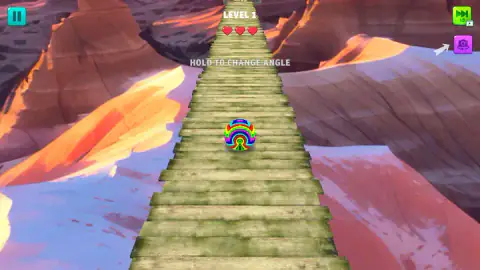
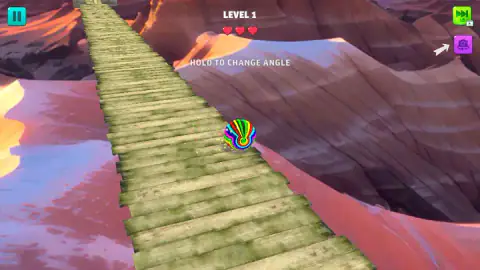
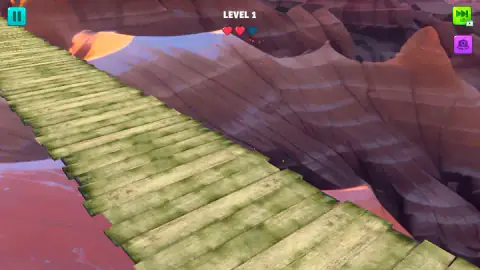
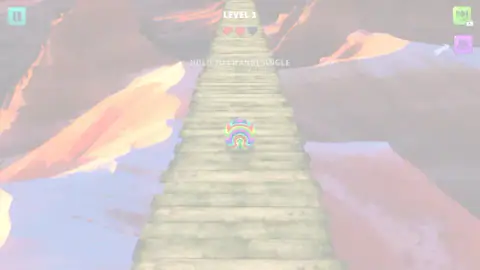
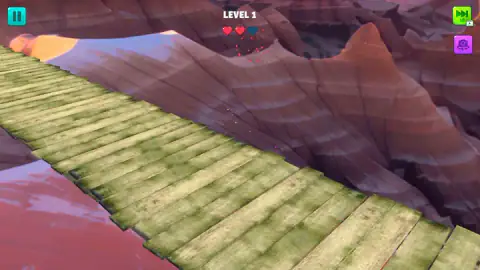
Taken by opening the game ourselves and letting it run — not supplied by the publisher, and not the same picture every other site shows.
How to play Rolling Balancer Ball
- Start the game. The ball appears at the near end of the planks with LEVEL 1 and three hearts above it.
- Drag up the screen, away from yourself, towards the far end of the bridge. The ball rolls, and keeps rolling after you let go.
- Give it more drags to keep it going, and steer as the walkway bends. It does not stay straight. The ball does.
- Roll it up the narrow ramp at the end and into the wooden box. The screen says LEVEL COMPLETED.
- Press the grey NEXT LEVEL text under the green button to go on.
What two sessions taught us:
- Drag away from yourself, not towards yourself. Four drags up the screen took us through level 1 the first time. The second time we mostly pulled the other way, down the screen towards us, and never got past the first bend.
- The bend is where you lose it. Both of our falls happened at the same place, on the same long curve to the left, with the ball riding the right-hand edge of the planks.
- A fall makes no sound. In ten minutes the game played exactly one sound, the one it makes when it opens. Nothing marks a fall or a lost heart, so you find out by looking at the hearts.
- Both green buttons are adverts. Each carries the word AD and a small film icon. The one during play skips the level; the one after it doubles the coins.
- The free way on is the grey text. On the level-completed screen it sits under the green button and looks like a caption.
Controls
| Drag up the screen (mouse or finger) | Rolls the ball along the walkway, away from you; four of these took us through level 1 |
|---|---|
| Drag down the screen | What we spent most of our second session doing, and it got us nowhere |
| Hold | A grey sign over the bridge reads HOLD TO CHANGE ANGLE, with an arrow pointing at the purple camera button |
| Purple camera button | A camera with a circular arrow under it; the tutorial arrow points here, and it did not change our view |
| Green button marked AD | Top right during play; by its fast-forward arrows it skips the level after an advert. We did not press it |
| Green CLAIM 2X button | On the level-completed screen, marked AD; doubles the level's coins after an advert. We did not press it |
| Grey NEXT LEVEL text | Under CLAIM 2X. Moves on without watching anything, and took us a couple of presses |
Features
- A rainbow-striped ball on mossy plank walkways thrown across a canyon of red and orange rock
- Three hearts under the level number that turn blue one at a time instead of disappearing
- A fall that costs a heart and puts the ball back at the start of the level, about three seconds later
- No sound for a fall or a lost heart; in ten minutes the game played one sound, its opening one
- A grey HOLD TO CHANGE ANGLE sign over the bridge and a white arrow aimed at a camera button in the corner
- Each level ends in a raised wooden box reached by a narrow three-plank ramp, and pays coins on a screen with an optional advert to double them
- Made by Drivix Games
Game details
- Developer
- Drivix Games
- Release date
- January 2026
- Last updated
- August 10, 2026
- Added here
- October 2025
- Technology
- HTML5 (3D)
- Platforms
- Browser (desktop, mouse), Browser (mobile & tablet)
- Saved progress
- Saving, when available, is managed by this game. Mava cannot confirm your level.
FAQ
How do you play Rolling Balancer Ball?
You drag up the screen, away from yourself, and the striped ball rolls off along a walkway of wooden planks and keeps rolling after you let go. A few drags in a row carry it along the bridge, and the level ends when it drops into the wooden box at the far end. Dragging the other way, down the screen, did nothing for us.
What do the hearts mean in Rolling Balancer Ball?
They are lives, and there are three of them under the level number. They do not disappear when you lose one. The heart stays where it is and turns blue, which is easy to miss while you are watching the planks. We lost two in one session and never saw what happens when the third one goes.
What happens when you fall off the bridge in Rolling Balancer Ball?
The view swings round to a side-on shot of the walkway, red specks scatter under the hearts, the screen washes white and the ball is back at the start of the level. It takes about three seconds and costs one heart, so a fall near the end of a long bridge costs you the whole crossing. Nothing makes a sound while it happens.
How long is a level in Rolling Balancer Ball?
Level 1 took us about thirty seconds and four forward drags on the run where we cleared it. On a second visit we spent ten minutes on the same level without finishing it, because the walkway bends and we kept going over the edge on the bend.
How do you skip the advert after a level in Rolling Balancer Ball?
The big green CLAIM 2X button is an advert that doubles your coins. To move on without it, press the grey NEXT LEVEL text just under it. It looks like a caption rather than a button, and it took us a couple of presses before level 2 loaded.
Is there water and a boat in Rolling Balancer Ball?
The game's listing describes bridges over water and a boat at the finish. On the levels we have seen, the walkways cross a dry canyon of red and orange rock and the finish is an open wooden box. Water and a boat may come in later levels; we have not reached them.
Who made Rolling Balancer Ball?
The game is credited to Drivix Games, the studio that also made TENKYU BALL. It was published in January 2026.
Can you play Rolling Balancer Ball on a phone?
It is listed for PC, Android and iOS, and it is built for a portrait screen, with drags as the only control. We played it on a desktop with a mouse, where dragging works the same way.