



About Attack super hole
The first thing we did in Attack super hole was wrong, and it is almost certainly the first thing you will do too. We tried to move the blue figures. They are the ones with heads and arms, they are the ones carrying something, and on a screen like this the little people are normally you. Here they are the meal.
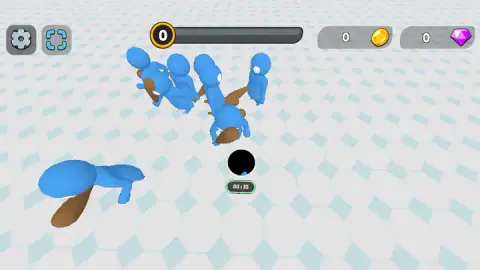
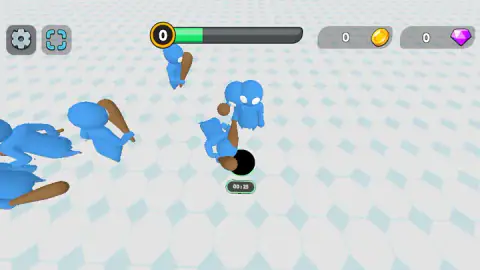
What you control is the black circle in the floor. A hole. A shape made of nothing, sitting a little below the middle of the screen, with a small green-rimmed pill underneath it like a name tag. You press on it and drag it, the way you would slide a coin across a table, and it goes where you pull it. Let go and it stops. We tried all four arrow keys and got nothing back that we could point at afterwards, which does not prove they are dead but does mean the drag is the only control we can describe honestly.
Start dragging and you notice something odd: the hole barely moves. In every picture we took across the session it sits in the same patch of screen, within a thumb's width of dead centre. What moves is the ground — a pale hexagon tiling with no walls, no horizon and nothing on it but blue figures, sliding underneath you while the hole stays put.
The game is credited to Lazy GameDev.
The listing dates it to June 2025, with its most recent update in August 2026.
Our own session was a single unbroken run of about four minutes. In that time we never reached a menu, a shop, a second level or any screen telling us the run was over, so this page is a careful account of one long first run and nothing more.
Four readouts, and only one of them moved
Across the top of the screen there are four things to look at. A round badge with a white 0 in a thick gold ring. A long bar beside it. A pill with a gold coin. A pill with a magenta gem. That is the whole instrument panel, and nothing explains any of it.
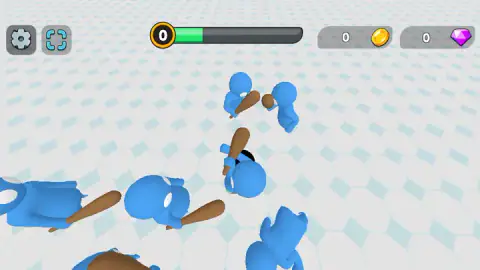
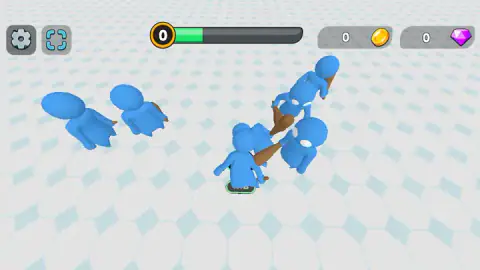
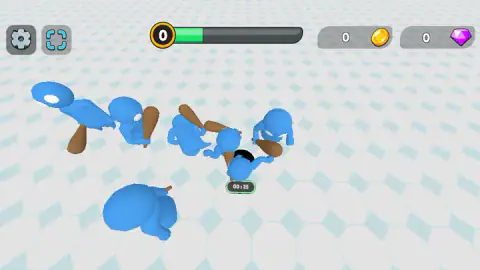
Here is what ours did. In our first picture, sixteen seconds in, the bar is grey from one end to the other. By the second it has turned green for about a fifth of its length. Later it is green for two thirds. In our last pictures it is green nearly all the way to the end, and it never once went backwards.
Over the same stretch, the other three never moved at all. Badge zero, coins zero, gems zero, in every single picture.
What makes the bar readable is that something else on the screen agreed with it. Count the figures. Our first picture has six or seven standing in a loose cluster. By the time the bar is two thirds green there are four left, and they are scattered.
When it is nearly full there is an empty plain with a pair of flat shapes lying on it.
Two instruments that cannot see each other told the same story, so we are confident about this one: the bar is a body count. And the rest follows. The bar is the goal, the coins and the gems are for something that lives past the goal, and filling nineteen twentieths of it paid out exactly nothing. That is not a complaint — it is the honest shape of the opening, and knowing it means you stop checking the wrong corner.
The clock that says 00:25 every time you look
Most games put the timer in a corner. This one hangs it under the hole, on a small dark pill with a green rim, and it travels with you.
It reads 00:25. It said that sixteen seconds into our session, and it still said it more than three minutes later, in a run that had not ended and did not end while we were watching. We enlarged the pill in every picture clear enough to read and never once caught it on another number.
We are not going to guess why. Either it was not running, or something kept putting it back, or it is counting something we never triggered. What we can tell a player is the practical half: in four minutes nothing ever caught up with us. Whatever that pill is for, it is not a reason to rush your first run.
Why the heap on the floor never looks the same twice
The blue figures do not die on cue. One is caught in mid-air, flung sideways with its club already gone. Another is folded head-down over the rim of the hole with its legs still above the tiles. A third is face down with its club lying a body's length away from its hand. Arms trail. Nothing is posed, and no two of our pictures hold the same shape twice.
That floppiness has a name: ragdoll physics. The name is literal — a rag doll has no stiffness in its joints, so when you drop it the whole thing collapses in on itself, and that is exactly what these figures do. Instead of playing a falling animation that an artist drew once, the machine works out how a limp body would fall from the position it happens to be in at that instant. Change the position by a hand's width and the fall comes out different.
It is older than it looks. The usual starting point is Jurassic Park: Trespasser, from 1998, which Guinness World Records credits as the first game to use rag doll physics; people who write about it tend to be more careful and call it one of the first. It was not a success. It is remembered for being broken. But the limp bodies came out of it and never left, because they solved a problem no animator can: a falling body has to look right from every angle, after every possible shove, and there are too many of those to draw.
Which is why it matters in a game this bare. There is one verb here, and in our hands there was no score to chase. Watching things fall over is a large part of what you get. If every figure dropped the same way, the twentieth one would be worth nothing at all.
More from Lazy GameDev, and more holes
Lazy GameDev has fourteen games on the same platform, and three of them are already on our shelves. Dino funny digging is the gentlest of them, Cube shooter is the loudest, and Make the glass happy asks you to think instead of drag. None of the three plays anything like this one, which is a fair summary of the studio.
If it is the hole you came for rather than the studio, Hole Eats All: Eat Them All hands you the same black circle on a tidier set of levels, and Color Hole turns it into a puzzle where swallowing the wrong thing is the way to lose. We have not taken either of those as far as we took this one, so treat them as signposts rather than verdicts. The rest of the shelf is in 3D games.
Screenshots
How to play Attack super hole
- Press on the black circle in the middle of the floor and drag it without letting go. That is the entire control scheme.
- Steer it under a blue figure rather than into one. Every clean swallow we photographed went in head first, from directly above.
- Watch the long bar across the top. It is the only readout that moved for us, and it fills as the floor empties.
- Go and fetch the stragglers. The crowd does not come to you, and the ones left at the end are usually lying down somewhere off to the side.
- Leave the two buttons in the top-left corner alone until you want them: one is a cog, one is fullscreen.
What we only learned by being there:
- You are the hole. It is worth saying twice, because nothing on the screen says it once. Nothing is labelled, there is no tutorial, and the only arrow in sight is the one you are dragging.
- The loud counters are the wrong ones to watch. The coin and the gem have their own pills in the corner and both of them sat on zero all the way through. The bar, which has no number on it at all, is the one doing the work.
- Aim the ground, not the hole. Because the hole stays pinned to the middle of the frame, dragging left is really dragging the whole floor right. It takes about a minute to stop fighting that.
- A cleared floor often is not. Bodies lie where they drop and stay flat on the tiles, so a plain that looks empty can still have two or three of them in it.
Controls
| Press on the black hole and drag without letting go | Moves the hole across the floor. This is the whole of the control, and it is the only thing we got the game to answer |
|---|---|
| Let go | The hole stops where you left it. There is no coasting and no momentum we could see |
| Arrow keys | Nothing we could verify. All four were tried and none produced a response we could point at in a picture. That is not the same as proving they do nothing |
| The cog button, top left | The game's own settings. We left it closed, so we are not going to describe what is behind it |
| The corner-brackets button, top left | Fullscreen, by the only thing its icon can mean. We did not use it either |
Features
- You are the hole, not the crowd: the thing you control is the plain black circle in the floor, and the blue figures standing around it are what it is for
- One verb, and that is the lot. You press on the hole and drag it. There is no jump, no attack button and no second control to learn
- The hole stays pinned near the centre of the screen in every picture we took. What moves is the floor — a pale hexagon tiling with no walls and no horizon on it
- The blue figures carry tapering wooden clubs and fall limp when they go over, so no two heaps on the floor look the same
- Four readouts across the top: a numbered badge, one long goal bar, a coin counter and a gem counter. In four minutes of play only the bar moved
- The countdown rides under the hole instead of sitting in a corner, and it read 00:25 in every picture of it we could make out, from sixteen seconds in to three minutes later
- Free in the browser with nothing to install, and listed for desktop, Android and iOS alike
Game details
- Developer
- Lazy GameDev
- Release date
- June 2025
- Last updated
- October 24, 2026
- Added here
- June 2025
- Technology
- HTML5 (3D)
- Platforms
- Browser (desktop), Browser (mobile & tablet, touch)
- Saved progress
- Saving, when available, is managed by this game. Mava cannot confirm your level.
FAQ
What do you actually control in Attack super hole?
The hole. The black circle in the floor is you, and the blue figures standing around it are what you are there to swallow. This catches people out, ourselves included, because on a screen like this the little people with arms and legs are normally the player and the dark shape is normally the danger. Here it is the other way round.
How do you move the hole in Attack super hole?
You press on the hole and drag it without letting go, the way you would slide a coin across a table. Let go and it stops. We tried all four arrow keys and got no response we could verify, so as far as our session goes the drag is the whole control scheme. The same gesture works under a thumb or a mouse.
What is the long bar at the top of the screen for?
It is the goal bar, and in our session it was the only readout that moved. It started grey from end to end, and over about four minutes it filled with green until it was nearly full. The floor emptied of blue figures at the same rate, which is the best evidence we have that the bar is counting what the hole swallows.
Why do the coin and gem counters stay at zero?
We do not know, and we would rather say so. A gold coin counter and a magenta gem counter sit in the top-right corner, and both of them read zero in every picture we took, including the ones where the goal bar is almost full. Whatever pays out coins and gems in this game, finishing most of one bar is not it.
Is there a time limit in Attack super hole?
A small dark pill with a green rim rides along underneath the hole, and it reads 00:25. It read 00:25 sixteen seconds into our session and it still read 00:25 more than three minutes later, in a run that never ended. We never caught it on another number, so we cannot tell you what starts it or what happens when it runs out.
Who made Attack super hole and when did it come out?
It is credited to Lazy GameDev, a studio with fourteen games on the same platform. The listing gives June 2025 for the release and August 2026 for the most recent update. Only the months are printed on the page itself, which is why this page does not claim a precise day.
Can you play Attack super hole on a phone?
It is free, it runs in the browser on this page with nothing to install, and it is listed for desktop, Android and iOS alike. The one control is a press-and-drag, which is a gesture built for a thumb before it is built for a mouse. We played it with a mouse, so how it feels on glass is the listing's claim rather than ours.
Did you finish Attack super hole?
No. We filled the goal bar to about nineteen twentieths of its length and the run simply carried on. We never saw a victory card, a game-over screen, a menu, a shop or a second level, and the number in the gold ring at the left end of the bar never moved off zero. Read this page as an honest account of one long first run, not as a tour of the whole game.