






About RageRoll.io
The usual bargain in an .io game is that nothing ends. You drop into an arena that was already running, you grow or you get eaten, and the arena carries on without you either way. RageRoll.io takes that bargain and puts a stopwatch on it: a match lasts ninety seconds, stops dead on a scoreboard, and then asks whether you would like another.
What survives from the older habit is that the arena does not wait for you. Our first match opened with three rollers in it, counted by a small figure beside a person icon in the corner. Before the clock was half gone, that figure read six. Others arrive while you are already rolling, and they keep arriving.
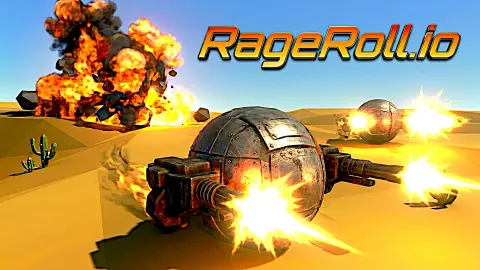
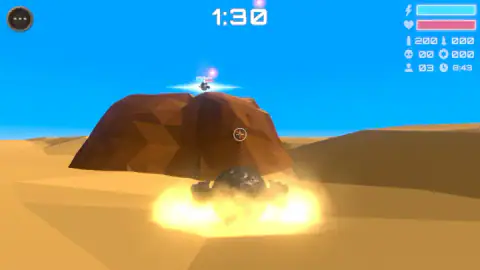
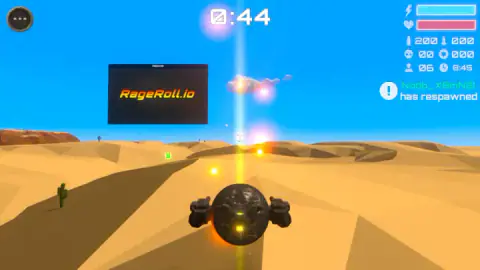
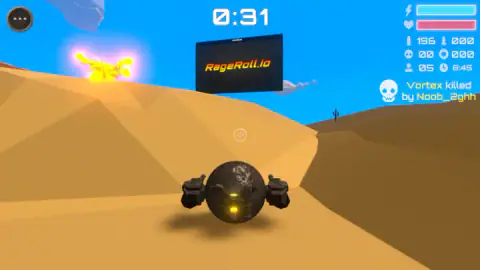
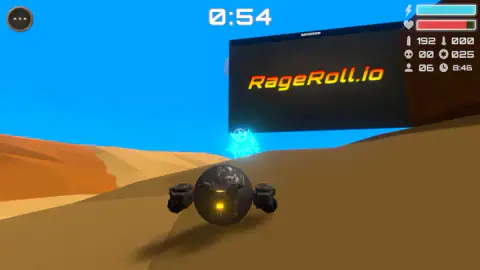
You are a dark, pitted sphere with a thruster pod on a short arm at each side and a slot of yellow light on the front, rolling across pale low-polygon dunes under a hard blue sky. There are cactuses, red rock outcrops, and — standing in the sand with no explanation offered — a giant flatscreen playing the game's own logo. A white crosshair sits dead centre and never moves, because you look with the mouse and the sphere goes where you are looking.
The listing credits Noble Savage Games and puts the game up in March 2026, with a last update that August.
Our own session ran about four minutes on a keyboard and mouse, across two matches. We came out of it with the kill counter still reading 00 and the health bar emptied at least once.
The .io on the end is a promise, and this one keeps about half of it
Those two letters are not a genre. They are a country code: .io is the internet domain assigned to the British Indian Ocean Territory, a scatter of atolls in the Indian Ocean. It became a kind of game by accident. In 2015 a browser game called Agar.io took the suffix because the letters read as input/output to anyone who writes software and the domain was easy to get. It was an enormous hit, Slither.io followed, and within a year the suffix had stopped meaning a domain and started meaning a format.
That format is a short list of promises, all of them about friction. It opens in a tab with no download and no account. You join a match already in progress, and dying costs you what you built but not your seat.
Hold RageRoll.io against that list and most of it survives. The arena was running before we got there, and the count of rollers in it changed twice while we were inside. The corner feed kept reporting kills and returns that had nothing to do with us, which is the quiet signal every .io game uses to say the place is populated. When we died, the game offered a way back rather than a game over.
What it drops is the shape. The classic .io game is a flat plane seen from above, where you are a dot eating smaller dots. This one puts you at ground level in a three-dimensional desert with a mouse-look camera, a health bar and a crosshair. It is a round of a shooter wearing an .io badge, and the ninety-second clock is the giveaway: endlessness was the one promise it chose not to keep.
The part we cannot close is the part the suffix implies hardest. The listing describes the opposition as computer-run rather than live opponents, and the screen confirmed nothing either way. Six names sat on the board at the end of our first match, one of them a long way ahead on points, and a screen cannot tell you whether a person was behind any of them. We raise it because .io has come to mean other people, and here that is a claim worth holding as a claim.
Everything you need is in one corner
The whole state of your roller lives in the top right: a cyan bar beside a lightning bolt, a pink one beside a heart, and under them six numbers — rounds, missiles, kills, a star counter, rollers in the arena, and that small clock. The health bar is the one to watch, because it is honest and quick. Ours was untouched through most of the opening minute, down a sliver in the second match, and all but gone with five seconds left on the first. No damage number, no hit marker, no red flash we could pick out: just a pink bar getting shorter.
The ammunition count says what kind of game this means to be. It opened at 200 rounds, which is a great deal of shooting for a minute and a half. What limits you is not bullets but the clock, and the business of finding somebody to spend them on.
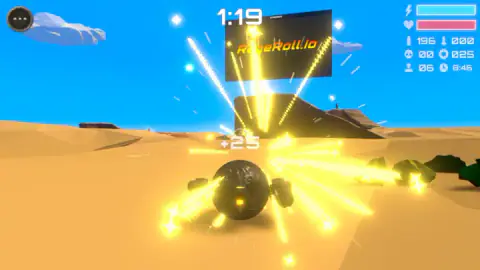
The star counter is the one we could not pin down. It sat on 000 for our whole first match. Then, in the second, our sphere vanished inside a burst of yellow light, a white +25 floated up out of it, and the counter read 025 from then on. The end-of-match board scores everyone on coins, and the panel beside it offers coins for watching an advert, so coins are the currency here. Whether that star is the coins or the score, we do not know.
Ninety seconds, then a board and three buttons
When the countdown empties, the desert stays where it is and a panel slides over it. On the left, a list of six numbered rollers, each with four figures after the name: points, kills, deaths and coins. On the right, three buttons stacked up — one offering coins in exchange for watching an advert, then NEW MATCH, then MORE.
That button is the only place money showed its face in our session. Nothing interrupted either match: no pre-roll, no mid-match break, no banner over the action. We left it alone; it says what it does and stays out of the way.
Press NEW MATCH and the game takes you back round through the mode and the length. The board itself is a flat accounting rather than a ceremony: one roller in our match had taken most of the points and the only kills, and the rest of the column was zeros and ones.
Here is what four minutes did not buy. No shop opened, so we cannot tell you what coins are for. The energy bar never moved, so we cannot tell you what drains it. We never fired a missile, never saw a second map, and never found out what Q, E, F, Shift or Space do beyond the fact that the game's own card lists them. Any page that tells you those things with confidence got them from somewhere other than playing it.
Other arenas with the same two letters
If the ninety-second shape suits you but a sphere does not, the shelf has other bodies to borrow. Snakewar.io and Snake 2077: Glitch War go back to the form the genre started in, which their names give away. Shrinkzone.io and Sworded.io: Spin and Rub carry the same suffix into arenas of their own. We have not given any of them the session we gave this one, so take them as neighbours, not verdicts. The rest are on the io games shelf.
Screenshots
How to play RageRoll.io
- Start from the control card. The game opens on a card with the keyboard keys down one side, the mouse actions down the other, a Start button and a tick box for not showing it again. Nothing moves until you press Start.
- On a later match, pick a mode and a length. Two modes are offered by name, a deathmatch and an elimination, then a choice of match length with ninety seconds already selected. Our first match skipped both and simply dropped us in.
- Roll with W, A, S, D and look with the mouse. Steering and aiming are one action: the crosshair is pinned to the centre, so the sphere turns to face whatever you are about to shoot.
- Shoot with the mouse buttons. The control card marks machine guns and missiles as mouse actions, and the corner keeps a separate count for each.
- Watch the countdown at the top. At zero the match stops where it stands and a board appears with every roller's points, kills, deaths and coins.
What we only found out by being there:
- The big clock and the small clock are different things. The countdown is the large number across the top. The little clock in the corner readout is the time of day — it matched ours to the minute in every capture.
- Ammunition is not refilled between matches. Our second match opened on exactly the count the first one had finished with. Nothing announces this, and nothing offers to top you up.
- Missiles come from somewhere else. That counter sat on 000 all session, and whatever fills it, we never crossed it.
- Read the corner feed. A skull means one roller has killed another; an exclamation mark means somebody has come back. Both tell you the arena is busier than the piece of it you can see.
- Rivals wear their health on their heads. Another roller on a rock, far enough off to be a smudge, still carried a name label and two short bars above it. You can read what state something is in before you commit.
Controls
| W, A, S, D | Rolls the sphere. The game's own control card puts these first, and they are the only keys we confirmed were moving us |
|---|---|
| Mouse | Looks around. The crosshair never leaves the middle of the screen, so the sphere goes wherever you are pointing |
| Mouse buttons | Fire. The control card lists machine guns and missiles among the mouse actions, and the corner readout keeps a separate count for each |
| Q, E, F, Shift, Space | Listed on the control card beside the movement keys. We rolled with WASD and never confirmed what these five do, so treat them as five things still to find |
| The three dots, top left | The only on-screen button during a match. We pressed it and could not tell what it changed |
Features
- A match runs on a countdown rather than forever: ours opened at 1:30 and stopped dead on a scoreboard
- The arena fills while you are inside it. Our first match began with three rollers in it and had six before the clock was half gone
- A feed in the corner posts a skull when one roller kills another and an exclamation mark when somebody comes back
- Rival rollers carry a name label and two small bars, energy and health, floating above them, readable from across the dunes
- Two kinds of ammunition in the readout: rounds, which opened at 200, and missiles, which never left 000 for us
- A star counter that jumped by 25 in a single burst of light, and an end-of-match board that scores everyone on points, kills, deaths and coins
- Keyboard and mouse together: WASD to roll, mouse to look and to shoot, with the crosshair pinned to the centre of the screen
Game details
- Developer
- Noble Savage Games
- Release date
- March 2026
- Last updated
- October 23, 2026
- Added here
- January 2026
- Technology
- HTML5 (3D)
- Platforms
- Browser (desktop)
- Classification
- Action , .io , Multiplayer
- Saved progress
- Saving, when available, is managed by this game. Mava cannot confirm your level.
FAQ
What kind of game is RageRoll.io?
It is a browser arena shooter played from behind a rolling metal sphere. You move over a low-polygon desert of dunes, cactuses and red rock, you look and shoot with the mouse, and a countdown at the top of the screen runs the whole thing. When it reaches zero the match stops and a board appears with everyone's points, kills, deaths and coins on it.
How long is a match in RageRoll.io?
Ninety seconds, in both of the matches we played. The clock starts at 1:30 and counts down in the middle of the top edge. Before our second match the game offered a choice of match length with ninety seconds already selected, so longer rounds appear to be available, but ninety is what it hands you by default.
How do you control your roller in RageRoll.io?
You roll with WASD and you aim with the mouse. The crosshair stays dead centre of the screen and the sphere follows your view, so steering and aiming are the same action. The game's control card also lists Q, E, F, Shift and Space, and marks machine guns and missiles as mouse actions, but we only ever confirmed the movement keys ourselves.
Are the other players in RageRoll.io real people?
We cannot tell you, and we would rather say so than guess. The game behaves as though they are there: the player count rose from three to six inside one match, the corner feed reported kills and respawns we had nothing to do with, and the end-of-match board listed six names. The game's own listing, though, describes the opposition as computer-run rather than live opponents. Nothing we saw on screen settled it either way.
What do the numbers in the corner of RageRoll.io mean?
The two bars are energy and health. Under them sit six readouts in three rows: rounds of ammunition, missiles, your kills, a star counter, how many rollers are in the arena, and a small clock. That last one is not the match timer — it tracked the real time of day for us while matches started and ended around it. The countdown that matters is the big number at the top of the screen.
Does your ammunition reset between matches in RageRoll.io?
Not in our session. Our first match started on 200 rounds and ended on 196, and our second match opened on that same 196 rather than going back to a full load. Missiles were a separate counter and it stayed on 000 throughout, so we never found out how one gets there.
Are there ads in RageRoll.io?
No advert interrupted either of our matches. The one place advertising appears is the panel after a match ends, where a button offers coins in exchange for watching one, stacked above the buttons for starting a new match and for more games. We did not press it, so we cannot say what it does beyond what it says on its face.
Who made RageRoll.io and when did it come out?
The listing credits Noble Savage Games and dates the release to March 2026, with a last update in August 2026. The same listing gives its platform as PC only, and we played it with a keyboard and a mouse, so we cannot tell you how it behaves on a phone.