About Football.io
Football has eleven players a side and exactly one of them may touch the ball with his hands. Football.io throws away the other ten. What is left is a round pitch with four goals cut into its rim, four goalkeepers, no kick-off, no offside and no way to stop the ball. It is the sport reduced to its one exceptional role, and it turns out that role is a game.
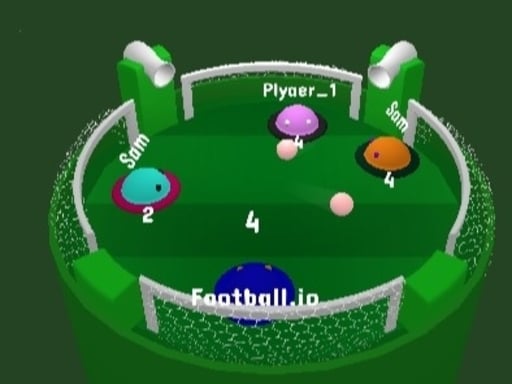
The pitch looks like the top of a drum seen from above. Your keeper — a blue blob the size of a small car — slides along the arc in front of the bottom goal and follows your mouse. Three more hold the left, top and right goals. Everyone starts with four lives, shown under their blob and, for you, again in large type across the centre. Every ball that crosses your line takes one, the screen shakes, a banner reads "Goal !", and the counter drops. At zero your goal is bricked up with a wall and the other three carry on without you. There is rarely only one ball: we counted three at once, with two cannons on the rim feeding in more.
Who made it is genuinely unclear, and we would rather say so than guess. GameMonetize, which distributes the copy you are about to play, credits Instant Games Studio, so that is what the credit box says. But the Unity file's own metadata names Feenu, an Indian studio trading as LIPY MEDIA in Greater Noida, and GameDistribution, which published it first on 18 November 2019, credits FG Studio. Nothing public reconciles the three. The file itself we can date: this build was last modified on 12 November 2021. On Y8, where it arrived on 27 November 2019, it holds 6.9 out of 10 from 177 votes.
There is nobody else online, and the game's own files say so
The .io suffix promises a shared arena. Here it is decoration. We unpacked the build — four Unity WebGL files, then the UnityFS bundle inside them, 173 LZ4 blocks and 22.6 MB of scenes. There is no WebSocket, no socket.io, no Photon, no UnityWebRequest and no ws:// anywhere in the game code. The two near-misses are innocent: XMLHttpRequest appears only in Unity's own Emscripten runtime, and NetworkIdentity only in the engine's table of class names, filed between SpatialMappingCollider and Graphic.
What it does have is three classes called AiLEFT, AiRight and AiTop, one per opponent, each with a method for finding the nearest ball and a field for how fast to follow it. And a roster: the names above your rivals come from one field in the scene file, a 99-byte string holding twelve entries.
Michael · Yassir · Slobodan · Player1 · Player2 · Player3 · Player_4 · Plyaer_1 · Matildias · Sam · Josh · Job
That eighth entry is a typo for Player_1 that nobody caught, and it is printed on screen, on the official thumbnail and on the loading card. There is no duplicate check either: in one round two of our three opponents were both called Yassir.
None of this makes it a bad game. It makes it a single-player game wearing a multiplayer costume, worth knowing before you go hunting for a leaderboard that does not exist. For the genre it is imitating, we wrote about where .io games came from.
The mechanic is older than the costume. The Unity project it was built from is called ping io — the class name survives in the compiled assembly — and Ping.io, a four-player defend-your-goal arena by the French studio Homa Games, reached the App Store on 21 August 2018, fifteen months before this appeared. Read that as a family resemblance, not an accusation: we found no document either way.
Football's rulebook spent 140 years trying to stop the ball. This game never lets it stop
The goalkeeper is not an original part of football. The Football Association's first Laws of the Game, written in 1863, make no provision for one at all. The position was added on 27 February 1871, at the FA's annual meeting in the Freemasons' Tavern in London, in one clause of Law 8: handling was forbidden "except in the case of the goal-keeper, who shall be allowed to use his hands for the protection of his goal".
Note what it does not say. It does not say in the penalty area, because there was not one. In 1871 the keeper could handle the ball anywhere on the field. Confining him to his own half came in 1887; to the penalty box, in 1912. Almost everything written about goalkeepers since has been an attempt to stop them standing still with the ball:
| Year | The rule | What it was trying to fix |
|---|---|---|
| 1883 | Two steps while carrying the ball | Keepers walking the ball upfield |
| 1931 | Four steps | The two-step limit being unenforceable |
| 1992 | The back-pass rule — no handling a deliberate pass from a team-mate's foot | Teams recycling the ball to the keeper to burn the clock |
| 1997 | Guidance that holding the ball for more than 5–6 seconds is time-wasting | The step count meaning nothing once keepers stopped walking |
| 2000 | Six seconds replaces the four-step offence outright | Making the guidance the actual law |
| 2025 | Eight seconds, and the punishment becomes a corner to the opposition | An indirect free kick being too weak to deter anyone |
The 1992 entry has the best origin story. Italia 90 finished on an average of 2.21 goals per match — still the lowest of any World Cup, and still a Guinness record. The tournament was widely blamed on defenders knocking the ball back to a keeper who could then pick it up and hold it. The IFAB tested a ban at the 1991 Under-17 World Cup and adopted it in May 1992. The newest entry is the sharpest: at its 139th AGM in Belfast on 1 March 2025 the IFAB replaced six seconds with eight and made the punishment a corner, the referee counting down the last five on a raised hand.
Now look at Football.io again. There are no hands. No possession, no six seconds, no eight, no corner and no back pass, because the ball cannot be held for a single frame — three of them are bouncing at once and two cannons are loading more. Every rule in that table answers the question what happens when the ball stops, and this game's answer is that it never does. That is why one control and no outfield players still reads as football rather than as Pong with grass painted on it.
Playing Football.io unblocked at school
It runs in the browser, needs no account and installs nothing, so it gets through most school filters that block downloads and app stores. Two honest caveats.
First, weight: about 9.3 MB of Unity WebGL to decompress and compile before the title screen appears. On a well-worn Chromebook the first load takes noticeably longer than a 2D game.
Second, advertising. The hosted copy opens with a data-consent notice, then a pre-roll video that becomes skippable after roughly eight seconds, and the publisher's SDK pushes cross-promotion hard — more than once, a click on the play disc took us to a completely different game instead of starting a round. It is served in a fixed 900 × 600 frame and is not marked mobile-ready, so treat it as a desktop or laptop game.
Other football games worth your time
If Football.io left you wanting a version with players in it, each of these answers the same compression problem differently:
- Soccer Random — two humans on one keyboard, one key each, and a pitch that changes shape after every goal. Local multiplayer instead of a simulated lobby.
- Toy Soccer Cup — our own game, and the deliberate opposite: deterministic flick physics, a full team on the table, opponents that do not miss on purpose.
- 12 MiniBattles — if what you wanted from the ".io" was another person. Two players, one screen, a football round among the twelve.
- Pocket League 3D — an enclosed football arena again, but in 3D and with cars.
- Basket Random — the same one-key ragdoll idea on a basketball court, by the studio behind Soccer Random.
Everything else in the same vein lives in our Soccer category.
How to play Football.io
- Press the play disc. The title screen offers an "Enter Name…" box. Type something or do not — it only labels your own goal.
- Find your keeper. You are the blob at the bottom, in front of the goal nearest the camera. Move the mouse; the keeper tracks the cursor along its arc. Arrow keys are offered as an alternative.
- Block, do not chase. Your keeper cannot leave that arc. All you control is where on it you are standing when the ball arrives.
- Watch the counters. Four lives each: yours in the centre, theirs under their blobs. The leader wears a crown; when everyone is level, nobody does.
- Survive. When a rival hits zero their goal is walled off and traffic through the remaining goals goes up. Be the last one with lives left.
Three things that only show up once you have looked inside:
- The bots aim badly on purpose. Each AI keeper finds the nearest ball and follows it with a deliberate random offset. In one of our rounds all three finished on two lives while we finished on nought.
- Every elimination makes it harder, not easier. Four goals share the incoming balls; three goals share them between fewer keepers. The end of a round is the dangerous part.
- The screen shake is information. The jolt on a heavy contact means a ball just changed direction fast. Find the new line before you track the old one.
Controls
| Mouse | Your keeper follows the cursor along the arc in front of your goal — the only control that matters |
|---|---|
| ← / → | Slide the keeper left and right, announced as an alternative to the mouse |
| Click | Press the play disc to start a round and to retry after "You Lost" |
| Name box | Type a name on the title screen — it only labels your own goal on the scoreboard |
Features
- One round pitch with four goals, four keepers and no outfield players at all
- Four lives each; every ball that gets past you takes one, and the counter sits under your keeper and again in the middle of the pitch
- Up to three balls in play at once, with two cannons on the rim feeding new ones in
- The current leader wears a crown; when everyone is level, nobody does
- Run out of lives and your goal is bricked up with a wall while the other three keep playing
- Three opponents that are AI scripts, drawing their names from a hard-coded list of twelve
- Roughly 9.3 MB of Unity WebGL to download, then a pre-roll ad you can skip after about eight seconds
Game details
- Developer
- Instant Games Studio
- Release date
- November 2019
- Last updated
- November 12, 2021
- Added here
- January 2023
- Technology
- HTML5 (Unity 5.6.7f1 WebGL, 900×600)
- Platforms
- Browser (desktop)
FAQ
Is Football.io multiplayer?
No. Despite the .io name and the "Enter Name" screen, you play alone against three bots. The build contains no WebSocket, no socket.io, no Photon and no network code of any kind — only three AI classes named AiLEFT, AiRight and AiTop, and a hard-coded list of twelve opponent names.
How do you play Football.io?
You are the goalkeeper of the bottom goal on a round pitch with four goals. Move the mouse to slide your keeper along your arc and block the balls before they cross your line. You start with four lives, lose one per goal conceded, and you are out at zero.
Who made Football.io?
Three sources give three different answers. GameMonetize, which distributes the copy played here, credits Instant Games Studio, and that is the authoritative record for this build. The Unity file itself carries the company name Feenu, an Indian studio trading as LIPY MEDIA, and GameDistribution credits FG Studio. Nothing public reconciles the three.
How many lives do you have in Football.io?
Four. The number appears under your keeper and again in large type in the centre circle. Each ball that crosses your line costs one life, and when you reach zero your goal is replaced by a solid wall and the round ends for you.
What are the names of the other players in Football.io?
They come from a list of twelve strings stored inside the game file — Michael, Yassir, Slobodan, Player1, Player2, Player3, Player_4, Plyaer_1, Matildias, Sam, Josh and Job. There is no check for duplicates, so the same name can appear twice in one round.
Can you play Football.io unblocked at school?
It runs in any browser with WebGL and needs no install or account, so it works on a school Chromebook. It is a Unity WebGL build of roughly 9.3 MB, so the first load is slower than a small 2D game, and a pre-roll ad plays before the title screen.
Is Football.io free?
Yes, and there is nothing to buy inside it. It is paid for by advertising — a consent notice, a pre-roll video that becomes skippable after about eight seconds, and cross-promotion for other games on the publisher's network.
When was the goalkeeper added to the rules of football?
On 27 February 1871, at the Football Association's annual general meeting in London. The original 1863 Laws of the Game made no provision for one. The 1871 wording allowed the goalkeeper to use his hands "for the protection of his goal" anywhere on the pitch; the restriction to the penalty area only arrived in 1912.