About Basket Random
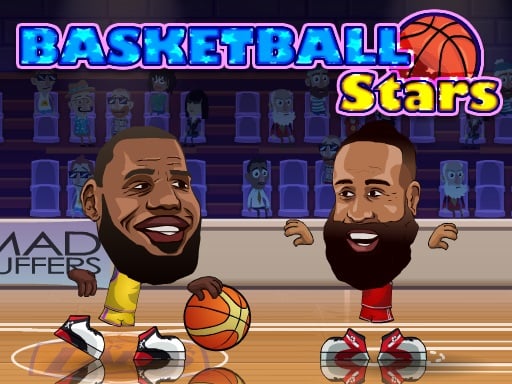
Basket Random gives each player one key. Not one key per character — one key for a whole two-man team, which means your two ragdolls hop, swing, jump, block and shoot together whether you meant them to or not. That is the joke, and it is also the entire control scheme. The left team plays on W, the right team on the up arrow, and the first side to 5 points wins.
The reason it is a game and not a coin flip is what that single key actually encodes. Your players are ragdolls, so they are always leaning somewhere; press the key and they move in whatever direction they happened to be swinging at that instant. Hold the key and they jump with an arm in the air, which is both your rebound and your block. Get the ball and it stays in your hand for exactly as long as you keep holding — release and it leaves, with a power that depends on how long you held. One button, four decisions, two bodies. Learning to fake a shot by holding a beat longer than your opponent expects is most of the skill ceiling.
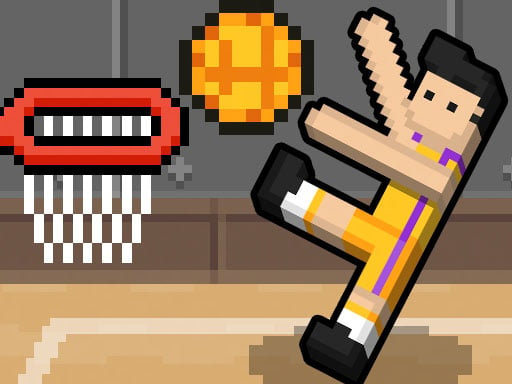
Then there is the part the name is about. After every point the game re-rolls four things at once: your players' bodies, the ball, the court and the hoop. You can find yourself short-armed on a snowy court with a slippery floor, throwing a heavy ball that refuses to bounce, at a rim that has quietly moved. The randomiser is not decoration — it hits the exact variables that real basketball spends a rulebook holding still.
RHM Interactive built it, the Tallinn company that has run twoplayergames.org since 2008 and also made Soccer Random, Volley Random and Boxing Random. That credit is not just a feed field: the copy of the game on RHM's own servers declares RHM Interactive as the build's author, and Apple lists the app under RHM INTERACTIVE OÜ. Basket Random went live in April 2020 and has stayed near the top of two-player lists ever since: 4.4 out of 5 from 72,824 votes on the studio's own portal, 8.8 out of 10 on CrazyGames, and around 3,780 reviews on the Android build. The iOS app scores noticeably worse, at 3.4 out of 5 — the browser version is the one people actually recommend.
What changes after every point
The randomiser is not vague chaos. It is four specific dice, and knowing which face you got is what separates a decent player from someone mashing a key.
The players. Four physical variations exist: long arms, short arms, a small head or a large head. Arm length changes your reach at the rim; head size changes where the ball ends up when it hits you, which happens constantly.
The ball. Four types. The classic ball behaves normally. The heavy ball does not bounce when it hits the floor and travels slowly, so lobbing it is pointless and rebounds die at your feet. The light ball bounces and accelerates far more than feels reasonable, so shots overshoot and loose balls run away from everyone. The colourful ball is worth +2 points, and it changes how both teams play the possession.
The court. City, beach, gym, or a snowy field where the ground is more slippery and control takes real practice.
The hoop. Rims come tall or short, and the net area comes wide or narrow. A wide net on a low rim is close to a free basket; a narrow net on a high one turns the round into a defensive scrap.
Real basketball freezes the numbers this game rolls
Basketball is unusually strict about its equipment, and reading the actual rulebook next to this game is funnier than it sounds. Under the FIBA Official Basketball Rules 2026 – Basketball Equipment, the top edge of the ring must sit 3,050 mm above the floor, with a tolerance of ± 6 mm. Six millimetres. The ring's inside diameter must be between 450 and 459 mm. A men's size 7 ball must measure 750–770 mm around and weigh 580–620 g.
There is even a rule for bouncing. Drop a legal ball from 1,800 mm and it has to rebound to between 1,035 and 1,085 mm — a 50 mm window that every match ball on earth has to fit inside. Basket Random takes that exact parameter, the one the sport polices to the millimetre, and turns it into a dice roll between a ball that will not bounce at all and one that bounces too much.
The hoop height is the best part of the joke, because it was never designed. In December 1891, at the YMCA Training School in Springfield, Massachusetts, James Naismith nailed two peach baskets to the lower rail of the gym balcony. The rail happened to be ten feet off the ground. More than a century later that accidental measurement is written into the rulebook to the millimetre, and it is the one thing about a basketball court that never varies between leagues — while this game moves it every twenty seconds.
Two players, one keyboard, two keys
Most games sold as 2 player basketball need two devices, an account, or a lobby. This one needs a second finger. Player one sits on W, player two on the up arrow, and because each side only owns a single key, two people can share a laptop without elbowing each other. It is closer to a 2v2 than a 1v1: each player runs two ragdolls at once, which is why the matches look like a scramble rather than a duel.
A race to 5 points ends in two or three minutes, so best-of-three fits into a break. There is no online mode — the studio has described one as planned for years without shipping it — so anything advertising "Basket Random online" is really describing this same shared keyboard.
Play Basket Random unblocked
People type Basket Random unblocked into a school computer at a very specific moment, so here is the mechanical answer rather than a sales pitch. A filter does not know what a game is. It works on hostnames: a list of domains, sorted into categories by a vendor, consulted before a single byte of anything arrives. The question is never whether this game is permitted. It is whether this address is on that list. If the page you are reading opened, nothing further needs permission — no installer, no browser extension, no account, no plugin, no unusual port. It is a web page.
Two addresses are involved, which is the part almost nobody explains. This article comes from us; the game is streamed into a frame from the publisher's own server. So if the text loads and the frame stays blank, the second host is the one being refused. Same symptom, different problem, and worth knowing before you decide the whole site is dead.
What the build asks of the machine is small and checkable. We requested every file it lists, compressed, the way a browser would: 61 files and 1.06 MB, of which roughly 448 KB has to land before the title screen appears. Before any of it runs, a support script tests three things — WebGL, WebAssembly and JavaScript modules — and refuses with "Software update needed" if one is absent. Any Chromebook still receiving updates passes. The same script also detects Kaspersky security software injecting itself into the page and names it outright, so if you see Kaspersky mentioned on screen, the antivirus broke the export and the network is innocent.
If the address genuinely is blocked, the answers are the boring ones: ask a teacher to allow it, or play at home. Routing around a filter somebody installed on purpose is not something we will help with.
More games by RHM Interactive
The Random sports series shares this exact design — one button, ragdoll bodies, a new set of rules every point: Soccer Random, Volley Random and Boxing Random. RHM's other family swaps the sport for a brawl in Drunken Boxing, which it publishes. If you want more two-player-on-one-keyboard chaos from elsewhere, 12 MiniBattles is the obvious next stop. More of this kind of thing lives in our sports category.
How to play Basket Random
- Pick a mode. 1 Player puts you against the CPU. 2 Player splits the keyboard: W on the left, up arrow on the right.
- Tap to move. There is no left or right key. Your ragdolls travel in the direction they are already leaning, so movement is a rhythm, not a steering wheel.
- Hold to defend. Holding the key jumps and raises an arm. That single action is your rebound, your contest and your block.
- Hold, then release, to shoot. The ball stays in your hand while the key is down. Release to fire; a longer hold means a harder throw.
- Get to five. First team to 5 points takes the match, which usually lands somewhere between two and three minutes.
Things that are not obvious on the first try:
- Spread your two players out. They share a key, but they do not share a position. If both ragdolls end up stacked on the same spot, half the court is undefended and the CPU will simply shoot into the gap.
- Jump before the shot, not during it. Blocking works on prediction. If you wait until you see the ball leave, your arm goes up late every time.
- The fake is real. Because shot power is tied to hold length, you can hold through an opponent's jump and release after they come down. This is the single most useful habit to build.
- Fight for the colourful ball. It is worth +2. In a race to 5, one colourful basket is 40% of a match.
- Respect the snowy court. The ground is more slippery there, so the same tap carries you further than you intended. Tap less.
- A short-armed round is a defensive round. When the randomiser gives you stubby arms, stop contesting at the rim and play for the loose ball instead.
Controls
| W (left team) | Tap to swing and hop — your ragdolls move in whatever direction they happen to be leaning when you press |
|---|---|
| ↑ Up arrow (right team) | The same single key for the second player, on the same keyboard |
| Hold (either key) | On defence, jump with your arm raised to block. With the ball, hold to keep it in your hands |
| Release (either key) | Shoot. The longer you held the key, the harder the ball leaves your hand |
| Left mouse click | Alternative to the keyboard for one of the two teams |
Features
- One key per team, and that key controls both of your players at once — direction, jump, block and shot power all come out of the same button
- [object Object]
- Four ball types, including a colourful ball worth +2 points that can flip a match in one possession
- First team to 5 points wins, so a full game takes two or three minutes
- 1 Player against the CPU or 2 Players sharing one keyboard — no second device, no matchmaking, no account
- Rated 4.4 out of 5 from 72,824 votes on the studio's own portal and 8.8 out of 10 on CrazyGames
- Plain HTML5 in a single browser tab, so it runs on school Chromebooks and old laptops
Game details
- Developer
- RHM Interactive
- Release date
- April 2020
- Last updated
- September 1, 2026
- Added here
- November 2022
- Technology
- HTML5 (2D ragdoll physics, 900×600 landscape)
- Platforms
- Browser (desktop), Chromebook, Android app, iOS app
- Classification
- Multiplayer , Sports
FAQ
How many points do you need to win Basket Random?
Five. The first team to reach 5 points wins the match. Most baskets are worth 1 point, but the colourful ball is worth 2, so a single lucky possession with it can end a close game.
What are the controls in Basket Random?
One key per team. The left team plays with W and the right team with the up arrow key; a left mouse click works as an alternative. Tap to hop and swing, hold to jump and block or to keep hold of the ball, and release to shoot.
Is Basket Random a 2 player game?
Yes, and it was built that way. Two people share one keyboard — W against the up arrow — with the court split down the middle. There is also a 1 Player mode against the CPU if nobody is around.
What is the colourful ball in Basket Random?
It is one of four balls the game can spawn after a point, and it is worth +2 instead of the usual 1. The other three are the classic ball, a heavy ball that barely bounces and travels slowly, and a light ball that bounces and accelerates far more than you expect.
Can I play Basket Random unblocked at school?
It is a single HTML5 page with no plugin, download or login, so it runs on a school Chromebook or a locked-down browser as long as the site itself is reachable. That is why it appears on so many classroom games lists.
Does Basket Random have an online multiplayer mode?
No. Both players have to be at the same keyboard. RHM Interactive has listed online play as planned, but it has not shipped, so anyone advertising "Basket Random online" is describing local two-player.
Who made Basket Random?
RHM Interactive, an Estonian studio in Tallinn that has run the two-player portal twoplayergames.org since 2008. Basket Random launched in April 2020 and is the best known entry in their Random sports series, alongside Soccer Random, Volley Random and Boxing Random.
How tall is the hoop in Basket Random compared to a real one?
A real ring is fixed at 3,050 mm above the floor with a tolerance of 6 mm under FIBA rules. Basket Random ignores that entirely and re-rolls the hoop between tall and short, with wide or narrow nets, after every point.