What are .io games? A short history and how to get good at them
Where .io games came from, why they are all multiplayer arenas, the design rules they share, and the strategies that work in almost every one.

If you have played a browser game in the last decade, you have played an ".io game" — even if it did not have .io in the name. The label started as a domain extension and became a genre. Here is where it came from, what the genre actually means, and the strategies that carry over from one .io game to the next.
Where the name comes from
The .io top-level domain belongs to the British Indian Ocean Territory. It was cheap, short and available when, in 2015, a single developer released a game about eating smaller cells and avoiding bigger ones. That game was Agar.io, it spread through streamers within weeks, and every follow-up copied the naming: Slither.io, Diep.io, Paper.io, Surviv.io. By 2017 ".io" meant a style of game rather than a country.
What makes a game an .io game
The originals share a design template that is worth spelling out, because it explains why the genre works so well in a browser:
- Instant join. No account, no lobby, no tutorial. Type a name, press play, you are in.
- One arena, many players. Everyone is on one big map, joining and leaving continuously.
- Grow or die. You start tiny and get bigger by collecting or eliminating; dying resets you to zero.
- One mechanic. Move, and usually one action button. Depth comes from the players, not the controls.
- Sessions of two to ten minutes. Perfect for a break, terrible for productivity.
Modern .io games add classes, upgrades and team modes, but the skeleton is the same. That skeleton is why the genre lives in browsers: it needs no download, no progression saves and no friends list.
Strategies that work in almost every .io game
Play the edges early. In the first minute you are the smallest thing on the map. Stay away from the centre, where the big players farm, and collect along the border until you are mid-sized.
Watch movement, not size. A large player moving straight at you is a threat; a large player moving away is food later. Most deaths come from not looking at the direction of the things around you.
Learn the one trick. Every .io game has a single advanced mechanic — splitting in Agar.io, boosting into a cut-off in Slither.io, drawing a tight loop in Paper.io. Learn it in your first three games; it separates the leaderboard from everyone else.
Bail early. When two big players fight, leave. The winner will be bigger and hungry.
Leaderboard players are targets. The moment you reach the top ten, half the map knows where you are. Play more conservatively, not less.
Where to start
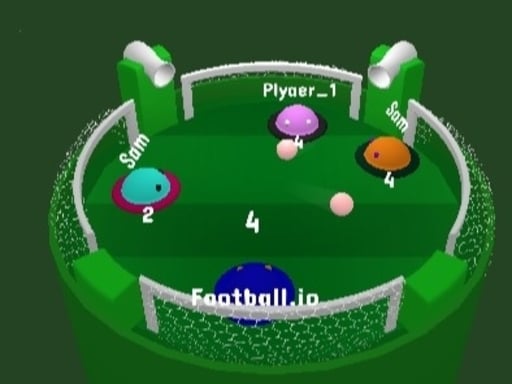
Our .io category collects the games built on that template. One warning worth having, because we found it the hard way while writing these pages: a lot of games wear the .io suffix without the multiplayer. Football.io looks like a twelve-player arena and names its rivals Michael, Yassir and Slobodan, but there is no networking code anywhere in it — the names come from a hand-written list inside the build, and one of them is a typo the developer never fixed. It is a good game against bots. It is not an .io game in the sense this article means.
Two more things the genre's own history predicts. Because these games live at an address rather than in a file, they die when the domain lapses: several we had listed went dark that way and we removed them. And because they are cheap to clone, the same arena reappears under a dozen names. Check whether you are actually playing against people before you believe a leaderboard.