










About Build levels – earn money!
A plinko board normally pays you for a miracle. The slot in the far corner carries the fat multiplier precisely because a ball dropped from the middle almost never gets there, and the whole shape of the thing is a bet against you. Build levels – earn money! turns that upside down and does it deliberately. The two slots in the centre of the floor are the x5 ones, and the payout falls away as you move outwards. The likeliest place for a ball to land is also the best place for it to land.
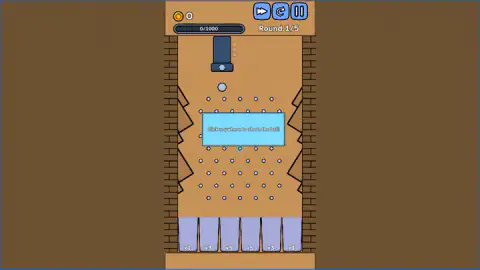
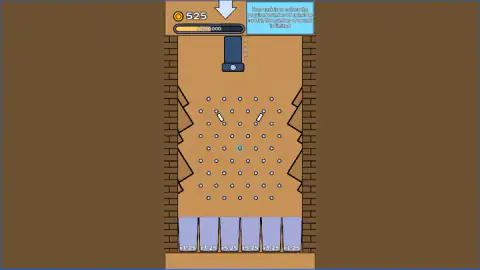
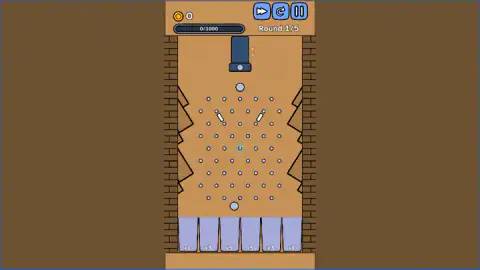
That inversion matters, because you cannot aim. The only instruction the game offers is a pale blue card across the first screen reading Click anywhere to shoot the ball, and anywhere is the operative word. There is no angle to set, no power bar to hold, no dragging the pipe left or right. A ball falls out of a dark blue pipe fixed to the top centre, works its way down through a staggered grid of pins and ends up wherever the bounces leave it. What you are allowed to change is the board.
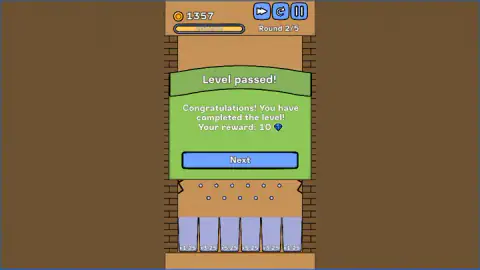
The top left corner holds a coin count with a bar underneath it, and in the first level that bar read 0/1000: a thousand coins to clear. To its right sits Round 1/5, which is not a schedule but a budget — the game's own tutorial card puts it as "the number of rounds is limited". Coins accumulate from one round into the next rather than resetting, and the instant the bar is full the level is over. Ours ended on the second round of five, with three never used.
The listing credits a developer going by eheeh3, dates the game to October 2024. One thing is worth settling before anything else, because the title raises it: the money here is gold coins and blue diamonds, both of them entirely inside the game. Nothing we saw could be cashed, claimed or withdrawn.
The board is Galton's machine, and the payouts give it away
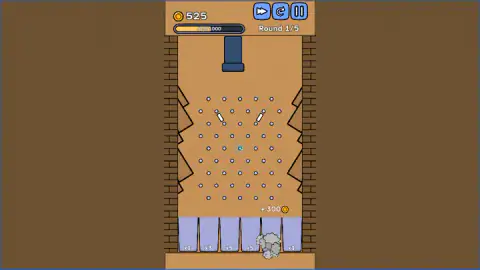
Count the pins and the thing becomes recognisable. There are forty-nine of them, in nine rows that alternate five and six so that every pin sits in the gap between the two above it. That staggered pattern has a name — a quincunx, after the five-dot face of a die, four at the corners and one in the middle — and so does the apparatus. Francis Galton, the Victorian polymath and cousin of Charles Darwin, had one built in the 1870s and put it in print in Natural Inheritance in 1889. Drop beads in at the top, let each one bounce left or right off every pin it meets, and the pile at the bottom comes out as a bell: tall in the middle, thin at the edges, the same shape every time.
The point Galton was making is that the bell is not designed. Each bounce is a coin flip, nobody steers anything, and yet enough coin flips stacked together give a result you can predict in advance. One ball is luck. A few hundred balls are a law.
Now look at the floor of this game again. Nine rows means nine left-or-right decisions, every ball starts dead centre, and the middle slots are therefore where the bell is tallest — and the middle slots are the x5 ones. A casino-style board would do the reverse, hanging its best numbers out at the edges where the bell is thinnest. This board pays you most for the outcome chance was already going to hand you, which is why a bad round here is disappointing rather than ruinous, and why the slow upward drift of the coin counter feels less like gambling than like watching a machine do arithmetic.
The board is not left pure, mind. Two jagged brown teeth bite inwards from each brick wall, narrowing the field at two different heights so a stray ball meets a slope instead of a straight drop. Two short white bars sit at opposing angles among the upper pins. And one pin, dead centre of the fifth row, glows cyan. It was there from our very first drop and we never found out what it does.
You cannot aim, so the game hands you the board instead
The rules panel, which the game files under Education, is unusually frank about the loop: "After all the balls are released, a store with cards will open for you. Each card either gives you some kind of bonus or allows you to install new objects on the level." Install objects on the level. That is the sentence the title is pointing at — the building you do is the board you are dropping into.
Two stores, and they work differently. The one between rounds spends nothing: it offers you a card, you take it or refresh the shelf, and it dies with the level. The one behind the Improvements button spends diamonds, and the shelf we found there held cards named Casket, Updated material, piggy bank and Overvoltage at 40, 60, 80 and 120. We had exactly the ten diamonds our first clear had paid, spent them, and the counter dropped to zero.
What came back was not an upgrade but a possibility. A card appeared under the heading "New map!" — Electrical pin, described as something that "strongly pushes the ball away from itself and gives extra coins" — with the line underneath: "Now this card will appear in the store after the round." The permanent store does not hand you power. It widens the deck the in-level store draws from. A counter in its top bar read 1 / 16, which is a fair hint at how long that deck takes to fill.
What a level actually costs you
The level list runs Level 1, Level 2, Level 3 and on down past Level 8 with a scrollbar still to go, so we cannot tell you how many there are. Levels 1 and 2 were lit when we opened it and the rest were dark. Above the list the game says the same level can be completed several times, and that each completion pays diamonds again, which makes replaying a cleared level the obvious way to fund the permanent store rather than a consolation prize.
The honest shape of the first hour, then, is this: the coin target is easy, the diamond cost of anything interesting is not, and the gap between them is the game. We did not play a second level and we never reached a 40-diamond card, so whether the later boards change their pin layout or only their target is something we cannot tell you.
More things that count up while you watch
If a bar filling on its own is the part you like, Idle Gravity Breakout 2 runs on the same pleasure with a ball that never stops, and Black Hole: Eat the Universe scales the numbers up until the screen cannot hold them. Grow Slime is the gentler version of the same curve, and Idle Zoo Tycoon swaps the pins for enclosures and the coins for visitors. Not one of those four has been played here for four minutes with a stopwatch on it, so they are suggestions rather than findings. The rest of the shelf is in clicker games.
Screenshots
How to play Build levels – earn money!
- Click or tap anywhere on the playfield. A ball drops from the pipe at the top and falls through the pins on its own.
- Watch where it lands. The six slots along the floor multiply the ball's value, and they run x1, x3, x5 outwards from the middle in both directions.
- Keep dropping until the round's balls are spent. A store then opens offering you one card, with the option to refresh the offer or skip to the next round.
- Repeat until the coin bar at the top left is full. That ends the level, whether or not you have used all five rounds.
- Take the diamonds the level pays out and spend them under Improvements, which is a separate store from the one between rounds.
What we only learned by sitting there:
- The budget is rounds, not balls. Running a round badly costs you a fifth of your chances, not the level. Coins already banked stay banked.
- The cheap card is the honest one. We took +0.25x Hole multiplier and watched all six slots change at once, from x1, x3 and x5 to x1.25, x3.25 and x5.25. A flat quarter on every slot is small, and it applies to every ball from then on.
- Nothing you buy mid-level survives it. We restarted the first level and the floor had gone straight back to its plain multipliers. Only the diamond store is permanent.
- The three buttons in the top right carry a double arrow, a circular arrow and two bars — speed, restart and pause by their icons. We never pressed them, so take that as what they look like rather than what we tested.
- The keyboard did nothing. Arrow keys and the space bar got no response we could detect.
Controls
| Click or tap anywhere on the board | Drops a ball out of the pipe. The game's own card says it in seven words, Click anywhere to shoot the ball, and anywhere is the operative one |
|---|---|
| Aiming | There is none. No angle, no power meter, no dragging the pipe. Where the ball goes is settled by the pins, not by you |
| The double arrow, top right | The usual speed-up control. We left all three top-right buttons alone during our session, so this is their shape, not a tested claim |
| The circular arrow, top right | Restart, by its icon |
| The two upright bars, top right | Pause, by its icon |
| Arrow keys, space bar | Nothing we could detect. Every input that did anything in our session was a click on the board or on a button |
| Back and Improvements | The two buttons under the level list. Back leaves it, Improvements opens the diamond store |
Features
- Six slots along the floor, and the two in the middle are the x5 ones: the best payout sits exactly where a dropped ball is most likely to end up
- Forty-nine pins in nine staggered rows, plus two angled white bars and a single pin at the dead centre that glows cyan
- A coin target per level, shown as a bar: ours read 0/1000 at the start and the level ended the moment it was passed
- Rounds are a budget, not a schedule. We cleared the first level on Round 2 of 5 and the remaining three were simply never used
- A card store opens between rounds. The one we took, +0.25x Hole multiplier, added a quarter to all six slots at once
- Cards bought inside a level do not survive it: restarting the first level put every slot back to its plain value
- Clearing a level pays diamonds — ours paid 10 — and diamonds buy permanent cards from a separate store reached through Improvements
- The level list runs from Level 1 downwards with a scrollbar still to go, and says the same level can be replayed for diamonds every time
Game details
- Developer
- eheeh3
- Release date
- October 2024
- Last updated
- October 23, 2026
- Added here
- March 2025
- Technology
- HTML5 (Godot)
- Platforms
- Browser (desktop), Browser (mobile & tablet, touch)
- Classification
- Arcade , Cards & Board , Clicker
- Saved progress
- Saving, when available, is managed by this game. Mava cannot confirm your level.
FAQ
What kind of game is Build levels – earn money!?
It is a plinko game played in the browser: balls drop from a pipe at the top of a tall board, bounce down through a grid of pins and land in slots that multiply what they are worth. Each level sets a coin target and gives you a limited number of rounds to reach it. Between rounds a store offers cards that change the board itself, which is the part that makes it a game rather than a slot machine.
How do you aim in Build levels – earn money!?
You do not. The only instruction the game gives is a card reading Click anywhere to shoot the ball, and clicking anywhere is genuinely all there is — there is no angle to set and no power to hold. The ball always leaves the same pipe at the top centre and the pins decide the rest. Your influence is exercised between rounds, by buying cards that reshape the board, not during the drop.
How many coins do you need to finish a level?
The first level asked for 1,000, shown as a bar in the top left corner that fills as coins come in. Coins add up across rounds rather than resetting, so a weak round is not fatal. We finished with 1,357 and the level ended as soon as the target was passed, without waiting for the rounds to run out.
What do the x1, x3 and x5 slots mean?
They multiply what a ball is worth when it lands there, and they are laid out symmetrically: x1 at each outer edge, x3 inside those and x5 for the two slots in the middle. One landing we caught on camera dropped into an x3 and three hundred coins floated up out of it. That arrangement is unusual — most boards of this shape pay the edges, not the centre.
Do upgrades carry over between levels?
The cards you take from the store during a level do not. We bought a card that added a quarter to every slot, watched the floor change from x1, x3 and x5 to x1.25, x3.25 and x5.25, and then saw the slots back at their plain values when we restarted that same level. The diamond store reached through the Improvements button is the one that unlocks things permanently.
What are the diamonds for?
Diamonds are the second currency and they are paid out for clearing a level — ours paid 10. They are spent in a separate store, reached by the Improvements button under the level list, on cards that cost 40, 60, 80 and 120 and upwards. What we unlocked did not appear on the board straight away: the game said the card would now show up in the in-level store after a round, so diamonds buy the chance of an upgrade rather than the upgrade itself.
Can you actually earn money in Build levels – earn money!?
No. The money in the title is the gold coin counter inside the game, which exists to fill a level's progress bar, plus the diamonds that unlock cards. Nothing we saw in our session could be cashed out, claimed or withdrawn, and the game never asked us for an account or for payment details. Treat the title as the name of a board game about coins, not as an offer.
Who made Build levels – earn money! and when did it come out?
The listing credits a developer going by eheeh3 and dates the game to October 2024, with its most recent update in August 2026. It is free, runs in the browser on this page with nothing to install, and is listed for desktop, mobile and tablet alike.