








About Fisher Clicker
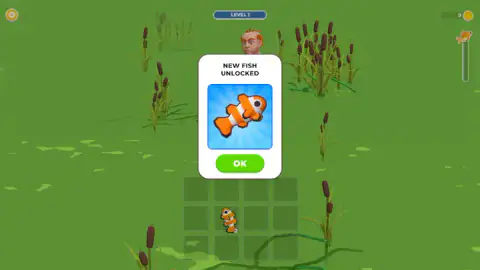
Two things are going on in this pond, and only one of them is fishing. Above the waterline there is a man on a wooden raft with a rod, a green reed pond around him, and a white float standing upright in the water a few steps in front of the raft. Below the waterline there is a board of twelve empty squares, four across and three deep. The fishing is the part you click. The board is the part that is actually a game.
Every fish you land arrives on that board with a small number printed by its tail, and two fish with the same number become one fish with the next number up. Ours began as squat yellow-green things badged 1. Two of those turned into an orange clownfish badged 2, and a card came up across the screen reading NEW FISH UNLOCKED with the clownfish framed inside it. Later a goldfish badged 3 sat alone on the board with a dashed panel above it offering six dollars for it.
So the rod is not the engine here. The rod is the thing that deals you cards, and the board is where you decide what they are worth. That is why a game with clicker in its name spends most of its attention on a grid.
The game is credited to White Light Company. The city builder is the tell. This is the house mechanic with a fishing rod bolted to the front of it.
The listing went up in April 2026 and was last touched in August.
One more thing before the detail, because it shapes everything below. We played this twice in one day, about four minutes each time, on a desktop with a mouse. Both times we stayed on LEVEL 1 and both times the coin counter in the top-right corner stayed on zero. Everything the game promises past the first sale — the rods, the boat, the clothes, the contests, the fishing house — is the game's own description of itself and not something we watched happen.
The ladder: two of a kind, every time
The arithmetic of this board is the oldest trick in casual games and it is worth seeing clearly. Two 1s make a 2. Two 2s make a 3. Which means a single 3 is four of your first catches, stacked.
Put the price on it and the shape of the game appears. The goldfish badged 3 was offered at six dollars, so those four small fish were worth a dollar and a half each by the time they had been folded together twice. Selling them one at a time would have been the slow road, and the board exists to stop you taking it.
That is also why the unlock card matters more than it looks. Each new rung arrives with its own portrait and its own species — a muddy yellow-green fish, then a clownfish, then a goldfish — so the ladder doubles as a collection. You are not only chasing a bigger number, you are finding out what the next fish looks like.
The white stick in the water is a float, and it is doing a real job
The thing you click is not decoration, and it is not a button that the artist drew to look like fishing. It is a float — a bobber, in American tackle shops — and in real angling it has three jobs at once.
It holds the bait at a chosen depth, so your hook hangs where the fish you want are swimming instead of lying on the bottom. It keeps that hook clear of the weed and rock down there, which is where tackle goes to be lost. And it tells you, from a distance, the one thing you cannot see: the bite. When a fish takes the bait, the float dips, slides or disappears, and that movement is the signal to strike.
That third job is the one this game borrows. A float is an information device. It is how an angler who cannot see underwater knows that something has happened underwater. In Fisher Clicker the whole pond is opaque — flat green, no fish visible in it anywhere — and the float is the only point on the surface that reacts to you at all. The game has turned the bite indicator into the control, which is a neater piece of design than the name of the game suggests.
Buying a better float, by the way, is on the game's own list of things to spend coins on, along with rods, a boat and clothes. In real angling that upgrade is not cosmetic either: a float matched to the weight of your rig shows a smaller, shyer bite.
There is a clownfish in a freshwater pond
Look at what is growing around the raft: bulrushes, the brown sausage-headed kind, standing in still green water. That is a freshwater marsh, as clearly drawn as a kid's picture book.
Now look at the fish on rung two. An orange body with white bands and a black outline — a clownfish, the anemonefish of coral reefs, which lives in warm salt water among the stinging tentacles of a sea anemone and would not survive a swim in a pond like this one. Its kidneys, gills and gut are built for seawater; drop it into fresh water and the balance that keeps its cells intact goes the wrong way.
Rung three is a goldfish, which genuinely is a freshwater fish and would be entirely at home in the reeds.
None of this is a complaint. Merge games pick their rungs for how different they look at the size of a thumbnail, not for where the animals live, and a clownfish is the most recognisable fish on earth for exactly that reason. But it is worth knowing which of the two is the real pond fish, because one of them you could meet in a lake near you and the other you could only meet on a reef.
More from White Light Company
Their merge board without the water is Merge Items Build City, where the pairs you make turn into houses and streets. King Dungeon is their biggest game, a mine-and-craft descent with a queen to rescue at the bottom. My Little Farm runs the same gather-and-upgrade arithmetic above ground, with wood, stone and bread instead of fish, and Miner Builder puts you in the cab of the machines.
If it is the fishing you came for rather than the merging, Deadly Catch! is the closer match: cast, wait for the bite, sell the catch, buy a better rod, then a boat to reach new islands. The rest are in clicker games.
Screenshots



How to play Fisher Clicker
- Click the white float in the water. It stands upright a short distance in front of the raft, and it is the only object on the pond that answers a click. Each catch drops a fish onto a free square of the board below.
- Read the badge. Every fish carries a number in the corner of its square. That number, not the species, is what matters.
- Drag one fish onto another with the same badge. They merge into a single fish one rung higher. The first time a new one appears, a card interrupts with its picture and an OK button; close it and carry on.
- Drag a fish up onto the dashed panel to sell it. The panel appears above the board with the price written in it, and the coins land in the pill at the top right.
What the two sittings taught us:
- Selling is a drag, not a click. This is the single most useful line on this page. We tapped the panel that said SELL 6$ more than once, in both sittings, and the coin counter did not move by a cent. The game's own instructions say to drag the fish to sell it, and that is the motion the panel wants: pick the fish up off its square and drop it on the dashes.
- The board has twelve squares, not nine. Three rows of four. Merging frees squares, so the board only chokes if you fish faster than you pair.
- A tube on the right edge fills up. It has a goldfish drawn at the top of it, and in one capture it had gone from empty to completely full while we fished, and was empty again a few catches later. We never saw what it hands over when it fills, so treat it as a meter worth watching rather than a reward we can describe.
- The gear in the top-left corner is the settings, and the blue pill in the middle of the top edge is the level. Ours read LEVEL 1 from the first second to the last, which follows: we never completed a sale, so we never gave it anything to count.
Controls
| Click or tap the white float in the water | Casts and catches; the fish lands on a free square of the board |
|---|---|
| Drag one fish onto another with the same number | The two become a single fish one number higher |
| Drag a fish onto the dashed SELL panel above the board | Sells it for the price written on the panel |
| Gear button (top left) | Opens the settings |
| Dynamite | Brings up several fish at once, per the game's own instructions; no dynamite appeared in our two sittings |
Features
- A board of twelve squares, four across and three deep, which is the real playing field: the fishing only feeds it
- Fish arrive badged with a number, and two of the same badge merge into one of the next number up
- A card reading NEW FISH UNLOCKED interrupts the first time a species appears, so the ladder doubles as a collection
- The level-3 fish on our board, an orange goldfish, was offered for six dollars on the sell panel
- Selling is a drag, not a click: our coin counter sat on zero for two sittings because we kept tapping the panel
- No timer, no lives and no game over appeared in either sitting; nothing on screen can take the board away from you
- Made by White Light Company
Game details
- Developer
- White Light Company
- Release date
- April 2026
- Last updated
- August 10, 2026
- Added here
- February 2026
- Technology
- HTML5 (3D)
- Platforms
- Browser (desktop, mouse), Browser (mobile & tablet, touch)
- Classification
- Clicker
- Saved progress
- Saving, when available, is managed by this game. Mava cannot confirm your level.
FAQ
How do you play Fisher Clicker?
You click the white float standing in the water in front of the raft, and the fish you catch drops onto a board of twelve squares below. Every fish carries a small number. Drag one onto another with the same number and the two become a single fish one number higher, which is worth more when you sell it. Selling is what turns the catch into coins.
How do you sell fish in Fisher Clicker?
By dragging the fish onto the dashed panel that appears above the board, not by clicking the panel. The panel shows the price it will pay, for example SELL 6$ for the goldfish we grew. We tapped that panel several times in two sittings and the coin counter never moved off zero, which is how we learned the difference.
What do the numbers on the fish mean?
They are the rung of the ladder. A fish badged 1 is a first catch, two of them merge into a fish badged 2, and two of those make a 3. In our sessions the 1 was a squat yellow-green fish, the 2 an orange clownfish and the 3 an orange goldfish offered at six dollars. Higher numbers are worth more, so the board is where the money is made rather than the rod.
Is Fisher Clicker an idle game?
Only halfway. It is filed under clicker and incremental, and the counting-up part fits, but nothing happens while you are not touching it. Each fish needs a click on the float, each merge needs a drag, and each sale needs another drag. It is a tapping game with an idle game's arithmetic.
Who made Fisher Clicker?
White Light Company. The merge board here is clearly the same idea as their city builder, with a fishing rod in front of it. The game went up in April 2026 and was last updated in August 2026.
Does Fisher Clicker work on a phone?
It is listed for PC, Android and iOS and described as a portrait game, which is the shape of a phone held upright. The controls are a tap and a drag, so a thumb should suit it better than a mouse. We played it on a desktop, where it filled a wide screen without anything being cut off, so we cannot vouch for the small-screen version from our own hands.
What can you buy with the coins in Fisher Clicker?
The game says rods, a float, a boat and clothes for the fisherman, with contests against other fishermen and a fishing house of your own further on. That is the game's own account of itself. We never completed a sale, so our coin counter stayed on zero and we never saw the shop, which is the main gap in this page.
Can you lose in Fisher Clicker?
Nothing in two sittings suggested you can. There was no timer, no lives, no failure message and no game over screen, and the pond never ran out of fish. The pressure such a game has, if any, comes from the board filling up with fish you have not merged yet.