






About Poker Clicker
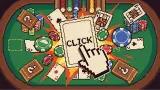
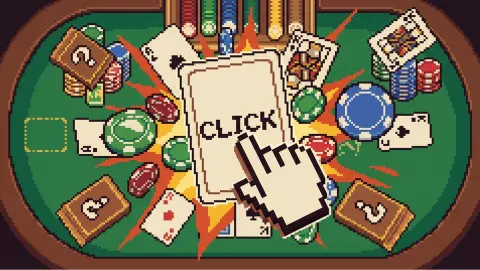
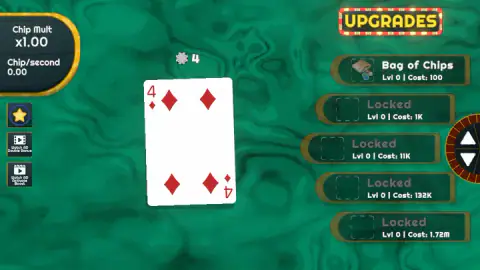
A poker game usually ends with somebody turning over a hand. This one never deals you one. A single card stands face up on a dark green table, and your whole job is to hit it. No opponent, no stake, no second card to compare it against. Click, and a different card takes its place. Click again, and a small number floats up off it into the counter above.
That number is the rank of the card you just hit. A two pays two, a ten pays ten, and we watched an eleven come up as well, so the court cards keep counting upwards. That is the only randomness in the game, and the reason the deck is here at all: not to make a hand, but to decide what this click was worth.
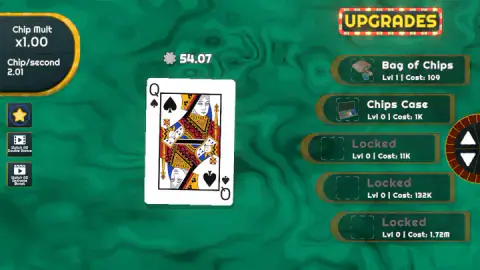
What turns that into a game is the column on the right. UPGRADES sits at the top in casino bulbs, and under it five rows, four of them blank, greyed out and marked Locked, with prices that run away into the millions. Only the top row is live when you start: a Bag of Chips, yours for 100 chips. Buy it and the second line on the left panel, Chip/second, stops reading zero. From there the counter climbs whether you touch anything or not, and clicking becomes a way of reaching the next price sooner.
The game is credited to AGhostDev. This one went up in March 2026.
We played it for about ten minutes on a desktop with a mouse, and took the pile from four chips to a little over two thousand. The rows at the bottom of the upgrade list never came close to affordable, and we say so below rather than guess at them.
The first bag is the only bargain on the list
We bought the same upgrade eleven times, writing down the price on the panel and the income beside it. Five moments from that climb show the whole shape:
| Level on the panel | Price of the next one | Chips a second |
|---|---|---|
| Lvl 0 | 100 | 0.00 |
| Lvl 1 | 109 | 2.01 |
| Lvl 3 | 130 | 4.01 |
| Lvl 7 | 183 | 8.01 |
| Lvl 11 | 258 | 12.01 |
The first bag is the bargain in that table. It costs a round hundred and starts the income at just over two a second, so it pays for itself in under a minute of you doing nothing at all.
Every bag after that adds exactly one chip a second. That flat figure makes the rest of the ladder readable without arithmetic: from the second purchase on, the price in chips is also the payback time in seconds.
The bag that costs 109 takes 109 seconds to earn back. The last one we bought takes over four minutes, which is most of a sitting.
Nine percent a step is a doubling every eight
Line those prices up and the gap between them is always the same share of the price: nine percent. That is not a quirk of this game, it is the standard shape of the genre, and it is the same curve as money left in an account earning interest, where each step is a percentage of a bigger number than the step before.
Money people have a shortcut for that curve called the rule of 72: divide seventy-two by the percentage and you get how many steps it takes for the figure to double. Here that gives eight, and the table bears it out. What matters while you play is the mismatch underneath. Your income grows by a fixed amount each time, one chip a second for ever, while the price grows by a share of itself. One of those outruns the other, always.
Which is why the locked rows exist. Each costs ten to thirteen times the row above, and that jump is the game pulling you off a ladder that has gone flat and onto a fresh one. We only reached the second row, the Chips Case at 1K, at the very end. One purchase of it took the income from twelve a second to twenty-three: near enough to everything the bags had built between them, bought in one go.
Its own next level then asks 1.09K, so the nine percent starts again on a bigger number. A third name, Stacked Chips, appeared underneath the moment the case was paid for, because a row keeps its name hidden until you own a level of the row above it.
There is a deck here, but there is no poker
A card on its own cannot make a poker hand, and the game never gives you a second one. Real poker has a name for the best you can do with that: high card. It sits at the bottom of the rankings, below a single pair, and beats nothing except a worse high card. The one thing this game shows you is the one worth least at a real table — and here it is the only thing that pays.
The deck itself is the standard French-suited one. Spades, hearts, diamonds and clubs are French designs from the end of the fifteenth century, simple enough to print from a stencil, which is why they spread across Europe and pushed out the engraved suits of the Italian and Spanish packs. The English names came from those older packs rather than from the pictures: spade from the Italian for swords, club from the Spanish baton. The symbol on screen and the word under your breath come from different countries.
What is left of poker here, then, is the furniture: the chips, the baize-green table, the ranks in the corners. You cannot lose a chip in this game except by deciding to spend it.
What ten minutes showed, and what it did not
Three things surfaced late. The game remembers you: we reloaded the page twice mid-session, came back through the cover both times, and found the same levels and the same pile waiting. A small gold-framed card slid into the bottom-left corner once, reading For starters — Unlock your first upgrade, the only sign it keeps score of anything beyond chips. And one advert covered the table on its own, followed by a grey prompt reading Click to keep playing; the counter kept climbing behind both, so nothing was lost but the view.
Plenty stayed out of reach. We never found out what the Chips Case or Stacked Chips change beyond that one line of income, and the last two rows were never remotely affordable. There is a second page behind the wheel at the right edge, and in an earlier sitting we got to it: its top row is a Silver Card at 7.5K, a separate ladder rather than a continuation of this one. This time we never turned the page at all. The star button stayed unpressed, the multiplier never left x1.00, and if there is an ending, we have not seen it.
More games built out of one repeated tap
The same studio's Idle Zoo Tycoon is the closest relative on our shelf: another idle game where the money arrives on its own and you decide what to spend it on. King of Fishing and Sausage Life are that studio in a louder mood, arcade games rather than ladders of prices. Grow Slime keeps the structure and buys eggs instead of ticking off rows, and Insect Clicker puts one creature in the middle of the screen and asks you to do one thing to it. The rest sits under clicker games.
Screenshots
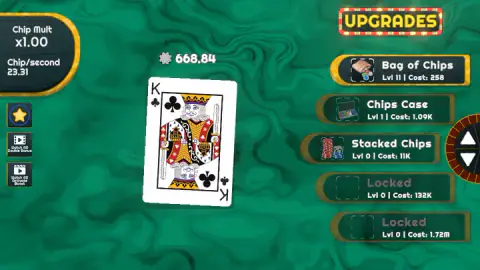
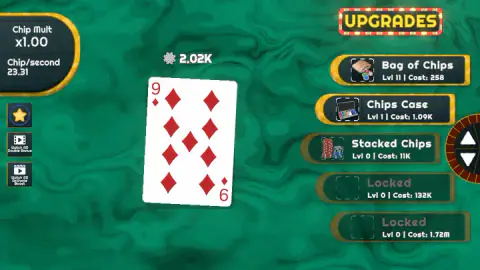
How to play Poker Clicker
- Press Let's Play on the cover. You land on a title card before the table. One press takes you in, and the sound it makes is the only sound the game has.
- Click the card. Every click pays its rank and deals a new one. The counter above it carries decimals, because once you own an upgrade it is ticking up between your clicks.
- Watch the top row of the list. It shows your level and what the next one costs, and it lights up gold the moment you can afford it. Click the row itself to buy.
- Keep an eye on the row below. The moment you buy a level, the blank row underneath stops saying Locked and tells you its name and its price.
What our run actually taught us:
- There is no back button because there is nothing to go back from. Card, counters and shop are one screen; the upgrade list is not a page you have to leave.
- The arrow keys do nothing. We pressed all four, repeatedly, and nothing moved.
- Buy the first bag the moment you can. It is the only purchase on the list that earns itself back in under a minute.
- Then keep buying that same row. Eleven in a row is a sensible opening, and it is what carried us to the thousand the second upgrade wants.
- Aim carefully at the wheel on the right edge. It is a small target; we missed it a dozen times.
Controls
| Let's Play button | The cover page you land on first. One press opens the table, and the sound it makes is the only sound in the game |
|---|---|
| Left click on the card | Pays you chips and deals a different card in its place. The figure that floats up is the rank of the card you just hit |
| Left click on an upgrade row | Buys the next level of that row. It lights up gold the moment you can afford it, and the counter drops by the price |
| Wheel at the right edge | Two arrows, up and down, that turn the pages of the upgrade list. It is a small target and easy to miss |
| Arrow keys | Nothing we could get out of them. This is a game for a mouse |
| Star button (left column) | Sits above the two advert buttons. We never pressed it, so we cannot tell you what it opens |
| Two Watch AD buttons | Optional extras in the bottom-left corner, one offering a double bonus and one a boost. We used neither |
Features
- One screen for everything: the card you click, the two numbers that measure you, and the shop you spend in, all visible at once with nothing to open or close
- A click pays the rank of the card in front of you, so the deck is the only randomness in the game: a two pays two, a ten pays ten
- An upgrade ladder that climbs about nine percent a level while the payoff stays flat, so each purchase takes longer to earn back than the one before
- A row stays blank and marked Locked until you buy the first level of the row above it, which is how the list tells you what is coming next
- A second upgrade at 1K that nearly doubled our income in one purchase, after eleven levels of the first one had built it a chip at a time
- It remembers you: we reloaded the page twice mid-session and came back to the same levels and the same pile
- Almost silent, and the counter keeps ticking through everything, including the one advert that covered the table
Game details
- Developer
- AGhostDev
- Release date
- March 2026
- Last updated
- August 10, 2026
- Added here
- December 2025
- Technology
- HTML5 (2D)
- Platforms
- Browser (desktop, mouse), Browser (mobile & tablet)
- Classification
- Clicker
- Saved progress
- Saving, when available, is managed by this game. Mava cannot confirm your level.
FAQ
How do you play Poker Clicker?
You click the card in the middle of the table. Each click pays you chips and deals a different card in its place, and the figure that floats up is that card's rank. When the counter passes the price shown on the top row of the UPGRADES list, you click that row to buy it, which raises the chips you earn per second from then on. There is no hand to make and no opponent to beat.
How many chips does each card pay in Poker Clicker?
Its rank. A two pays two, a ten pays ten, and the court cards keep counting past ten. That is also what the Chip Mult line on the left panel is for, since it multiplies whatever the card is worth, but in ten minutes of play ours never moved off x1.00.
What does the Bag of Chips upgrade do in Poker Clicker?
It is the first upgrade you can afford, at 100 chips, and it starts your passive income. Before it, the Chip/second line on the left panel reads zero and the only chips you get are the ones you click for. After it, the counter rises on its own at just over two a second, and each further level of the same upgrade adds exactly one more chip a second.
How expensive do the upgrades get in Poker Clicker?
Steeply, and in two ways at once. Each level of a row you already own costs around nine percent more than the last, so the price doubles roughly every eight purchases: the first bag costs 100 and the twelfth costs 258. Each new row below is a jump of ten to thirteen times the one above, and the first page runs from 100 chips up to 1.72M. The second row, the Chips Case at 1K, was worth the wait: one level of it nearly doubled our income on its own.
Does Poker Clicker save your progress?
Yes, at least within a sitting. We reloaded the page twice during our run and both times came back through the cover screen to the same upgrade levels and the same income, with no reset and no prompt. We have not left it for days and come back, so long-term saving is not something we can promise.
Are there ads in Poker Clicker?
Two buttons marked Watch AD sit in the bottom-left corner throughout, one offering a double bonus and one a boost, and both are things you choose to press rather than interruptions. Separately, one advert did cover the table on its own during our ten minutes, followed by a small grey prompt reading Click to keep playing. Your chips carry on accumulating behind it, and one click puts you back where you were.
Is there betting or real money in Poker Clicker?
Nothing we saw asks you to stake anything. There is no bet, no hand, no opponent and no cash prize: the chips are a counter that only goes down when you choose to spend it on an upgrade. The poker in the title is furniture, not a wager, and this page is not advice about gambling of any kind.
Who made Poker Clicker?
AGhostDev, according to the game's listing. The game was published in March 2026 and last updated in August 2026. We found no studio website to confirm the name against a second source, so it rests.