




About Idle Gravity Breakout 2
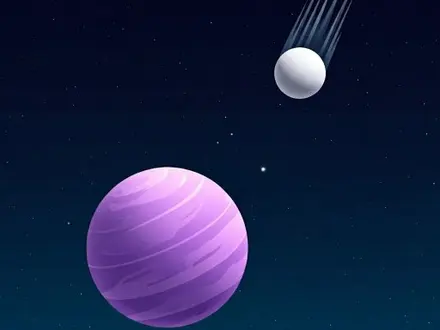
Most clicker games are about your finger: the faster you tap, the faster the number goes up. Idle Gravity Breakout 2 turns that around within a minute. Your tap does exactly one point of damage and never gets better on its own. What gets better is the swarm: balls you buy that fall towards the planet, strike it, bounce away and fall back again without you touching anything.
The trick that keeps it interesting is merging. Buy a sixth ball of any type and all six explode into a single ball with five times the attack. From that moment on, every ball of that type you buy is born with the multiplied strength. So the question is never just "can I afford another ball"; it is which of the five types is closest to its next fusion, and whether a cheap Regular Ball about to merge beats an expensive Spiky Ball that is not.
It was made by Ineasoft, a one-person studio that works in the free GDevelop engine, and this browser version was published on 27 December 2024. It is the same project as the studio's Android app, IDLE Gravity Breakout, which has passed 500 downloads on Google Play. On its page on an indie-games site, the studio says an average session lasts about half an hour, which matches the moment the economy starts pushing back.
Why the planets outrun your money
The whole game is built on two numbers pulling in opposite directions, and seeing them explains every decision.
Each planet has 13% more health than the last, and that compounds with no ceiling. The money it pays grows in steps instead: one coin per planet in stages 1 to 10, two in stages 11 to 20, three in 21 to 30. Meanwhile each ball costs 15% more than the previous one of its type.
| Stage | Planet health | Money per planet |
|---|---|---|
| 1 | 10 | 1 |
| 20 | 98 | 2 |
| 50 | 3,811 | 5 |
| 75 | 80,920 | 8 |
| 100 | 1,717,993 | 10 |
Between stage 50 and stage 100 a planet becomes about 450 times tougher, while its reward only doubles. No amount of tapping or buying keeps up with that, and it is not meant to. Merging is the first escape, because a fusion multiplies a whole type at once. Prestige is the second: it resets the stage, your money and your balls, keeps every ability you bought, and pays one skill point per five stages reached and one diamond per ten. Diamonds buy the only permanent multipliers in the game: 10% more damage, 5% more income, and click power multiplied by ten.
The gravity in this game is not Newton's
Real gravity weakens with distance. Newton's law says the pull between two bodies falls with the square of the distance between them: twice as far, a quarter of the force. That is why a real moon settles into an orbit instead of dropping straight in.
The planet in Idle Gravity Breakout 2 does not work like that. Every ball receives the same pull at any distance, aimed at the planet's centre. After each hit the ball gets a small random shove outwards, and the edges of the screen bounce it back. So your balls never orbit. They fall, strike, fly off, slow down and fall again, in loops that keep roughly the same rhythm however far out they drift.
That has a direct effect on how you play. A ball that has flown far away is not lost; it is simply on a longer lap. And because the pull is identical for every ball, what decides your damage is not where the balls are but how hard each one hits, which is exactly what merging and the ability upgrades multiply.
Idle Gravity Breakout vs Idle Gravity Breakout 2
The first game is not on this site, but its listing is still up, and comparing the two shows what changed. The original, listed in May 2021, ran in an 800×600 landscape window. Planets gained only 5% health per stage, and every upgrade, from Poisoner to Gravity Pull, was bought with diamonds.
The sequel turns the screen upright for phones and splits the economy in two: skill points for the ball abilities and diamonds for the prestige shop. Poison and Gravity Pull are gone; the Spiky Ball's critical hit replaces them. It adds the gold moon, trails behind every ball, and around twenty planet designs. It also makes planets grow far faster, 13% per stage instead of 5%, which is why prestige matters so much more here.
Breakout without a paddle, and not the other Idle Breakout
The name borrows from Breakout, the Atari arcade game released in May 1976. Nolan Bushnell and Steve Bristow came up with a one-player Pong where a ball chips away at a wall of bricks, and Steve Wozniak built the prototype with Steve Jobs over four days. Idle Gravity Breakout 2 keeps only the ball and the target. There is no paddle and no wall, and nothing you steer: the planet's pull does the job the paddle used to.
It is also easy to confuse with Idle Breakout, a much better-known game by Kodiqi from 2019 where balls clear numbered bricks. They share an idea, balls that play for you, but they are unrelated games by different developers.
Saving, phones and closing the tab
The game writes your progress to the browser's storage every second and reads it back when you return, so a refresh costs nothing. Clearing site data or switching browser starts you from zero. There is no offline income: nothing keeps track of how long you were away, so the balls only work while the page is open.
On a phone it fits naturally, since the whole layout is a tall portrait screen and every action is a tap. The engine treats a finger exactly like a mouse click.
More games by Ineasoft and other idle picks
For more idle clickers built around one repeating swing, Lazy Orcs hands you one bone-idle orc and one click per hit, working through 28 plants for a demanding king. Pumpkin Monster is a Halloween anti-stress clicker where the coins buy twenty weapons to use on a ragdoll pumpkin-headed monster, and Bouncy Rush is a one-button runner where your character bounces on its own and each click flips gravity. Tiny Fishing keeps the same drag-and-release rhythm with a fishing line instead of falling balls. The rest are in our clicker category.
How to play Idle Gravity Breakout 2
- Tap the planet. Each tap takes one point off its health bar at the top. The first planet has 10, so the opening minute really is a clicker.
- Buy your first ball. A Regular Ball costs 3 money. Planets in stages 1 to 10 pay one coin each, so it takes three planets.
- Keep buying and let them merge. The row at the bottom shows how many of each type you own. The sixth ball fuses the set.
- Spend skill points. They arrive when you reach stage 11, 21, 31 and so on. Open Upgrades and raise the ability chances of your ball types.
- Prestige when the wall arrives. In the Mystery Shop, confirm the reset. You go back to stage 1 with every upgrade intact, plus skill points and diamonds.
Before you start:
- The sixth ball briefly makes you weaker. Six balls become one ball worth five, so the moment after a fusion deals slightly less damage than the moment before. It pays back with the very next purchase of that type.
- Watch for the moon on slow planets. A gold moon only crosses the screen once a planet has survived 20 seconds, and it resets every time a planet breaks. Tap it before it leaves; it takes four seconds to cross.
- Damage pauses between planets. Each new planet appears some distance away, and while the camera glides over, the pull on your balls switches off. Many small, fast kills lose more time to that pause than one big one.
- Fire and ice stack inside a planet. Every burn adds to a damage-over-time total that keeps ticking until the planet dies, and a freeze makes every ball hit 25% harder on that planet. Both wipe clean with each new planet, which is why they shine on the tough ones.
- Skills cost their own level. Raising a chance from 1 to 2 costs 1 point, from 9 to 10 costs 9. Spreading points across abilities is cheaper than maxing one.
Controls
| Click or tap the planet | Deal your click damage, which starts at 1 — the only way to break the first few planets |
|---|---|
| Buy buttons (bottom of the screen) | Buy a Ball, Fire Ball, Ice Ball, Earth Ball or Spiky Ball; each purchase makes the next one of that type 15% dearer |
| Gold moon | Tap it as it crosses the screen for bonus money; it only appears when a planet has survived 20 seconds |
| Upgrades button | Spend skill points on the ball abilities, and open the Mystery Shop for diamonds and prestige |
Features
- Five ball types with their own abilities — a 5× opening hit, burning, freezing, mini balls and critical hits
- A sixth ball of any type fuses the whole set into one ball with five times the attack, and every later ball of that type keeps the bonus
- Planets gain 13% health per stage with no ceiling, so the run never ends and never ends in defeat
- Skill points arrive at stages 11, 21, 31 and so on, and each ability costs its current level in points up to a maximum of 99
- Prestige resets the stage and your balls but keeps every upgrade, paying skill points and diamonds for how far you got
- Progress is saved in the browser every second; there are no offline earnings while the tab is closed
Game details
- Developer
- Ineasoft
- Release date
- December 2024
- Added here
- April 2023
- Technology
- HTML5 (GDevelop 5, Box2D physics, 600×1200 portrait)
- Platforms
- Browser (desktop), Browser (mobile & tablet, touch)
- Download size
- 4.9 MB
- Ad requests
- 2 (few)
- Has a save
- Yes
- Saved progress
- Saving, when available, is managed by this game. Mava cannot confirm your level.
Measured by opening the game ourselves on 2026-09-11, not taken from the feed. Twelve seconds on a phone-sized screen, with ad requests counted and blocked rather than loaded.
FAQ
How do you play Idle Gravity Breakout 2?
Tap the planet to damage it and earn money when it breaks. Spend that money on balls, which fall towards the planet on their own and hit it again and again. When progress slows down, spend skill points on abilities in the Upgrades screen, and eventually prestige to start again stronger.
How does merging work in Idle Gravity Breakout 2?
Merging is automatic. Buying a sixth ball of the same type destroys all six and leaves a single ball with five times that type's attack. Every ball of that type you buy afterwards also carries the multiplied attack, but the price keeps climbing from where it was.
When should I prestige in Idle Gravity Breakout 2?
When planets take far longer to break than they earn. Prestige pays one skill point for every five stages and one diamond for every ten, and you keep every upgrade, so a reset at stage 50 returns 10 skill points and 5 diamonds. A reset at stage 12 is almost worthless.
Does Idle Gravity Breakout 2 keep earning when the game is closed?
No. Nothing keeps working while the tab is closed, so balls only deal damage while the page is open. Your stage, money, balls and upgrades are saved in the browser every second, and they come back the next time you open the game on the same device and browser.
Is Idle Gravity Breakout 2 the same game as Idle Breakout?
No. Idle Breakout is a separate brick-breaking idle game by Kodiqi, first released in 2019, where balls clear numbered bricks. Idle Gravity Breakout 2 is by Ineasoft and has no bricks at all; its balls are pulled towards a single planet.
What is the difference between Idle Gravity Breakout and Idle Gravity Breakout 2?
The first game ran in a landscape window, bought every upgrade with diamonds and toughened each planet by 5% per stage. The sequel is a portrait game with separate skill points and diamonds, 13% tougher planets per stage, a gold moon bonus and a save every second.
Who made Idle Gravity Breakout 2?
Ineasoft, an independent developer who builds with the free GDevelop engine and publishes on an indie-games site under the same name. The same studio made Crazy Breakout, and the game is also sold as a mobile app, IDLE Gravity Breakout, on Google Play.
Can you play Idle Gravity Breakout 2 on a phone?
Yes. The game is laid out as a tall portrait screen and every action is a tap on the planet, a button or the moon. The engine treats a finger exactly like a mouse click, so nothing on the keyboard is needed.