








About Maskinery Idle
A clicker normally gives you something that cannot fight back. A cookie, a cow, a mine shaft: you click, a number goes up, and nothing on the screen has an opinion about it. Maskinery Idle puts a grid of carved stone tiles on a beach at dusk and lets the red ones hand your damage straight back to you. In the first capture of our session the heart at the top of the screen read 75 out of a possible 250, and we had not yet worked out that the thing losing health was us.
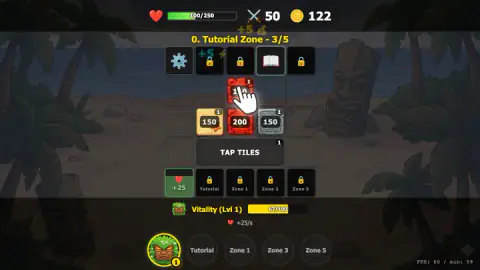
Every tile wears a number on its face, and that number is the health it has left. Up in the header, beside a pair of crossed swords, sits your Power, which read 50 for the opening minutes of our run. Click a tile and its number falls by exactly that much. Take it to nothing and the tile breaks, the gold counter in the header keeps climbing, and a bar beneath the board creeps forward.
What is unusual is how openly the arithmetic is on display. The red tile in the middle of the board read 200, then 150, then 100, one click at a time. No damage roll, no luck, no hidden multiplier: the figure in the header is the figure that comes off.
The game is credited to d954mas, and the same name carries it on an indie-games site alongside more than twenty other projects - game jam entries, a shooter, prototypes, a couple of earlier idle games. There is no studio here with a logo and a press kit.
It has been available since February 2026.
Our own session ran about four minutes on a desktop, and it never got out of the opening zone, the one the game labels Tutorial. We did not meet the boss that the listing's notes place at the end of a zone, we never found the village those same notes describe, and we never touched Rebirth. Everything below was on the screen in that time.
The masks are the whole upgrade tree
A strip under the board always shows one mask, its level, and what it is doing for you. For most of our session that was Vitality (Lvl 1), a green tiki face with a bar filling towards 100 and a line underneath promising 25 health a second.
Break enough tiles and that bar fills. When ours did, the mask went up a level and both halves of the readout doubled: the bar now ran to 200 and the healing to 50 a second. That is the shape of the progression here. Not a shop with price tags, but a thing you are already using that gets better because you used it.
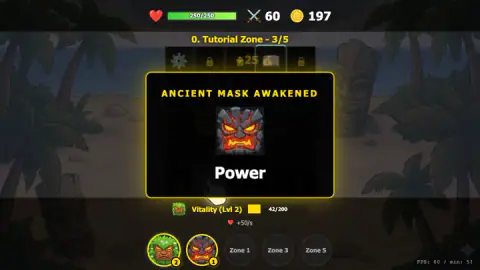
Then a popup took over the screen - ANCIENT MASK AWAKENED, a red stone face, and under it a single word: Power. From that moment two round portraits sat at the foot of the screen, green and red, each with its level on a small badge, and a yellow ring around whichever one was active. Click the other and the strip above changes to its numbers.
The red mask is the one worth watching, because its arrival is visible in the header. Before the popup, the figure beside the crossed swords read 50. From the popup onwards it read 60, and the mask's own line reads plus ten. It does not sit in a menu quietly improving things: it adds its number to the one you can see, and every click after that lands harder.
The board hits back, and then it starts working for you
The red tiles are the reason this is not quite a clicker like the others. In most of the genre the thing you click is inert - that is the whole joke of the format, that the object has no say in the matter. Here the object has a health bar, and so do you, and both of them go down.
The compensation arrives at roughly the same point in the tutorial. A second button appears in the bottom row of the grid, red, carrying crossed swords and the number 12, and from then on the whole board loses health whether your hand moves or not. In our last captures every tile fell in matched steps, reds and greys dropping by the same amount at the same moment, always a multiple of that printed 12. That is the idle half of an idle game arriving: progress that does not need you.
What we could not work out is the unit. Twelve per second, per tick, per something else off to the side: the button does not say, and four minutes was not enough to measure it honestly. An open question is worth more than a rate we would be guessing at.
Rebirth is this genre's oldest trick, and we never got to it
The game's listing describes a good deal we never saw: five stages to clear in each location, a boss on the last of them big enough to cover nine squares of the grid, a village where gold is spent, and a Rebirth system. We reached none of it, and we will not describe a game we did not play.
The last of those is worth knowing about before you start, though, because it is the mechanic that defines this whole family and it has a name. In an incremental game, prestige means throwing your progress away on purpose in exchange for a permanent bonus, so that the next run climbs faster than the one you sacrificed. Wikipedia's article on the genre credits Clicker Heroes, by Playsaurus, as an early populariser of the idea. Rebirth looks like this game's word for the same bargain.
The family is older than most people assume. The same article names Progress Quest, from 2002, as the game usually considered the first idle one - a joke at the expense of role-playing games, which played itself while you watched. The genre got its audience a decade later, when Julien "Orteil" Thiennot's Cookie Clicker turned the joke into a format. Maskinery Idle adds one thing to that line: tiles that refuse to sit there and be clicked.
More games by d954mas
The game's listing gives six games under the same name and four of them are on our shelves, none of them another clicker.
Slime Planet Eater is the closest in spirit: a slime that swallows steadily larger things, the same escalation without the combat. Drill the Snake defends the surface against segmented snakes coming up through tunnels, and Toy Smash knocks a tower of cans and crates off a carnival platform with a cannon. Cyberpunk Block Puzzle is the quiet one, sliding glowing blocks along fixed axes towards matching connectors.
If it is the loop you came for rather than the maker, RPG Idle Clicker runs the same bargain - click for damage, collect gold, buy a better weapon - with monsters where this one has masonry. The rest is in clicker games.
Screenshots
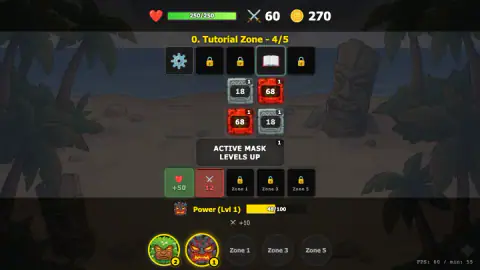
Taken by opening the game ourselves and letting it run — not supplied by the publisher, and not the same picture every other site shows.
How to play Maskinery Idle
- Click a tile to hit it. The number printed on it is what it has left, and your Power is what comes off. Keep clicking the same one and it breaks.
- Watch the heart, not only the tiles. Red tiles are enemies. The listing's control notes say they reflect your damage back at you, and that one will lock itself if your health is too low to survive the exchange.
- Let the green mask put you back together. It heals a fixed amount every second with no input from you, and the figure is printed under the board. Attack while it works and the two numbers race each other.
- Swap masks by clicking their round portraits along the bottom of the screen. Only one is active, it wears a yellow ring, and the strip above it always tells you which bonus you are currently getting.
- Collect gold, and know where it is meant to go. The listing's notes say broken tiles drop gold and energy, that gold buys more health, faster healing and more Power at a village, and that energy is what levels the masks up.
What four minutes taught us:
- Sitting still is a move. Once the red mask was awake, every tile on the board lost health between captures whether we clicked or not, in steps of 24 and 36 - both multiples of the 12 printed on the red button that had appeared in the grid.
- Red costs more than grey. On every board we saw, a red tile carried exactly fifty more health than the grey one next to it, and it still did at the end of the session, when both were nearly broken. Grey is the cheap clear; red is the one that costs you.
- Your health comes back on its own. With the green mask active, the heart refilled from 75 to full across our first few captures while we carried on clicking.
- The zone shortcuts skip the even numbers. Along the bottom: Tutorial, Zone 1, Zone 3, Zone 5, every one but the first wearing a padlock. We have no explanation for the gaps and will not invent one.
- It does not stutter. The game keeps a frame counter in the bottom right corner. Ours sat at 60 all session, and the lowest reading beside it was 51, during the popup.
Controls
| Left click on a tile | Attacks it. The number printed on the tile drops by exactly the Power shown at the top of the screen |
|---|---|
| Left click on a round mask portrait at the foot of the screen | Makes that mask the active one. The strip above it changes to that mask's level and bonus |
| Left click on the buttons in the bottom row of the grid | The abilities. A green one carrying a heart, and later a red one carrying crossed swords |
| Mouse only | Everything that happened in our session happened because of a click. The keys we tried did nothing |
Features
- A grid of carved stone tiles where each tile wears its remaining health on its face
- Damage equal to the Power figure at the top of the screen, with no spread - the tile we were hitting went 200, 150, 100 at a Power of 50
- Red tiles carrying exactly fifty more health than the grey ones beside them, on every board we saw
- Masks with their own level and their own bar - Vitality healed 25 a second at level one and 50 at level two
- A second mask, Power, that arrives with a popup and raises the figure in the header by ten
- A red button marked 12 that chips every tile on the board at once, so the board keeps falling while you sit still
- Gold that climbed from 117 to 270 in about four minutes, with nowhere we could find to spend it
Game details
- Developer
- d954mas
- Release date
- February 2026
- Last updated
- August 10, 2026
- Added here
- December 2025
- Technology
- HTML5 (2D)
- Platforms
- Browser (desktop), Browser (mobile & tablet, touch)
- Classification
- Clicker
- Saved progress
- Saving, when available, is managed by this game. Mava cannot confirm your level.
FAQ
How do you play Maskinery Idle?
You click the tiles on a grid. Each tile has a number printed on it, which is the health it has left, and a click takes off exactly the Power figure shown at the top of the screen. Reduce a tile to nothing and it breaks and pays you gold. The listing's control notes say the whole game is played with a single click or tap and that no keyboard is needed, which matches our session - nothing we pressed on the keyboard did anything.
What do the numbers on the tiles mean in Maskinery Idle?
They are health, not score or cost. A tile loses exactly your Power with every click, so with Power at 50 the red tile we were hitting read 200, then 150, then 100, one click at a time. On every board we saw, a red tile carried exactly fifty more health than the grey tile beside it.
Why does my health go down when I attack in Maskinery Idle?
Red tiles are enemies rather than scenery. The listing's control notes for the game say they reflect your damage back at you, and that an enemy locks itself if your health is too low to survive the exchange. We cannot confirm the locking from four minutes of play, but our heart counter was down to 75 of 250 early in the session and the healing spent a while catching up.
What are the masks in Maskinery Idle?
They are the upgrade system, and you wear one at a time. The strip under the board shows the active mask, its level and what it does for you - our green Vitality mask healed 25 health a second at level one and 50 at level two, with its bar doubling from 100 to 200 at the same time. A second mask, Power, arrives with a popup reading ANCIENT MASK AWAKENED and raises the Power figure in the header by ten.
Does Maskinery Idle play itself?
Partly, and only after a while. A red button marked 12 appears in the bottom row of the grid once the Power mask is awake, and from then on every tile on the board loses health at the same moment whether you click or not. Across our last captures the drops were always a multiple of that 12. We did not measure the rate, so we will not tell you what it is per second.
What is Rebirth in Maskinery Idle?
The game's listing describes a Rebirth system, and we never reached it, so we can only tell you what the word means in this kind of game. Resetting your progress on purpose in exchange for a permanent bonus is called prestige in incremental games, and the genre has used it for years - Clicker Heroes, by Playsaurus, is usually credited with popularising it. Rebirth appears to be this game's name for the same bargain.
Who made Maskinery Idle?
It is credited to d954mas, who is one person rather than a studio - the same name carries the game on an indie-games site alongside more than twenty other projects, including game jam entries and two earlier idle games. No studio name appears on screen while you play. The game has been available since February 2026 and last updated in August 2026.
How long does Maskinery Idle take to finish?
We cannot tell you, because we did not get close. Our session ran about four minutes on a desktop and never left the opening zone, which the game labels Tutorial and marks out of five stages. We never met the boss that the listing's notes place at the end of a zone, never found the village those notes describe, and never spent the gold we collected.