

About Cyberpunk Block Puzzle
The words "block puzzle" usually mean one thing: shapes wait in a tray, you drop them on a grid, and full lines vanish. Cyberpunk Block Puzzle does none of that. The blocks are already on the board when a level opens, and the whole job is to get them off it.
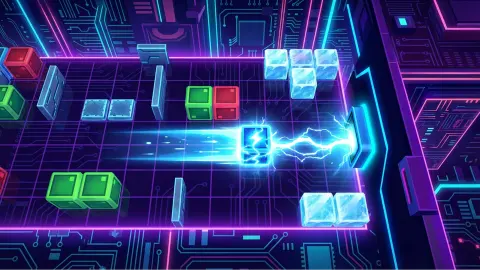
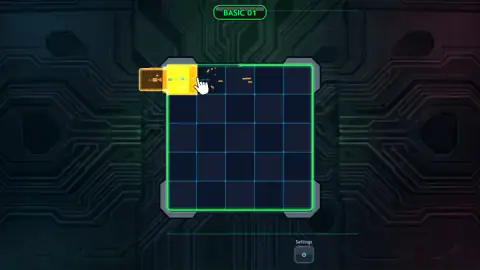
The board is a printed circuit: dark blue cells behind a pale grid, a glowing green frame, copper tracks across the backdrop. Each block is a component with a microchip drawn on it, and on the edge of the board, level with each one, sits a small chip of the same colour carrying a single word, OUT, and a triangle pointing away. Drag the orange block to the orange OUT and it slides through, turns white-gold, breaks into sparks and is gone.
What makes it a puzzle is that blocks get in each other's way. A long bar sits across the path of another, and it has to leave first, or at least step aside.
We have played it twice with a mouse, a quarter of an hour. The first visit cleared BASIC 01 and BASIC 02 and then stuck on BASIC 03 with three blocks still on the board. The second spent ten minutes on BASIC 01 alone and emptied it, which sounds like the lesser run and taught us more: the first board is where the game explains itself.
The game is credited to a developer who signs as d954mas. It has been available since March 2026.
The exits are chips, and they take themselves away
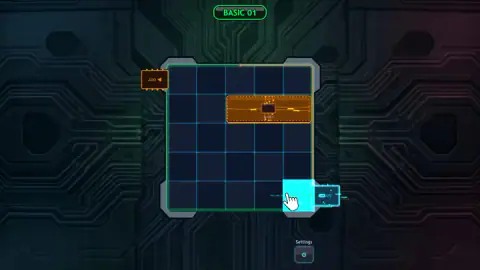
BASIC 01 is five cells by five and holds two blocks: a cyan one near the bottom right and an orange bar three cells long. The orange bar shows what the art is doing: not a coloured rectangle but a strip of circuit board, with a black chip soldered in the middle, gold tracks running out to both ends and a serial number underneath, too small to read.
The two exits sit on opposite edges: cyan on the right, level with the cyan block, orange on the left in the top row. Each is drawn as a chip with legs, turned to face the board, which makes for a small joke: the left one is rotated, so its OUT reads upside down.
BASIC 02 grows to six by six and brings new shapes: a cyan square of four cells, an orange L of three and a purple piece near the bottom corner. The hand is still there. It sent the cyan square to the left and, once the board had cleared, the orange L straight up to a port on the top edge. That board also carried two cyan chips, one on each side. The hand used the left one, and both were gone afterwards.
Ten minutes on the first board, and nothing hurried us
Our second visit never got past BASIC 01, and the game let it happen. We dragged the orange bar out of its starting row and around the grid, from the second row down to the third and across a column, and nothing objected. No clock ran. No counter ticked. There is no score anywhere, only the level name in its green tag and a Settings button under the board.
Nor does the help give up. The white hand and the green dotted line stay on screen for as long as you ignore them, and they point at the same move until you make it. We eventually did: the bar went up a row, turned left and slid through the orange port, leaving the grid empty. The sitting ended there, so BASIC 02 stayed out of reach that day.
That wandering settles something the store listing raises. The listing says each block slides along one axis only. Ours did not. The bar changed row twice, and the game's own hint draws a right angle rather than a straight line.
The flip side of that patience: nothing tells you when you are wasting your time. A pointless drag looks exactly like a useful one.
The NOOB bar fills a third at a time
Above the board, from the second level on, runs a green bar labelled 1. NOOB. It read 33% when BASIC 02 opened and 67% when BASIC 03 opened. One finished level, one third.
The bar did not move while we worked on a level: on BASIC 03 we took two blocks out and it stayed where it was, so it counts finished levels and not blocks. The arithmetic says a third level fills it. We never got there, so we cannot say what a full bar gives you or what the second rank is called. The "1." in front of the name tells you there is one.
BASIC 03 is the first level nobody solves for you
The third board is five cells wide and six tall, it holds five blocks, and no hand and no dotted line showed on it in the two minutes we spent there. The layout is a small trap. A tall cyan bar stands in the middle column with its port at the bottom, and two long bars, orange above red, lie stacked across its way. On either side sit two squares, purple on the left and green on the right, and their ports are on the top edge on the wrong sides. The squares have to swap places.
We began well. The red bar went out to the right and the orange bar to the left, each through its own chip, which left the column under the cyan bar clear all the way to its exit.
Then we pushed the cyan bar up when it should have gone down. Standing at the top of the middle column it cut the upper half of the board in two, and when the purple square went into the top left corner the bar was between it and its port. We brought the square back down and along the bottom row into the far corner, one drag for the whole trip. That was our last useful move.
From that position the way out is short: the cyan bar has nothing under it, so one pull downward empties the middle column and the squares can cross. We did not play those moves, so take them as a plan and not as a record. The lesson holds for any board of this kind: a block with a clear run to its port should take it at once, before you use it as furniture.
Three levels in, the listing is still mostly promises
The listing on the game's listing mentions more than 70 levels, obstacles on later boards, a currency, higher ranks and a daily puzzle. Three levels in, none of it has appeared, and we would rather say so than describe it second hand.
It also promises a hint when you wait. On BASIC 01 the help is constant and impossible to miss. On BASIC 03 we waited, without meaning to, and nothing came.
It suits players who like traffic-jam puzzles and want one without a clock: a level can sit on the screen while you think, and the first two boards teach the idea to a child without a line of text. It is not for someone after a falling-block game, whatever the name suggests, and how hard it gets later we cannot tell you: our run stopped at the first board nobody guided.
More sliding puzzles, and more from d954mas
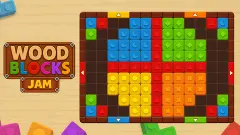
Wood Blocks Jam is the closest relative: coloured blocks leave a wooden board through gates of their own colour, also without a clock. ExitBlocks: Color Match Puzzle plays the same idea against a timer, and Coffee Color Blocks asks you to park each block at its gate instead of pushing it out. From the same developer we have Drill the Snake, which is nothing like this one: a one-button defence game. The rest are under puzzle games.
Screenshots
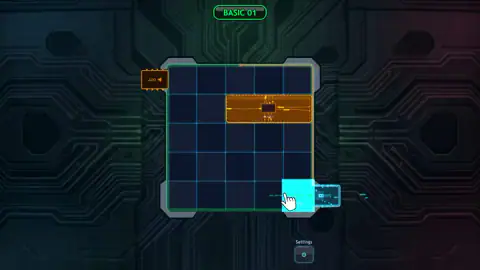
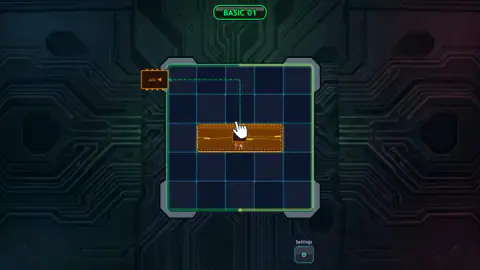
Taken by opening the game ourselves and letting it run — not supplied by the publisher, and not the same picture every other site shows.
How to play Cyberpunk Block Puzzle
- Click into the game. The first board, BASIC 01, opens with a white hand already pointing at a block.
- Hold the mouse button on a block and drag it. The block follows the pointer across empty cells, and it can turn a corner on the way.
- Take it to the edge of the board beside the chip of its own colour. It leaves in a shower of sparks, and the chip goes with it.
- Repeat until no block is left. The next level opened for us without a results screen in between.
What two visits taught us:
- Follow the dotted line, corner included. On BASIC 01 the hint for the orange bar is a green dotted track that runs up one row and then turns left. The bar has to change row before it can reach its port.
- Count the ports, not the blocks. A chip disappears with its block. The ones still glowing on the edge are an exact list of what remains to be done.
- Empty the exit lane before you touch anything else. On BASIC 03 we moved a block away from its exit and built ourselves a wall.
- A port is one cell wide and some blocks are not. The squares are two cells wide. We did not get one out on our own, so we cannot tell you which two cells of the edge they use.
- Leave the keyboard alone. The arrow keys did nothing, and neither did Escape: every move is a drag.
Controls
| Left mouse button, hold and drag | Slides a block across the free cells of the grid, corners included |
|---|---|
| Release at a matching port | The block leaves the board through the chip marked OUT in its own colour |
| Back arrow next to the level name | Shown from BASIC 02 on; we did not press it |
| Settings button under the board | We did not open it |
| Keyboard | The arrow keys and Escape did nothing we could see or hear |
Features
- Every exit is a small chip on the edge of the board with the word OUT and an arrow pointing outward
- A port disappears along with its block, so the chips still showing are the list of what is left
- Blocks are drawn as components, with a black microchip and gold traces printed on the orange bar
- A white hand and a green dotted line show the route, right-angle corners included, and they never time out
- A rank bar labelled 1. NOOB that read 33% after one level and 67% after two
- Boards that change size from level to level, five by five, then six by six, then five by six
- No clock, no score and no move counter on the levels we played
Game details
- Developer
- d954mas
- Release date
- March 2026
- Last updated
- August 10, 2026
- Added here
- January 2026
- Technology
- HTML5
- Platforms
- Browser (desktop)
- Classification
- Puzzle
- Saved progress
- Saving, when available, is managed by this game. Mava cannot confirm your level.
FAQ
How do you play Cyberpunk Block Puzzle?
Hold a block with the mouse and drag it across the empty cells of the grid. On the edge of the board sits a small chip in the same colour, with the word OUT on it and an arrow pointing away. Bring the block to that spot and it slides through and is gone. The level ends when the board is empty.
Is Cyberpunk Block Puzzle like Tetris?
No. Nothing falls, nothing is placed and no lines are cleared. The blocks are already on the board when a level starts, and the job is to slide them out in an order that keeps their paths open. It belongs with sliding puzzles and traffic-jam puzzles.
Do the blocks only move in one direction?
Not on the levels we played. On BASIC 01 the orange bar changed row twice while we worked, and the game's own hint for it draws a right angle: up one row, then left to the port. The store listing speaks of blocks tied to one axis, so that may arrive on later boards we did not reach.
Is there a timer or a move limit in Cyberpunk Block Puzzle?
We saw neither. On our second visit we spent ten minutes on the first board, moving one bar back and forth, and nothing counted the moves, nothing ran down and nothing ended the attempt. There is no score on screen either, only the level name.
What does the NOOB bar mean in Cyberpunk Block Puzzle?
It is a rank bar above the board, labelled 1. NOOB. It appeared when the second level opened and read 33%, then 67% on the third, so each finished level added a third. We never saw it fill, so we cannot say what the second rank is called.
How many levels does Cyberpunk Block Puzzle have?
The listing on the game's listing speaks of more than 70. Across two visits we reached three, all named BASIC, and finished two of them, so we cannot confirm the total or describe the later boards from our own play.
Can you play Cyberpunk Block Puzzle on a phone?
It is listed for PC, Android and iOS, in landscape and portrait. We played on a desktop with a mouse only, so the phone version is the listing's word and not something we tested.
Who made Cyberpunk Block Puzzle?
The game is credited to a developer who signs as d954mas. The game was published on 11 March 2026 and last updated in August 2026.