




About Grid Odyssey: Nonograms
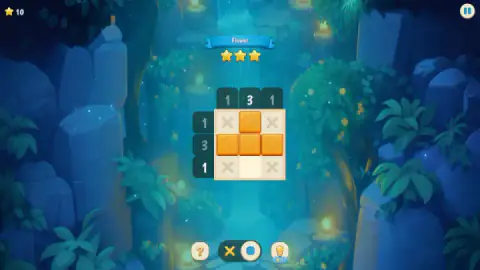
The word odyssey promises a long trip. The first stop is a board of nine cells. Grid Odyssey: Nonograms opens on a three-by-three puzzle called Flower, with an orange dog in a patterned robe holding up a scroll that tells you which cell to click. It takes about a minute, and it is the right way to begin, because the whole game rests on one idea that is easier to do than to read about.
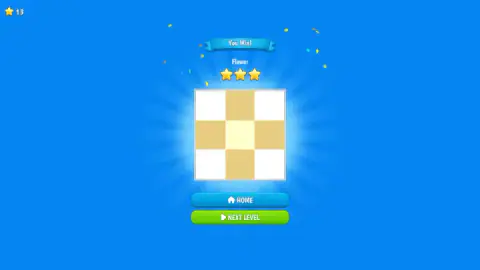
That idea is the nonogram. Every row and every column has a number beside it, and the number says how many filled squares sit next to each other in that line. Nothing else is given. You work out which cells are filled, and when you are right they form a small picture. Flower turned out to be a cross of four tan petals round a pale centre.
The game is credited to a developer listed as AI Doodle. It was published in April 2025.
A word on how much of it we saw. We played for about four minutes on a desktop computer, with the mouse. We finished Flower with three stars and got part of the way into the second puzzle, Cave, before we stopped. Everything after Cave is outside this page, including how many puzzles there are and how big the boards get.
Stars are the score and the hint money
The number next to the star in the top left corner is the only running total in the game. It read 10 when we started. Three gold stars sit under the name of each puzzle, and when we finished Flower with all three, the counter went up to 13.
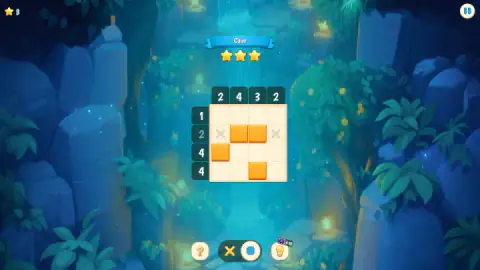
The light bulb at the bottom right spends them. It carries a small tag with its price, 5 stars. We pressed it twice on Cave and the counter fell from 13 to 3. As far as we could tell, each hint filled in a single correct square. That is a poor trade on a board this small: one puzzle had earned us three stars, and one square cost five.
With 3 stars left we could not afford a third hint, and the button changed. The price tag disappeared and a small purple badge with a play symbol and +10 appeared on the bulb. That reads as an offer of ten stars for watching an advert. We did not press it, so we cannot tell you what follows.
We never filled a wrong square, so we do not know what a mistake costs or whether it takes away one of the three stars under the level name.
Cave, solved from its clues
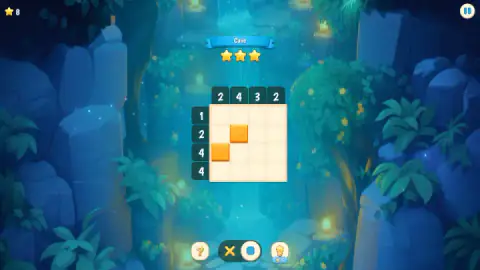
We left Cave unfinished, with four squares on the board. It does not need hints, though. The clues settle every cell, and working through them shows how the whole game is meant to be played.
Cave is four cells wide and four tall. The columns read 2, 4, 3, 2 and the rows read 1, 2, 4, 4.
- Rows 3 and 4 say 4 on a board four wide. Fill both completely. That is eight squares.
- Column 2 says 4. Fill it from top to bottom. Two of its cells are done already; the new ones are in rows 1 and 2.
- Row 1 says 1, and it now has its one. Cross the other three cells.
- Columns 1 and 4 say 2, and each has two squares from the bottom rows. Their upper cells are empty.
- Row 2 says 2. It has one square in column 2 and needs a neighbour. Column 1 is ruled out, so it is column 3, which brings that column to its three.
Eleven squares, no guesses. The squares we had placed when we stopped agree with this. What picture they make in colour we cannot say, because we did not see the win screen for it.
The puzzle began with the lights of a Tokyo skyscraper
The nonogram is younger than it looks. According to Wikipedia, in 1987 a Japanese graphics editor named Non Ishida won a competition in Tokyo by designing pictures made of skyscraper lights, switched on or off window by window. Turning that into a paper puzzle was a short step: give the solver the count of lit windows in each row and column and let them rebuild the picture. A Japanese puzzle author, Tetsuya Nishio, came up with the same puzzle independently at about the same time.
The name came later and from Britain. The puzzle collector James Dalgety joined Ishida's first name to the end of the word diagram, and The Sunday Telegraph began printing a nonogram every week in 1990. The same puzzle is also sold as griddlers, hanjie and paint by numbers.
That origin explains the two tools in this game. A window is either lit or dark, and knowing that one is dark is as useful as knowing that one is lit. The cross is how you write down a dark window. On a three-by-three board you can do without it. Larger nonograms cannot be solved by most people without it, and mathematicians have shown that deciding whether an arbitrary nonogram has a solution at all is among the hard problems of computer science.
Who it is for
It suits anyone who has never tried a nonogram and wants to be walked through one. The tutorial explains each control at the moment you need it, the first boards are tiny, and we saw no clock on screen.
If you already solve these on large grids, the opening will feel slow. We cannot tell you how long it stays that way, since we did not get past the second puzzle. And the hint economy is worth knowing before you lean on it: on these early boards a hint costs more stars than a finished puzzle pays.
More logic and number puzzles on Mava Games
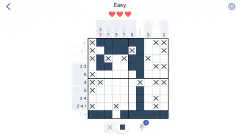
Nonogram is the same puzzle with a different frame: Easy, Medium and Hard boards, and three hearts that pay for mistakes. Coloring by Numbers. Pixel Room also builds pictures square by square, with the logic taken out and furniture as the reward. Classic Number Puzzle is a sliding tile board with a move counter, and Crosswords: Big Collection swaps number clues for word clues. The rest are under puzzle games.
Screenshots
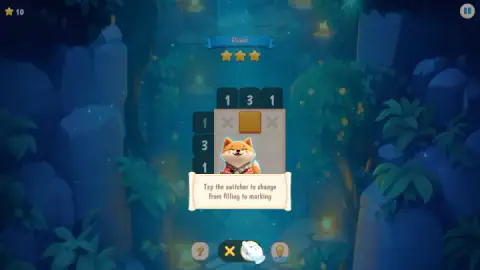
Taken by opening the game ourselves and letting it run — not supplied by the publisher, and not the same picture every other site shows.
How to play Grid Odyssey: Nonograms
- Read the clues round the board. Numbers above belong to columns, numbers on the left belong to rows.
- Click a cell to fill it. A filled cell turns into an orange square.
- Use the switcher at the bottom to change tools. The yellow cross marks a cell as empty; the blue square goes back to filling.
- Watch the clues dim. When a line is complete its number fades, so the bright numbers are the work that is left.
- Fill the last square. The level ends by itself and shows the finished picture with your stars.
What our session taught us:
- Start with the clues that leave no room. A clue as large as the board is wide means the whole line is filled. Cave has three of them.
- The game crosses out a finished line for you. On Flower, the top row has a clue of 1. We filled its middle cell and the two cells beside it were crossed straight away, before we had touched the cross tool.
- You can drag. The tutorial has you sweep across a row to fill it in one stroke, which is quicker than three clicks.
- The question mark is not the hint. It opens the Rulebook, a rule card with a worked example. The hint is the light bulb, and it costs stars.
- Check which tool is selected before you click. The switcher stays where you left it. A cross where you meant a square is easy to miss on a small board.
Controls
| Click a cell | Fills it with an orange square, or marks it with a cross, depending on the switcher |
|---|---|
| Click and drag along a row | Fills several cells in one stroke (the tutorial teaches this) |
| Switcher (bottom centre) | Changes the tool between the yellow cross (this cell stays empty) and the blue square (fill) |
| Light bulb (bottom right) | Buys a hint for 5 stars from the counter in the top left corner |
| Question mark (bottom left) | Opens the Rulebook, the game's own rule cards |
| Pause button (top right) | Opens a panel with a Music switch and three buttons: Home, Reset and Resume |
Features
- Classic nonogram rules: numbers beside each row and column say how many squares in a row are filled
- A guided first puzzle, Flower, on a three-by-three board, followed by Cave on four-by-four
- Two tools on one switcher, fill and cross, so you can record the cells you have ruled out
- Clue numbers that dim once their line is complete
- A star counter that doubles as hint money: it started at 10, a three-star win added 3, a hint cost 5
- Every puzzle has a name and shows its finished picture in colour on the win screen
- Made by AI Doodle
Game details
- Developer
- AI Doodle
- Release date
- April 2025
- Last updated
- August 10, 2026
- Added here
- May 2025
- Technology
- HTML5 (2D)
- Platforms
- Browser (desktop, mouse), Browser (mobile & tablet, touch)
- Saved progress
- Saving, when available, is managed by this game. Mava cannot confirm your level.
FAQ
How do you play Grid Odyssey: Nonograms?
Each puzzle is a grid with numbers above the columns and to the left of the rows. A number tells you how many filled squares sit side by side in that line. You click cells to fill them, use the switcher at the bottom to mark cells you know are empty with a cross, and the level ends when the filled squares match every clue and form a picture.
What do the numbers on the grid mean?
A clue of 3 means that line contains one unbroken run of three filled squares. A clue equal to the width of the board means the whole line is filled. In Grid Odyssey: Nonograms the first two boards are three and four cells wide, so several clues can be solved at a glance.
What is the cross for in a nonogram?
A cross marks a cell you have proved must stay empty. It does not score anything; it is a note to yourself that narrows down where the remaining squares can go. In Grid Odyssey: Nonograms you switch between the cross and the fill tool with the control at the bottom centre of the screen.
How do hints work in Grid Odyssey: Nonograms?
The light bulb button carries a price tag of 5 stars, taken from the star counter in the top left corner. We began with 10 stars and earned 3 for finishing the first puzzle, so 13 stars paid for two hints and left 3. With too few stars for another hint, the price tag was replaced by a small +10 badge with a play symbol, which we did not press.
What is the solution to the Cave level?
Cave is a four-by-four board with column clues 2, 4, 3, 2 and row clues 1, 2, 4, 4. Fill rows 3 and 4 completely and all of column 2. Row 2 then needs one more square, and it goes in column 3, because column 1 already has its two. That makes eleven filled squares and no guessing.
Is there a timer in Grid Odyssey: Nonograms?
We saw no clock and no move counter on either of the two levels we played. The only numbers on screen besides the clues were the star counter and the price of a hint. The pause button stops the game and offers Home, Reset and Resume.
Who made Grid Odyssey: Nonograms?
It is credited to a developer listed as AI Doodle. It was published on 7 April 2025. It is listed for PC, Android and iOS; we played it on a desktop computer with the mouse.