

About Nonograph
Most nonograms charge one price for a mistake. Nonograph keeps two accounts. Your first wrong square takes a heart and a star, and a clock that cannot actually stop you takes another star just for being slow. You are not racing to survive. You are racing for a grade.
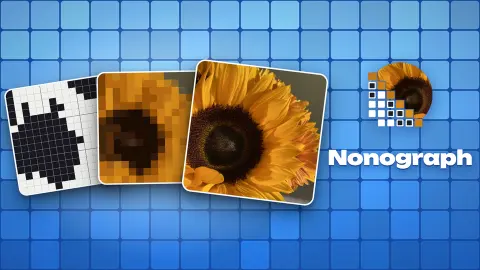
A nonogram is a logic grid: the numbers beside each row and above each column say how many filled squares sit side by side, and in what order. Nonograph's listing promises a photograph at the end of each solved grid, where most games of this kind give you a small blocky picture.
We have to be plain about that promise: we did not see one. In about ten minutes we played part of the tutorial and the first board of the first chapter, Animals. We lost all three hearts once and stopped with four squares of that board's 15 filled. The chapter counter never left zero.
Nonograph is by BigMag Games. It was published on 28 October 2026, two days before we played it.
Three stars need a clean board in 35 seconds
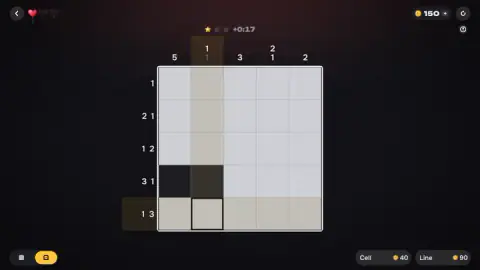
The first board opens with three gold stars and a countdown from 0:35, with a green bar under the grid that shrinks and turns orange near the end. This is how the stars moved across our attempts:
| What the board showed | Stars |
|---|---|
| No mistakes, 0:17 left | 3 |
| One mistake, 0:05 left | 2 |
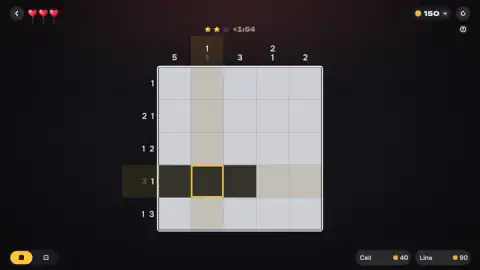
| No mistakes, clock at +0:06 | 2 |
| One mistake, clock at +2:33 | 1 |
| Two mistakes, clock at +0:06 | 1 |
| Out of lives, clock at +1:24 | 1 |
Our reading is that the first mistake costs one star and passing the clock costs another. A second mistake took nothing extra, and we never saw the display go below one. No screen we saw explains the rule.
At zero the clock turns round and counts up with a plus sign, and it had reached +2:33 with the board still open. Once that star is gone, nothing is hurrying you, so slow down and stop guessing.
If you want the star back, leaving does not help. Esc took us to the map, and when we returned the clock had gone from +0:06 to +0:15 on the same attempt. The round arrow at the top right is the real reset: it asks "Start over?" and says the board and the timer will reset. We pressed Cancel, so we did not test what it does to your hearts.
The map's star bar reads 0/60 beside a board counter of 0/20, so three stars a board. Two icons on that bar look like chests, so stars probably pay out something.
The first board, worked from its clues
The first board of Animals dealt us the same clues every time. There is only one way to fill it, and we worked it out on paper after our run, so what follows is logic and not something we finished on screen. Skip it to try it yourself.
| Line | First | Second | Third | Fourth | Fifth |
|---|---|---|---|---|---|
| Rows, from the top | 1 | 2 1 | 1 2 | 3 1 | 1 3 |
| Columns, from the left | 5 | 1 1 | 3 | 2 1 | 2 |
- Column one is a 5. On a five-square line, that fills the whole column.
- Row one is a 1. Column one just supplied it, so the rest of the row is empty.
- Rows four and five have no room to spare. Each needs three squares and one more with a gap between, which is exactly five. Fill both straight away.
- Column three is a 3. Rows four and five are already filled there, and a block cannot have gaps, so row three joins them.
- Column four is 2 1. Row five is the lower block and row four is empty, so the upper block can only sit in rows two and three.
- The last two rows finish themselves. Row two becomes two squares, a gap, one more. Row three is one square, a gap, two more.
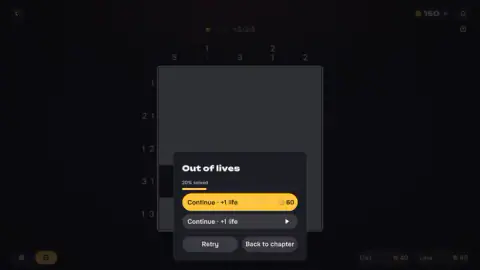
That makes 15 filled squares. The Out of lives panel told us we were 20% solved with three of them in place, which fits. This is also the trick to take to bigger boards: start with any line whose numbers plus gaps add up to the width of the grid. The tutorial makes the same point: "There's no spare room here".
A heart also buys you the answer
When you are wrong, the game corrects the square as it takes the heart. A wrong fill flashed pink and then settled white with a dot. A wrong mark left the square dark instead. The tutorial says it directly: "The game showed the right cell."
So a heart is also information. Three hearts means two answers before the third ends the attempt. That costs a star, but on a board you are stuck on, it may be a fair trade.
The counter showed 150 coins the first time we saw it, and it never moved. In the bottom right corner sit two buttons, Cell at 40 coins and Line at 90. Their names suggest that they reveal a square or a line, but we never pressed them.
Run out of hearts and the panel offers one more life for 60 coins, the same through a button with a play icon, usually the mark of a video, then Retry and Back to chapter. We pressed Esc, went to the map and pressed Play, which gave us an empty board, full hearts and a fresh clock with no coins taken. Paying only makes sense when you are close to the end of a large board.
Nintendo charged minutes for a mistake in 1995
The puzzle is younger than it looks. In 1987 Non Ishida won a competition in Tokyo with grid pictures made by switching skyscraper lights on and off. Tetsuya Nishio, a professional Japanese puzzle maker, came up with the same idea independently and published it in another magazine.
On paper, nothing tells you that you are wrong. A bad guess spreads quietly across the grid and may only show up much later. A computer can check every square at once, which creates a new problem: if being wrong is free, you can just click everything.
Nintendo, which trademarked the name Picross, short for "picture crossword", had an answer in Mario's Picross, released on Game Boy in Japan in March 1995. Each puzzle gets a time limit of 30 minutes. Your mistakes take time off it: two minutes, then four, then eight.
Nonograph splits the price. Hearts stop you clicking at random, stars keep the score, and the clock only touches the score. If Picross ever made you feel rushed, that is the difference that matters here.
What we did not get to see
We did not solve a board, so we saw no photograph, no star award and no second board. We cannot confirm the listing's 300 puzzles, 15 chapters, boss puzzles against the clock or daily large grid. We did not open the Gallery, the next-chapter arrow or the help button, saw no ad, and did not try right click or touch.
Who it suits
It suits a first-timer, because the tutorial starts on three squares a side and each error is corrected at once, and anyone who likes a grade to chase. If you enjoy being wrong for a long time and finding out on your own, the instant check takes that away.
Similar games
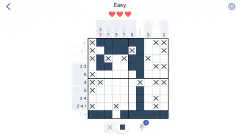
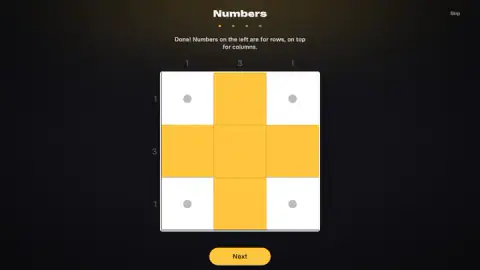
Nonogram has three hearts too, and its Easy board is ten squares a side. Grid Odyssey: Nonograms opens with the very same 1 3 1 cross and spends its stars on hints. Catdoku Sudoku Puzzle keeps the logic and drops the numbers, with cats in coloured regions. There are more in our puzzle games.
Screenshots
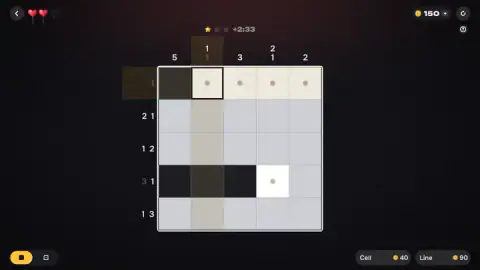
Taken by opening the game ourselves and letting it run — not supplied by the publisher, and not the same picture every other site shows.
How to play Nonograph
- Read a clue. A "3" means three filled squares together. "2 2" means two squares, a gap, then two more.
- Fill squares. Click one, or hold the button and drag along the line.
- Mark what must be empty. The switch at the bottom left changes to marking, which turns a square white with a grey dot.
- Watch the numbers. Each one dims when its block is done.
- Clear the board. The later stops on the chapter map stayed padlocked for our whole run.
Tips from our run:
- Look at the switch before you touch the grid. It stays where you left it, and all three of our first hearts went while it was on mark.
- Use the dimmed numbers. In a column reading 1 1, only the lower 1 dimmed when we had the lower square. The game is telling you which block you placed, a help you do not get on paper.
- Let finished lines finish themselves. When we filled the only square of a row with clue 1, the other four took their dots untouched.
- Drag in a straight line. A drag is no safer than a click. One of ours wandered across a square that should have stayed empty, and it cost a heart.
Controls
| Left click on a square | Fills it, or marks it white if the switch is on mark |
|---|---|
| Hold and drag along a line | Applies the same action to each square you cross |
| Switch at the bottom left | Changes between filling squares and marking them empty, and stays where you leave it |
| Right click | Marks a square empty, according to the listing's controls list; we used the switch instead |
| Esc | Returns to the chapter map without resetting a live board |
| Round arrow at the top right | Opens "Start over?", which resets the board and the timer |
| Tap and drag on touch screens | Fill a square and paint a line, according to the listing's controls list; we did not try touch |
Features
- Three hearts per board, and each wrong square is corrected by the game as it takes the heart
- A 35-second clock on the first board that costs a star when it runs out but does not end the attempt
- Clue numbers dim one at a time, so a column of 1 1 tells you which of the two you have just placed
- A line with its last block filled gets dots on all its other squares by itself
- A chapter map of 20 boards with a star bar out of 60, starting with a chapter called Animals
- Paid helpers named Cell and Line, at 40 and 90 coins, with 150 coins in the counter when we arrived
Game details
- Developer
- BigMag Games
- Release date
- October 2026
- Last updated
- October 30, 2026
- Added here
- October 2026
- Technology
- HTML5
- Platforms
- Browser (desktop, mouse), Browser (mobile & tablet, touch, landscape or portrait)
- Saved progress
- Saving, when available, is managed by this game. Mava cannot confirm your level.
FAQ
How do you play Nonograph?
Nonograph is a nonogram, a logic grid where the numbers beside each row and above each column say how many filled squares sit side by side, in order. You fill squares by clicking or by dragging along a line, and you can mark the ones you know are empty. A short tutorial teaches this on a three-by-three cross and then on a five-by-five board.
What happens when you make a mistake in Nonograph?
A wrong square costs one of your three hearts, and the game then shows you the correct state of that square. The tutorial warns about it with the line that in levels a mistake costs a heart. The same applies to marking: we lost hearts for marking squares that should have been filled.
How do you get three stars in Nonograph?
As far as our boards showed, you need no mistakes and you need to beat the clock, which starts at 35 seconds on the first board. Our display dropped to two stars after either one and to one star after both. The game did not spell this rule out on any screen we saw, so treat it as our reading of the display.
Does the timer end the level in Nonograph?
No, not on the board we played. When the countdown reaches zero it starts counting up with a plus sign, and you lose a star. We reached more than two and a half minutes past zero and the board stayed open.
What do I do on the Out of lives screen in Nonograph?
You can pay 60 coins for one more life, press a second Continue with a play icon that looks like a video reward, press Retry, or go back to the chapter. We pressed Esc, went to the map and pressed Play, which gave us a clean board, full hearts and a new clock with our coins untouched. If you are near the start of the board, there is little reason to pay.
How many puzzles does Nonograph have?
The game's listing gives 300 puzzles across 15 chapters, with grids up to 15 by 15 and a daily puzzle. What we saw fits that sum: the first chapter, Animals, has a counter out of 20. We only played its first board, so we cannot vouch for the larger grids.
Who made Nonograph?
It is by BigMag Games. It was published on 28 October 2026. When we checked, so that number does not tell you much yet.
Can you play Nonograph on a phone?
It is listed for Android and iOS as well as PC, in landscape and portrait. Its controls list says you tap to fill and drag to paint a line, with the fill or mark switch at the bottom of the screen. We played with a mouse and did not try it by touch.