

About NumMerge Clash
Most number puzzles since 2048 work the same way. You push the whole board in one direction, two equal tiles bump into each other, and the number doubles. NumMerge Clash keeps the numbers and throws out the rest. Nothing slides. You tap one card, every matching card touching it is pulled in, and the values are added, not doubled.
That small change matters more than it looks. A 3 that swallows another 3 becomes a 6, and there may be no other 6 on the board for a long time. Every merge makes a number that is a bit harder to pair, so the puzzle is not how to merge, which is easy, but how to avoid leaving the board full of loners.
The game is by Glazicblr and was published in September 2026. We played one four-minute sitting: the tutorial, four merges and a lot of time spent learning what the game does not let you do.
The queue shows eight cards, and one of them is a question mark
Above the board runs a strip of small cards. That is everything that is going to fall in, in order. When we merged the bottom card of the second column into its neighbour, everything above it in that column dropped one row and a new card appeared at the very top. The front card of the strip had gone, and a new one had been added at the far end.
It means you can see the future, mostly. Before a merge you can check which number will land in that column and whether it will sit next to something it matches. One card breaks the rule. A card with a question mark sat in the queue from the start, and its number stayed hidden until it fell. Ours turned out to be a 2.
The strip is also where you can cheat a little. A tutorial card explains that unlocked cards can be bought to the front of the queue, through a green button with a plus sign next to it. That costs coins. Our coin counter stayed at zero for the whole sitting, so we did not buy anything and cannot tell you what the collection holds.
Ten merges buy one swap
Under the board sits an energy bar marked out of 20, with three buttons. Two arrows in a circle are the swap, a purple bomb is the destroy, and both cost 10. The third button, a plus with a lightning bolt, is for buying more energy.
We watched the bar climb one step for every merge, from empty to four after our four merges. So the rate is simple. Ten merges earn you one rescue move, and a full bar holds enough for two.
That changes how the early game should feel. Energy is the only thing that saves you when the board locks up, and the board locks up later, when the numbers are big and scattered. The easy merges at the start are where you fill the bar. We never got to 10, so we cannot say how the swap and the bomb feel in use; the game's description says the swap trades two neighbouring cards and the bomb removes the one you pick.
Why adding is harder than doubling
In 2048 every number on the board is a power of two, so any tile has a family of others it can one day meet. NumMerge Clash has no such family. Values add, so after a few moves the small starting cards share the board with odd-sized numbers that have no partner yet.
You can see it in our own board. The first merge, guided by the tutorial, turned a 3 into a 6. Three moves later that card was still sitting in the middle row with nothing of the same value anywhere on the board. It was not in the way yet, but it was a card we could no longer use.
The game's help card shows the bigger version of the idea. On its small example grid, the centre 2 has a matching 2 on its left and another below it, and the text says the card increases by the sum of everything it takes in. Tapping it would pull in both. Bigger merges clear more space, but they also make larger, odder numbers. The skill is choosing between a small merge now and a large one that leaves a 9 nobody else can match.
The score follows the same arithmetic. The crown counter at the top went up by the value each merge pulled in: three for the first, then two, then two again, for a total of 7 after three merges. An hourglass beside it counted our moves.
Achievements that ask for an exact score
The game's achievement list opens with a group called Perfect Hit: score the exact number of points, no more, no less. The entries are locked and hidden behind question marks, but their names show. One is "9+10=?", one is simply "67", and the third is "If you know what I mean".
Anyone who has been near a school playground lately will recognise the first two as running internet jokes. Read as a puzzle, they hint at the target: land the score on a particular number. Because every merge adds a known amount to the crown counter, you can steer towards it, as long as you watch the total rather than just merging whatever is closest. We did not unlock any, so we cannot confirm the exact targets.
Who it is for
It suits players who like slow, calculated puzzles with a bit of arithmetic in them. There is no clock on the screen and no reflex test. Children who can add small numbers can follow it from the first move, and the help card is clear about the rule.
It is not a sliding 2048 game, and it is not a match-3 where combos fall from the sky. Each move is one tap and one decision. Be aware that coins, a shop and bought energy are part of the design, even if we never needed them in a short sitting.
More number merging
Number Click Merge is the closest relative, with the same tap-to-merge idea on a grid of numbers. Drop & Merge 2048 and Merge 2048 go back to doubling, with cubes and blocks you drop into place. The rest are in our puzzle games.
Screenshots
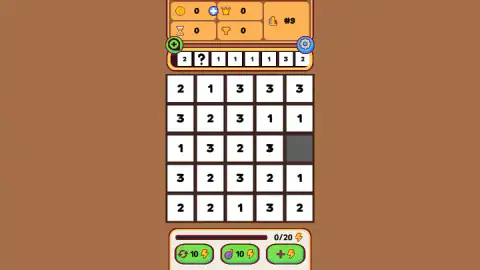
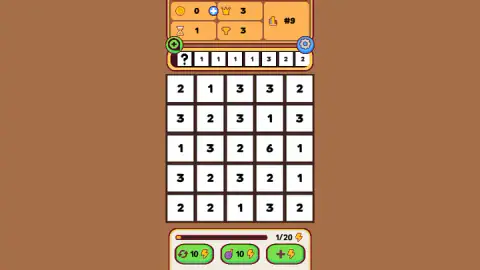
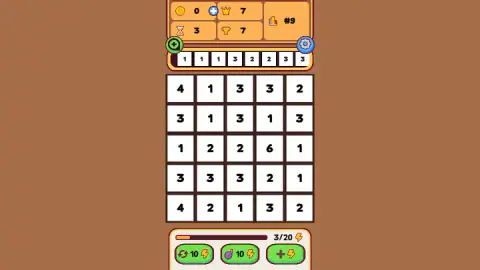
Taken by opening the game ourselves and letting it run — not supplied by the publisher, and not the same picture every other site shows.
How to play NumMerge Clash
- Look for two cards with the same number touching side by side or one above the other. Diagonals do not count.
- Click or tap one of them. Its matching neighbours merge into it and its number goes up by their total.
- The merged cards leave the board. The cards above them drop down, and the first card of the queue at the top falls into the gap.
- Keep going for as long as there is a move. The game's description says it ends when nothing on the board can merge and you lack the energy for a swap or a bomb.
Tips from our run
- Choose which card you tap. The tapped card is the one that grows and stays where it is, so tap the card in the spot where you want the bigger number to live.
- Do not drag. We tried to pull cards towards each other several times and nothing moved. Holding a card down opens its information sheet instead, which is useful once and a nuisance after that.
- Read the queue before each move. It shows the next eight cards, and the one at the front decides what lands in the column you just emptied.
- The first board holds only 1s, 2s and 3s. That is when merges are cheap, so use them to build energy before the numbers spread out.
Controls
| Click or tap a card | Pulls every matching card beside it (left, right, above, below) into it and adds their values |
|---|---|
| Press and hold a card | Opens the card's information sheet |
| Swap button (circular arrows, 10 energy) | The game's description says it swaps two cards that sit side by side; we did not use it |
| Bomb button (10 energy) | The game's description says it removes the card you pick; we did not use it |
| Green + button by the queue | Opens the card collection, where unlocked cards can be bought to the front of the queue |
Features
- A 5x5 board of numbered cards that starts with nothing higher than 3
- Merges add, they do not double: a 3 that takes in one 3 becomes a 6
- A queue of eight upcoming cards on show above the board, one of them a question mark
- When a card is merged away, the column above drops and the front of the queue falls in at the top
- One point of energy per merge, up to 20; a swap or a bomb costs 10
- Achievements for finishing on an exact score, with joke names such as "9+10=?"
- By Glazicblr
Game details
- Developer
- Glazicblr
- Release date
- September 2026
- Added here
- August 2026
- Technology
- HTML5 (2D)
- Platforms
- Browser (desktop, mouse), Browser (mobile & tablet, touch)
- Classification
- Puzzle
- Saved progress
- Saving, when available, is managed by this game. Mava cannot confirm your level.
FAQ
How do you play NumMerge Clash?
You tap a numbered card on a 5x5 board. Every card next to it with the same number, to the left, right, above or below, merges into it, and the tapped card's value goes up by their total. The merged cards leave the board, the cards above slide down and a new card falls in from the queue at the top.
How does merging work in NumMerge Clash?
The values add up instead of doubling. When we tapped a 3 with one 3 beside it, it became a 6. The game's own help card says the tapped card grows by the sum of every matching neighbour, so a card with two matching neighbours takes in both at once.
How do you get energy in NumMerge Clash?
In our game every merge added one point of energy, on a bar that holds 20. The swap and the bomb each cost 10, so you earn one rescue move for every ten merges. The game also lets you buy energy with coins.
What is the question mark card in NumMerge Clash?
It is a card in the queue whose number you cannot see in advance. In our game it was revealed as a 2 when it dropped onto the board. Every other card in the queue shows its number, so it is the one surprise you cannot plan around.
When does NumMerge Clash end?
According to the game's description, the game ends when no card on the board has a matching neighbour and you do not have enough energy for a swap or a bomb. We did not reach that point in our sitting, so we cannot say what the end screen shows.
What are the 9+10 and 67 achievements in NumMerge Clash?
They are hidden achievements in a group called Perfect Hit, which asks you to score an exact number of points, no more and no less. The names are internet jokes. We did not unlock any, so we cannot confirm which scores they ask for.
Who made NumMerge Clash?
NumMerge Clash is by Glazicblr and has been available since September 2026.
Can you play NumMerge Clash on a phone?
Yes. It is listed for mobile and the board is a portrait column, the shape of a phone screen. The game's description says you tap cards with your finger and hold a card to read about it. We played with a mouse and did not test touch.