






About Merge Combo
Most merge puzzles pay you for the size of what you build. Merge Combo, in the part we played, pays for the order in which you build it. A move that ended in a four, reached as the second step of a chain, earned us 11 points. A move that ended in a five, the bigger block, made with one plain merge, earned less than half of that.
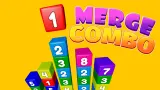
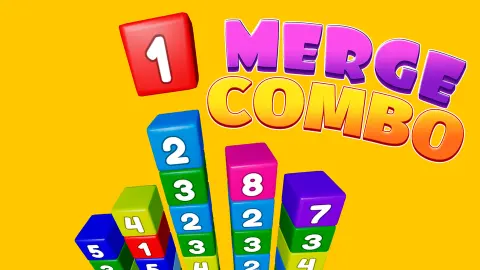
The board could not be simpler. Five columns of numbered cubes stand on a wooden floor, eight cubes to a column. You lift the cube at the top of one column and set it down on another. Two cubes with the same number become one cube with the next number up. If that new cube is now resting on its own match, they merge too, and so on down the column.
It is by FOVapps and was published in November 2024.
We should say how much we saw. We played for about four minutes, landed ten moves, took the counter from 0 to 74 and made two fives. We stayed on level 1 with the bar about half full. This page tells you what those ten moves showed and marks the rest as untested.
The combo pays the second merge double
The counter in the top right corner is the only score on screen, and the game never explains it. Ours moved seven times, and all seven fit one pattern: each merge pays the number on the new cube, multiplied by its place in the chain.
- A single merge that made a five paid 5. That happened twice.
- A two-step chain, a three and then a four, paid 11: three for the first merge, and the four counted twice. That happened four times.
- A three-step chain paid 20: a two, then a three counted twice, then a four counted three times.
Add those seven moves and you get 74, which is exactly where our counter stopped. Treat it as our reading of seven moves and not as a published rule. Longer chains may behave differently, and we never made one.
The consequence is easy to state. A big cube made the plain way is cheap. The points are in the staircase: a column whose top cubes climb by one as you go down, waiting for a single cube to set the whole run off.
Why a one dropped on one, two, three becomes a four
Our best move looked like nothing. One column had a one on top, a two under it and a three under that. We dropped a single one on it. The two ones became a two, which met the two and became a three, which met the three and became a four. Four cubes went in and one came out.
That is counting in binary, the number system with only two digits. In binary, two of anything cannot stay in one place: one plus one leaves a zero and passes a one along to the next place. Schoolbooks call it a carry. When the next place is already full, the carry moves on again, so a run of ones with one more added turns into a single one followed by zeros.
The cubes do the same thing. Each number is worth two of the number below it, so a two is two ones, a three is four ones and a four is eight. A staircase of one, two and three is a run of full places. One more cube, and the carry runs to the bottom of the staircase.
It also gives you a way to read the whole board. The opening layout we were given had only ones, twos and threes, and together they were worth 87 ones. No new cubes arrived while we played, and the worth of the board never changed: merging only repacks it. If nothing more is dealt, 87 can be packed into a seven at best, with a few small cubes left over. We stopped at five, so that ceiling is arithmetic and not something we reached.
What the screen shows and what we left untouched
Under a small 1 in the top left corner there is a bar. It filled as the counter rose and stood at about half when we stopped. Our estimate is that it fills somewhere near 145 points and that the small number is the level. We did not get there, so we cannot say what the next level changes, or whether new cubes arrive with it.
Above the counter sits a button reading +200 beside a film icon. By its look it offers 200 points for watching an advert. We did not press it. With a full bar apparently worth less than that, it would likely skip most of a level, but that is a guess from the numbers on screen.
We never opened the gear in the top left corner. We saw no clock, no move limit and no way to lose. We ended with two fives on top of neighbouring columns and did not make the six. We did not test a phone.
Who it suits
Players who like to stop and count. Nothing moves until you move it, and the interesting question each turn is not where a merge is available but which merge leaves a staircase behind it. If you want falling pieces, pressure or an opponent, this is not that game: what we saw was one still board and a number going up.
More number puzzles to merge
Binary Drop teaches the same counting in twos openly, with lights instead of cubes. NumMerge Clash merges a card with every matching neighbour at one tap, and Merge Mania sets numbers against each other with a clock running. For merging with gravity instead of arithmetic, Fruit Fusion drops fruit into a box. The rest are under puzzle games.
Screenshots
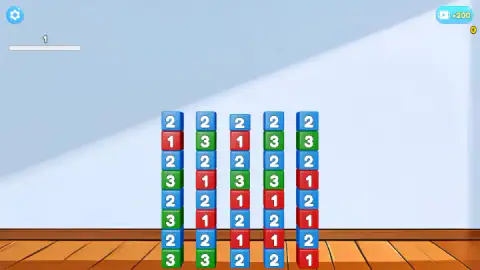
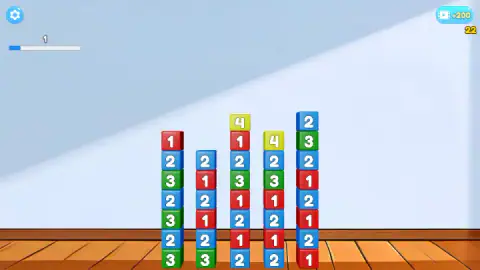
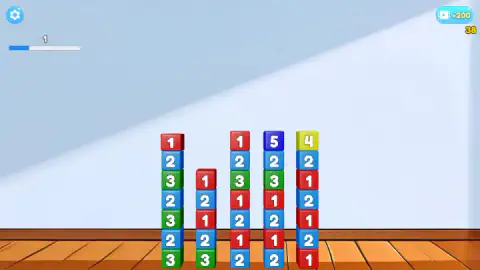
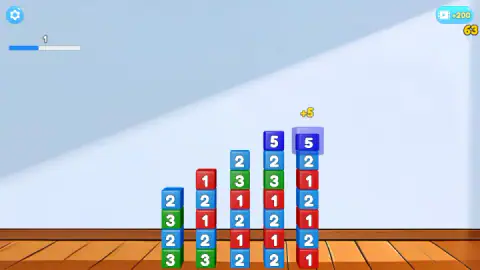
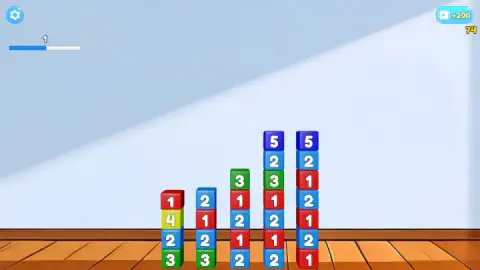
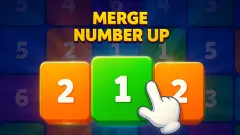
Taken by opening the game ourselves and letting it run — not supplied by the publisher, and not the same picture every other site shows.
How to play Merge Combo
- There is no menu. The board is the first thing on screen, and the first drag is the first move.
- Drag the top cube of any column and release it over another column. It does not have to be the one next door: we carried a two across two columns and it merged where it landed.
- Match the number underneath. Two ones make a two, two twos make a three, two threes make a four. The new cube stays on the column where you dropped.
- Watch what the new cube lands on. If it matches the cube below, they merge by themselves. That is the combo of the title.
- Use a mismatch on purpose. A cube dropped on a different number just sits there. It scores nothing, but it is how you move a cube out of the way.
What our ten moves taught us:
- Click does nothing, drag does. We clicked cubes several times before noticing nothing happened. The game only answers to a drag.
- Start from the top. Every move that worked lifted the cube at the top of a column. Read each column as a stack: you can only reach what is under a cube by moving that cube first.
- Look two cubes down before you drop. A two dropped on a two is a small move. A two dropped on a two that sits on a three is a chain, and it paid us nearly four times as much.
- Parking is free. Three of our ten moves put a cube on the wrong number just to uncover the one beneath. Nothing was lost by it.
Controls
| Drag the top block of a column onto another column | If the block it lands on has the same number, the two become one block a number higher |
|---|---|
| Drop on a different number | The block simply sits on top of that column; no points |
| Single click on a block | Nothing happened in our run; the game wants a drag |
| Gear (top left) | Settings by its icon; we did not open it |
| +200 button with a film icon (top right) | Not pressed by us; by its icon, an optional advert in exchange for 200 points |
Features
- Five columns of eight numbered blocks, 40 in all, and only ones, twos and threes at the start
- Two equal blocks make one block a number higher, and it merges again if it lands on its match
- Chains pay more at every step, as far as our seven scoring moves show
- Any top block can travel to any column, next door or not
- No clock and no move counter on screen
- A level bar that was about half full after four minutes
- Made by FOVapps
Game details
- Developer
- FOVapps
- Release date
- November 2024
- Last updated
- August 10, 2026
- Added here
- March 2025
- Technology
- HTML5 (Cocos)
- Platforms
- Browser (desktop, mouse), Browser (mobile & tablet)
- Classification
- Puzzle
- Saved progress
- Saving, when available, is managed by this game. Mava cannot confirm your level.
FAQ
How do you play Merge Combo?
Drag the block at the top of one column and drop it on another column. If the block it lands on shows the same number, the two fuse into one block a number higher, and if that new block now sits on its own match it fuses again. A block dropped on a different number just stays there. There is no clock.
How does scoring work in Merge Combo?
In our run every merge paid the number on the new block, multiplied by its place in the chain. Making a 5 on its own paid 5. Making a 3 that fell onto another 3 and became a 4 paid 3 plus 8, which is 11. That pattern fitted all seven of our scoring moves, but it is our reading of the counter, not a rule the game states.
What is a combo in Merge Combo?
A combo is a chain: one drag that sets off several merges down the same column. Our longest was three merges from a single block, a 1 dropped on a column whose top three blocks read 1, 2, 3. It turned into a 4 and paid 20 points, almost twice what a two-step chain gave us.
What is the highest number you can make in Merge Combo?
We reached 5, twice, and stopped with those two 5s sitting on top of neighbouring columns, so a 6 was one drag away. No new blocks arrived during our session. If that holds for the whole level, the 40 starting blocks add up to a single 7 at most, with a few smaller blocks left over. That is arithmetic on the opening board, not something we played out.
Can you lose in Merge Combo?
We did not see a way to lose. Nothing fell from above in our four minutes, the columns only got shorter, and there was no clock or move limit on screen. We did not fill the level bar or run out of moves, so we cannot say what happens at either point.
Who made Merge Combo?
Merge Combo is by FOVapps. It was published in November 2024 and was last updated in August 2026.
Can you play Merge Combo on a phone?
It is listed for PC, Android and iOS, in landscape and portrait, and the only gesture is a drag. We played on a computer with the mouse in a wide window. We did not test a phone ourselves.