
About 2048 Merge Blocks
The number in the name comes from a game where you never touch a tile. In the original 2048 you push the whole board in one direction and hope the right pair collides. 2048 Merge Blocks removes the pushing. You point at a tile, and if it has equal neighbours, they all fold into it.
That sounds like a simpler game, and for the first few taps it is. The catch is in how the new number is worked out. Two equal tiles double, as you would expect. Three do not make three times the value. They make four times. Seven made sixteen times in our run. So the question on every move is not "what can I merge?" but "should I wait until this group is bigger?"
The game is by Good Games. This one was published in February 2026.
We should say how far we got. We played for about four minutes and took the score from 832 to 1,232. We did not reach the target tile. Everything below comes from the merges we made and from reading the board between them.
The size of the group sets the multiplier
This is the rule the game never spells out on screen, and the one worth learning first. We worked it out by comparing the board before and after each merge.
| Tiles in the group | What we merged | What we got | Multiplier |
|---|---|---|---|
| 2 | two 32s, and later two 64s | 64, then 128 | double |
| 3 | three 4s, and three 16s | 16, then 64 | four times |
| 5 | five 4s | 32 | eight times |
| 7 | seven 2s | 32 | sixteen times |
We never merged a group of four or six. The game's own instructions put four tiles in the same bracket as three, and six in the same bracket as five. If that holds, the fourth and the sixth tile add nothing, and you would do better to leave them on the board for another group.
A pair creates nothing new: two 32s are worth 64 before and after. A big group does.
Seven 2s add up to 14, and the game handed us a 32 for them. That is why low tiles are not clutter here. A sprawl of small tiles across the bottom rows is the cheapest way to make a mid-sized one out of thin air.
The score follows the same logic. In all seven of our merges, the points added were exactly the value of the tile created. Our best move was the last one, two 64s into a 128, worth 128 points on its own.
New tiles are not always small
In the sliding original, the tile that appears after a move is a 2 or, now and then, a 4. Here the refill is far less predictable. Most of the tiles that dropped in for us were low, but we watched a 64 arrive at the top of a column more than once.
That changes how you plan. Our 128 came about because a fresh 64 landed directly on top of another 64 that had dropped in earlier. We built neither of them and had not set it up. So merges near the top of a column are worth a second look after every fall, and a board that looks stuck may not stay stuck.
The 512 that never moved
Our session opened straight onto a full board showing 832 points, with a 256 and a 512 already sitting in the middle column. We saw no menu before it. Those two tiles were still there, untouched, when we stopped.
That is the hard part of this game. Small tiles pair up constantly because there are many of them. A 512 needs another 512 beside it, and nothing we built came close.
On paper, the multiplier offers a shortcut: three 512s touching would make the target in one tap, and so would five 256s. We have to be clear that this is arithmetic from the table above, not something we played.
Where the name comes from
The original 2048 was released on 9 March 2014 by Gabriele Cirulli, an Italian web developer who built it over a weekend. It is played on a 4 by 4 grid. You slide every tile at once, two equal tiles that collide become one tile of double value, and the goal is the tile the game is named after. Cirulli published the code under a free licence, which is one reason so many games carry the number in their name. 2048 Merge Blocks is one of those, with no link to him.
Knowing the original helps you see what this game changed. There, every step up is one pair at a time, and the skill is keeping the board tidy while you slide. Here the board is always full, tidiness means nothing, and the multiplier lets you skip steps. A handful of 2s becomes a 32 in one tap, a climb that takes fifteen separate merges by doubling alone.
Helpers, coins and the ad offer
Four buttons sit under the board: a light bulb, a curved arrow, a hammer and a pair of crossed arrows. Each is marked 50. The game's instructions name three of them as undo, hammer (remove one tile) and shuffle. The bulb is not explained there; a hint is our guess.
We started with no coins and finished with none, so we used no helper. When we tapped one anyway, a card offered an optional rewarded ad for 100 coins, enough for two uses. It has a "No Thanks" button, and the board is as you left it when you close it.
A trophy in the top corner carries a rank number. Ours started near 894,000 and climbed about 48,000 places in those 400 points, with a "Rank Up" banner on the way. We did not open the trophy.
What we did not see
The game's description mentions levels, a daily challenge and an endless mode. We saw none of them offered, and no screen to choose between them. We did not see the win screen, a game over or what happens when no group is left. We did not test a phone, although the game is listed for Android and iOS as well as computers.
Who it suits
Players who like to stare at a board and count. There is no timer and no reflex test, and each move is one tap. If you enjoy the sliding original for its tight, tidy endgames, this is a looser game: more luck in the refill, more reward for patience with big groups. If you want a quick result, the first 128 comes fast. The 2048 does not.
More number puzzles
Block Blast 2048 is the closest relative in our catalogue, another tap-to-merge board of the same size with its own goal. NumMerge Clash pulls matching neighbours into a card and adds them up on a smaller grid. Merge 2048 drops numbered tiles into a jar and lets gravity do the matching. For the powers of two themselves, Binary Drop teaches how 1, 2, 4 and 8 build every other number. The rest are under puzzle games.
Screenshots
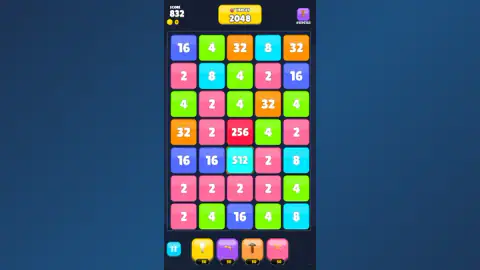
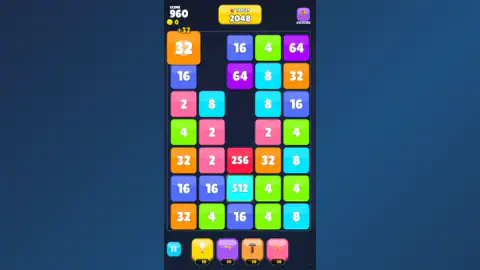
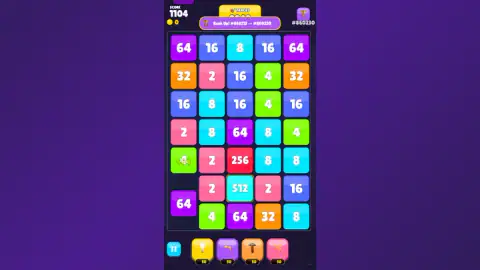
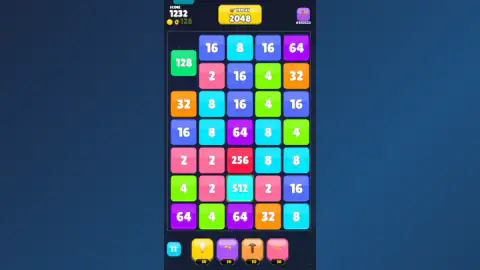
Taken by opening the game ourselves and letting it run — not supplied by the publisher, and not the same picture every other site shows.
How to play 2048 Merge Blocks
- Find a group. Look for two or more tiles with the same number that touch. Sides count, and so do corners.
- Tap one tile of the group. The whole group collapses into a single bigger tile, and it appears on the square you tapped.
- Watch the fall. Tiles above the gaps drop down, the new tile drops with them, and fresh tiles come in from the top until the board is full again.
- Repeat towards the target. A yellow panel above the board reads TARGET 2048.
What our session taught us:
- Where you tap matters. The merged tile is born on the square you tap. Tap the member of the group that sits next to the number you want to build towards.
- One tap was enough for us. The game's own instructions describe a first tap to highlight a group and a second to merge it. In our run each merge followed a single tap.
- A lone tile is dead weight. We tapped the 512 again and again before accepting it. With no equal neighbour, nothing happens and the score does not move.
- It is a pointer game. The arrow keys got no response from the board. There is nothing to slide.
- Nothing rushes you. We saw no clock and no move counter on screen.
Controls
| Click or tap a tile | Merges it with every equal tile connected to it, diagonals included; the new tile appears where you tapped |
|---|---|
| Click or tap a tile with no equal neighbour | Nothing happens |
| Light bulb, curved arrow, hammer, crossed arrows (bottom row) | Four helpers at 50 coins each; we had no coins and used none |
| Blue pause button (bottom left) | Pause; we did not open it |
| Trophy (top right) | Shows your rank number underneath; we did not open it |
Features
- A board of 5 columns and 7 rows, always full, with a 2048 target shown above it
- Tap-to-merge groups that connect sideways, up and down and diagonally
- A multiplier that grows with the group, from double for a pair to sixteen times for seven tiles in our run
- New tiles that fall in from the top, and not only small ones; we saw a 64 arrive
- Four helpers priced at 50 coins each, with an optional rewarded ad worth 100 coins
- A rank number under a trophy that climbs as you score
- Made by Good Games
Game details
- Developer
- Good Games
- Release date
- February 2026
- Last updated
- June 26, 2026
- Added here
- December 2025
- Technology
- HTML5 (2D)
- Platforms
- Browser (desktop, mouse), Browser (mobile & tablet)
- Classification
- Puzzle
- Saved progress
- Saving, when available, is managed by this game. Mava cannot confirm your level.
FAQ
How do you play 2048 Merge Blocks?
Tap a numbered tile that touches at least one tile of the same value. The whole connected group, diagonals included, collapses into one bigger tile where you tapped, the tiles above fall and new ones drop in from the top. The target shown above the board is a 2048 tile. A tile with no equal neighbour does nothing when tapped.
How is 2048 Merge Blocks different from the original 2048?
The original 2048 is a sliding game on a 4 by 4 grid where two equal tiles make one tile of double value. 2048 Merge Blocks has no sliding at all. You tap groups on a 5 by 7 board, and a larger group multiplies the number further: in our run a pair doubled, three tiles gave four times the value and seven gave sixteen times.
Do diagonal tiles connect in 2048 Merge Blocks?
Yes. Two of our merges only worked because of diagonal links, including a group of seven 2s that became a 32. When you scan the board for groups, check the corners of each tile as well as its sides.
How does scoring work in 2048 Merge Blocks?
In our session every merge added the value of the tile it created. A merge that made a 32 added 32 points and one that made a 128 added 128. We went from 832 to 1,232 points in seven merges.
Who made 2048 Merge Blocks?
The game is by Good Games. It was published in February 2026 and last updated in June 2026. It is not connected to Gabriele Cirulli, who made the original 2048.
Is 2048 Merge Blocks free, and does it have ads?
It is free in the browser with no download and no account. The four helpers cost 50 coins each, and when we tapped one with no coins the game offered an optional rewarded ad worth 100 coins. You can close that offer and keep playing without it.
Did you reach the 2048 tile?
No. We played for about four minutes, made seven merges and the highest tile we built ourselves was a 128. The board we were given already held a 512 and a 256, and neither found a partner while we played. We never saw the win screen or a game over.