











About Binary Drop
Most maths games for the browser are flash cards with a timer: a sum appears, you pick an answer, the next sum appears. Binary Drop asks for something different. It never shows you the word binary in the play area. It shows you a row of lights, tells you what each light is worth, and lets you work out the rest.
The first level has three columns, worth 4, 2 and 1. Some rows hand you a number and ask you to build it from lights. Others hand you lit lights and ask for the number. Do both enough times and you are reading and writing binary numbers without having been told how.
The game is by Samir Ahmane, and it was published in September 2026. We played about four minutes of level 1 and cleared a handful of its rows. This page sticks to what we saw.
Lime rows ask for a number, violet rows give you one
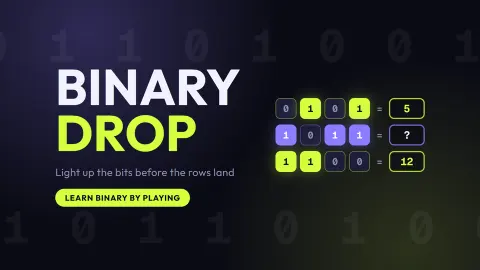
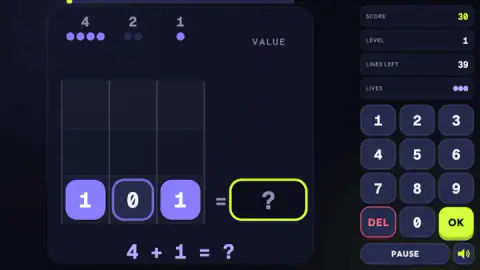
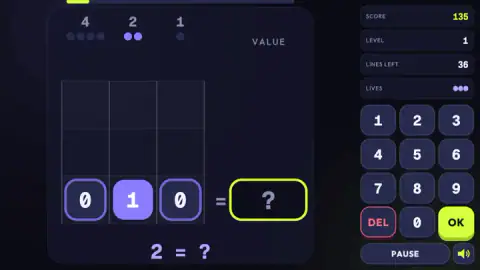
The two colours are two directions of the same skill. A lime row is decimal to binary: the game says 3, and you find that the 2 and the 1 make it. A violet row is binary to decimal: the game shows 1 0 1, writes 4 + 1 = ? under it, and you type 5.
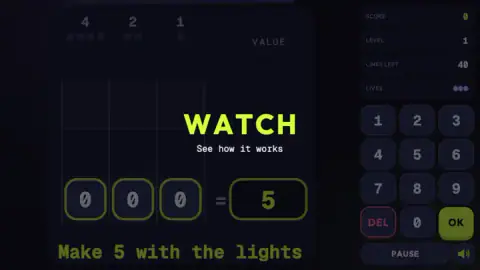
The opening demonstration does a lime row for you. A card says "WATCH, see how it works", the target is 5, and the game lights the answer itself. When it finished, our score read 30 and the line counter had gone from 40 to 39, so even the demonstration row counts.
In our run, neither colour needed the OK button. The violet row cleared as soon as we typed the 5. The lime rows cleared the moment the right lights were on. OK and DEL are there for longer numbers and slips of the finger.
The minute we lost on the numbers at the top
Our second row took far longer than it should have. The target was 3, and we kept clicking the large 2 and 1 at the top of the board, expecting them to switch the columns on. Nothing happened.
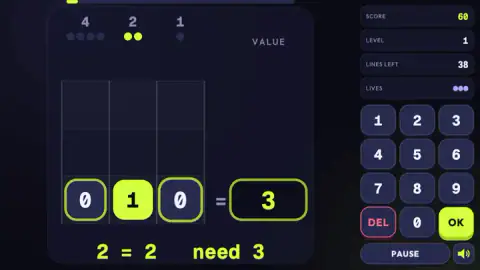
The switches are the three boxes in the answer row. Once we tapped the middle box it turned to 1, the two dots under the 2 lit up, and the line below read "2 = 2, need 3". Tapping the right-hand box finished the row on the spot. That row took us about a minute, most of it spent on the wrong buttons, so the first tip above is the one we wish we had read first.
Why every number has exactly one answer
The column values are not chosen at random. Each one is double the one to its right, 1, 2, 4, and the next would be 8. These are the powers of two, and they have a property that makes this puzzle fair: every whole number can be made from them in only one way, using each at most once.
That is the whole idea of binary, the number system computers use, where every digit is either on or off. The German mathematician Gottfried Wilhelm Leibniz set it out in a paper to the Paris Academy of Sciences in 1703, showing that any number can be written with nothing but 0s and 1s. In Binary Drop, a lit box is a 1 and a dark box is a 0, so a row is a binary number you can see.
For you as a player, this means a lime row never has two right answers. If your lights add up to the target, you have found the only combination. It also explains the "biggest first" tip: with values that double, taking the largest one that fits never leads you wrong. With three columns, the largest number you can make is 7, with every light on.
What the score and counters tell you
The panel on the right holds four counters: score, level, lines left and lives. Lives are shown as three dots, and we never lost one in level 1, where rows wait at the bottom of the board and nothing falls.
The score rose by 30 for each of our first two rows, then by 35, then by 40. The game's own instructions mention streaks, so we read the growing reward as a bonus for solving rows in a row without a slip, but we did not break a streak to check. A thin bar at the top of the board grows as the lines-left counter comes down.
The pause card shows your level, your score and the word NORMAL, with buttons to resume, turn sound effects off or restart. We did not see a setting to change NORMAL, so we cannot say what other modes exist.
What we did not reach
We played only inside level 1. The game's instructions say rows start to fall from level 3, like blocks in a falling-blocks game, that a row reaching the bottom costs a life, and that each level adds more lights and more speed. A fourth light would be worth 8 and push the largest number to 15. We have not seen any of that ourselves, so treat it as the game's promise, not our report.
Who is it for? Level 1 is calm enough for a child who can add small numbers, and the rows we saw had targets no higher than 5. Anyone who has always wondered how computers count will get the idea in a few rows. If you already read binary fluently, the interest will be in the later, falling levels.
More number puzzles to try
The powers of two return in Merge 2048, where every tile you join doubles, the same 2, 4, 8 that run along the top of this board. For quick sums against the clock, Correct Math gives you three seconds per question, and Brain Buster: Multiplayer Math Puzzle Game turns mental arithmetic into a duel. The rest are in our puzzle games.
Screenshots
Taken by opening the game ourselves and letting it run — not supplied by the publisher, and not the same picture every other site shows.
How to play Binary Drop
- Look at the top of the board. Each column has a value, 4, 2 and 1 in level 1, with that many dots under it.
- Look at the row at the bottom. It has one box per column, each showing 0 or 1, then an equals sign and a target box.
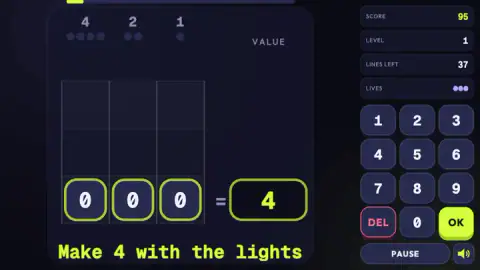
- On a lime row, the target shows a number and the line below says "Make 3 with the lights". Tap boxes in the row to switch lights on until they add up to it.
- On a violet row, the lights are already set and the target shows a question mark. Add up the lit columns and type the total on the keypad.
- A correct row clears and the next one appears. Clear 40 rows to finish the level.
Tips from our games
- Tap the boxes in the row, not the numbers above the columns. The numbers at the top of each column are labels, not switches.
- Watch the line under the board. With only the 2 switched on and a target of 3, it read "2 = 2, need 3", which tells you exactly what is missing.
- Start with the biggest column that fits. For 5, the 4 fits, leaving 1; for 3, the 4 is too big, so take the 2 and then the 1.
- On a violet row, glance at the dots. The lit dots under each column count out its value, so you can add them even without the numbers.
Controls
| Click or tap a box in the answer row | Switches that light on or off (0 becomes 1 and back) |
|---|---|
| On-screen keypad (0-9, DEL) | Types or deletes the total on a violet row |
| OK | Confirms an answer; in our games the right answer was accepted before we needed it |
| PAUSE | Opens the pause card with Resume, Sound effects and Restart |
Features
- Every row is a short binary number made of lights, and each column is worth a fixed amount shown above it
- Lime rows give you a target and ask you to switch on lights that add up to it
- Violet rows come already lit and ask you to type what they add up to
- Little dots under each column value show its worth at a glance, and they light up when that column is on
- A line under the board tells you how far off you are, such as "2 = 2, need 3"
- Level 1 uses three lights worth 4, 2 and 1, has 40 rows to clear and gives you three lives
- The game starts with a demonstration row that plays itself before handing you control
Game details
- Developer
- Samir Ahmane
- Release date
- September 2026
- Last updated
- September 23, 2026
- Added here
- September 2026
- Technology
- HTML5 (2D)
- Platforms
- Browser (desktop, mouse), Browser (mobile & tablet, touch)
- Saved progress
- Saving, when available, is managed by this game. Mava cannot confirm your level.
FAQ
How do you play Binary Drop?
Each row on the board is a set of lights, and every column is worth a number shown at the top, 4, 2 and 1 in the first level. On a lime row you switch on lights until they add up to the target. On a violet row the lights are already set and you type their total on the keypad.
How do you turn on a light in Binary Drop?
Tap the box in the answer row itself, the one showing 0 under the column you want. It turns into a 1 and the dots under that column's value light up. Tapping the big numbers at the top of the columns does nothing, which cost us about a minute on our second row.
Do you need to press OK in Binary Drop?
In our games, no. A lime row cleared the moment the right lights were on, and a violet row cleared as soon as we typed the right digit. The OK button is there, but the game checked our answers before we reached for it.
How does Binary Drop teach binary numbers?
Each row is a binary number written as lights, where a lit box is a 1 and a dark box is a 0. The column values double from right to left, 1, 2, 4, so a row reading 1 0 1 means 4 plus 1, which is five. Making and reading those rows over and over is the lesson.
How many rows are in a level of Binary Drop?
Level 1 starts with 40 lines left on the counter, and every solved row takes one off. We cleared four rows, one of them the demonstration row, and played only inside level 1, so we cannot say how long later levels are.
Do the rows fall in Binary Drop?
Not in level 1, where each new row simply waits at the bottom of the board. The game's own instructions say rows start falling from level 3 and that a row that lands costs one of your three lives. We did not get that far, so we have not seen it.
Who made Binary Drop?
Binary Drop is made by Samir Ahmane, and It was published on 22 September 2026.
Can you play Binary Drop on a phone?
The game is listed as playable on phones and tablets, and everything is done by tapping boxes and keypad buttons. We played it on a computer with a mouse and did not test it on a touch screen ourselves.