




About Tricky Queue: Logic Puzzle
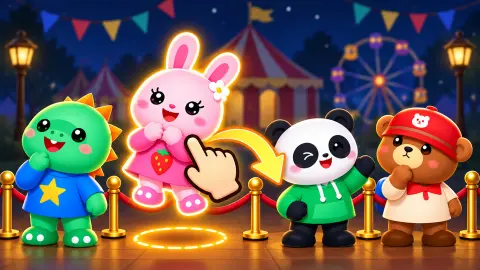
Most logic puzzles hand you a grid of ticks and crosses and leave the real thinking to a pencil. Tricky Queue keeps the pencil out of it. Four animals wait between velvet ropes at a fair at night, three clue cards hang on a wooden board to the right, and the only move you have is to make two animals trade places.
That limit is the game. One card might pin the panda to spot 1. Another says the bunny stands somewhere before the dinosaur, without saying how far before. You read the cards, picture the one line that obeys all of them, and then build it swap by swap. Nothing tells you how you are doing until you press Check Order, and a wrong press is not free.
Tricky Queue: Logic Puzzle is by NANAMINER, the studio that also made the merge clicker Dumplings: Who Will You Get?. It was published on 26 October 2026 and was updated the next day, so it is too new to have player numbers worth quoting.
Three symbols, and the one that needs care
The clue cards use pictures of the animals' heads and one symbol between them. There are three.
The circled number is a fixed spot. "Panda = 1" means the panda stands first, full stop. On the third level the card was bunny = 4: the bunny goes to the back.
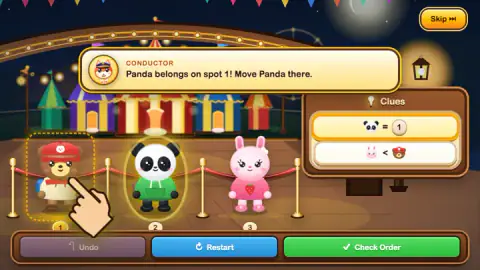
The < sign means earlier. The Conductor puts it plainly in the tutorial: "<" means earlier, so bunny < bear means the bunny stands somewhere in front of the bear. It does not have to be right in front: any spot closer to the start of the line will do.
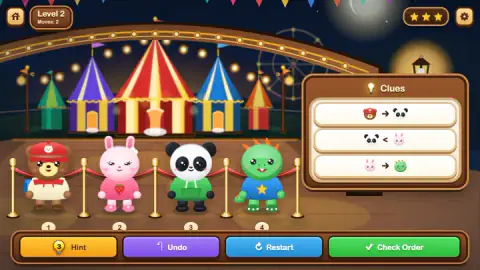
The arrow turned up on the second level, with bear → panda and bunny → dinosaur. In the order that cleared the board, both pairs stood side by side, in that direction. The game's description talks about animals that must stand next to each other, and the arrow is the only symbol we met that could mean it. Treat it as "directly before" and you will not go wrong; we never saw an arrow card fail, so we cannot show you the case where only the gap matters.
Every board we saw was two swaps from solved
This is the part the game never tells you. Each of the first three levels started with the four animals sorted into two pairs, and each pair only needed to trade places with each other.
On level 1 the line opened as dinosaur, bear, panda, bunny, and the answer was panda, bunny, dinosaur, bear. Swap the first and third animals, then the second and fourth, and you are done. Level 2 started as bunny, dinosaur, bear, panda and had to end as bear, panda, bunny, dinosaur: the very same two swaps. Level 3 opened as panda, bunny, dinosaur, bear and solves as dinosaur, bear, panda, bunny. Same two swaps, same spots.
All three boards we saw could be fixed in two swaps. We took 6 on the first and 11 on the second, which is a fair picture of what happens when you start moving animals before you have finished reading. Whether the later levels keep to this pattern, we cannot say.
What the stars are counting
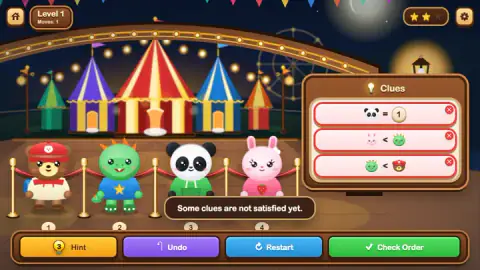
The star meter in the top-right corner starts every board on three. It fell to two on level 1 the instant a wrong Check Order went in, and that level ended with two stars after 6 moves and 184 seconds.
Level 2 is the more interesting case. The meter still showed three stars at 11 moves, right before we pressed Check Order, and no wrong answer had gone in on that board. The result card gave us one star. So stars weigh more than wrong answers: the move count, the clock, or both, also count. The result card shows both figures, which suggests the game is watching both, but we cannot tell you where the lines are.
Why queue puzzles feel familiar
If this kind of clue looks like homework, it is because it used to be. Ordering puzzles, where a handful of people or objects must be lined up from a few facts about who comes before whom, are a classic of reasoning tests and puzzle books.
The best-known ancestor is the Zebra Puzzle, printed in Life International magazine in December 1962: five houses in a row, fifteen clues, and the question of who owns the zebra. It is often credited to Albert Einstein, with no evidence that he had anything to do with it. Sequencing questions of the same family filled the Analytical Reasoning section of the LSAT, the American law school admission test, until it was dropped from the exam in August 2024.
Tricky Queue uses the same three kinds of fact those puzzles rely on: a fixed position, an "earlier than" and an "immediately before". The difference is scale and feedback. Four animals means only 24 possible lines, and you can try them with your hands instead of drawing a table.
How far our run went
We played one session of about ten minutes on a computer, using the mouse. We finished the tutorial and the first two levels, and we were working on level 3 when the session ended. Between the first and second levels the distributor showed its own card, "We skipped the ad this time", with a Continue playing button; there was nothing inside the boards themselves.
The game's listing promises 60 levels across six festival areas and a daily puzzle. We stayed in the first area, at the fair with the striped tents and the Ferris wheel, and never opened the daily puzzle, the settings or the Home screen. We did not use a hint either. The game is listed for phones and tablets, but we did not try it on a touch screen.
Who it suits
Tricky Queue suits younger players learning what "before" and "after" mean in a line, and adults who want a short, quiet logic puzzle with no timer pushing them. The first boards are gentle, and the star rating gives a reason to replay one cleanly. If you already solve logic grids for fun, the early levels will be over in seconds.
For animals and clues on a bigger board, try Logic Storm: Animals Puzzle or Pets and Paints: Logic Puzzle, where colours join the clues. Kaku: Shikaku Logic Puzzle is a different kind of logic with the same no-guessing rule. NANAMINER's other game here is Dumplings: Who Will You Get?. There are more in our puzzle games.
Screenshots

Taken by opening the game ourselves and letting it run — not supplied by the publisher, and not the same picture every other site shows.
How to play Tricky Queue: Logic Puzzle
- Read the clue cards on the right. A number in a circle fixes an animal to that spot; spots are counted from 1 on the left. A < puts the animal on its left earlier in the queue. An arrow joins two animals in order.
- Drag one animal onto another and the two swap places. The game's own instructions say tapping two animals in turn does the same; when we picked one, a small swap sign appeared above its head.
- Keep swapping until you believe every card holds. The cards do not light up while you work, so the checking is yours.
- Press Check Order. A right answer brings up a card with one to three stars, your moves and the time in seconds. A wrong one turns the clue cards red, shows "Some clues are not satisfied yet" and knocks a star off the meter in the top-right corner.
- Undo takes back your last swap and Restart resets the board. Hint, in the bottom-left corner, starts with three uses.
Tips from our session
- Place the fixed animal first. A card with a number is the only clue that names a spot outright. Put that animal there and the other three only have three places left.
- Chain the < cards into one line. On the first level the cards said bunny before dinosaur and dinosaur before bear. Read together, that is bunny, dinosaur, bear, and with the panda fixed on spot 1 there is nothing left to guess.
- Solve it in your head, then swap. Each move adds to the counter, and the counter feeds the stars. We dragged animals back and forth on the second level and paid for it.
- Never use Check Order as a test. The star meter dropped from three to two the moment our first wrong answer went in, with only one swap on the counter.
- The tutorial can be skipped. A Skip button sits in the top-right corner while the Conductor, an orange-and-white animal in a blue peaked cap, talks you through a three-animal queue.
Controls
| Drag (mouse or finger) | Drop one animal on another and the two trade places |
|---|---|
| Tap two animals | Same swap, one tap each, according to the game's own instructions |
| Check Order button | Submits the queue; a wrong answer costs a star |
| Undo / Restart buttons | Take back the last swap, or put the board back as it started |
| Hint button | Asks the game for help; the counter on it starts at 3 |
Features
- Four animals stand in a numbered queue: a bear in a red cap, a panda, a pink bunny and a small green dinosaur
- Three clue cards per board, with three symbols: a fixed spot, a < for earlier, and an arrow
- The cards stay neutral while you swap and only turn green or red when you press Check Order
- A wrong Check Order lowers the star meter in the top-right corner before the board is even over
- The result card shows stars, your move count and the time in seconds
- A guided tutorial with three animals and two clues, which a Skip button lets you jump
Game details
- Developer
- NANAMINER
- Release date
- October 2026
- Last updated
- October 27, 2026
- Added here
- October 2026
- Technology
- HTML5 (2D)
- Platforms
- Browser (desktop, mouse), Browser (mobile & tablet, touch)
- Classification
- Puzzle
- Saved progress
- Saving, when available, is managed by this game. Mava cannot confirm your level.
FAQ
How do you play Tricky Queue: Logic Puzzle?
Four animals stand in a numbered queue and three clue cards say where some of them must be. You drag one animal onto another to swap their places, and when you think every clue holds you press Check Order. If the order is right, the level ends with one to three stars.
What does the < sign mean in Tricky Queue?
It means earlier in the queue. The animal on the left of the sign has to stand closer to spot 1 than the animal on the right, but not necessarily right next to it. The game's own guide, the Conductor, sums it up as "<" means earlier.
What does the arrow clue mean in Tricky Queue?
The arrow appeared on the second level, linking a bear to a panda and a bunny to the dinosaur. In the order that solved the board, both pairs stood side by side in that direction. The game's description mentions clues about animals that must be next to each other, so the safest reading is: the first animal stands directly before the second.
How do you get three stars in Tricky Queue?
Do not press Check Order to test an idea, because a wrong answer drops the star meter straight away. The move count matters too: our second level ended with one star after 11 moves, although the meter still showed three. Work out the whole line first; every board we saw could be fixed in two swaps.
Is there a hint button in Tricky Queue: Logic Puzzle?
Yes. The yellow Hint button in the bottom-left corner shows a counter that starts at 3. We did not use it in our session, so we cannot tell you what it reveals or whether the counter refills.
How many levels does Tricky Queue: Logic Puzzle have?
The game's listing promises 60 levels spread over six festival areas, plus a daily puzzle. We played the tutorial and the first three levels, all in the first area, so we have not checked that figure ourselves.
Who made Tricky Queue: Logic Puzzle?
It is by NANAMINER, the studio behind the merge clicker Dumplings: Who Will You Get?. It was published on 26 October 2026 and was updated the following day.