









About Ant Picnic
The number on an ant card looks like how strong the team is. It is really a debt. Send a team of 17 and it keeps one of your five work slots until it has carried off 17 blocks, and if those blocks cannot be reached, it just sits there. Ant Picnic is a puzzle about what you can afford to have waiting.
On the screen it looks gentle: a pixel apple on a grid of grey stone, a small anthill, ants trooping out to carry the colors away. For two levels it stays gentle, because the tutorial tells you every tap. Then level 3 gives you a butterfly, and within a few taps all three front cards can be marked blocked, with nobody telling you what to spend next.
Our account is short by the game's own measure. In one session on a computer with the mouse we cleared the apple, the flower and the butterfly, and we were stuck on the watermelon at level 4 when the session ended. The counter on the top bar reads 1 / 1002, so we saw very little of it.
The game comes from VladimirShark, according to the game's listing, and dates from October 2026.
Blocked does not mean you cannot send it
You might expect the game to refuse a useless move. It lets you make it and charges you a slot. The second tutorial is built around teaching that: it has you send a yellow team to its yellow center while the center is still sealed behind red petals, and that team simply waits.
That gives you a second thing to manage alongside the queues. On the butterfly we had a brown team and a yellow team parked side by side within our first few taps, with a note from the anthill explaining that the color was not reachable yet. By the time a third of the blocks had gone, every slot was empty again without our touching those teams. As far as we could tell, parked teams go back to work on their own when a route opens, which is also what the tutorial told us.
So a parked team is not a mistake in itself. It is a loan on a slot, and the question is how soon you can pay it back.
The game's own hint tells you the rule it cares about
The hint is worth using once just to see how it talks. On level 3 it pointed at a red team of 17 and told us that team would collect all its blocks and free its slot, and that the next in the queue was blue.
Two things are packed into that. The first is the test for a good move: a team that can finish straight away costs you nothing, because the slot comes back. The second is that a good move is also judged by what it uncovers, so the biggest number on the table is not automatically the one to send.
There is no clock in any level we played. The only pressure is the slots, so you can stare at the board for as long as you like before each tap. A button beside the hint switches the ants between x1 and x2, which only changes how long you watch them work.
From a 56-block apple to a 206-block watermelon
The size of the levels does not climb gently. The apple has 56 blocks and the flower 58, both with tutorial notes on every step. The butterfly, called Summer Wings, jumps to 185.
It took us 25 moves. That number is not a score to beat, as far as we could tell.
The Teams counter on the flower started at 7, and the win panel reported 7 moves. On the butterfly it read 23 with two teams already in slots, which adds up to the same total as the panel.
It looks as though every team in the queues gets sent exactly once, so the puzzle is the order and not how few you use. We have only those two levels to go on.
Level 4, Watermelon Secret, has 206 blocks and changes the goal line to Rescue the ladybug. A ladybug sits in a white gap in the middle of the fruit, behind a rind of green and cream, red flesh and dark seeds. The tag under the board changes from Warm-up to Tactics at the same point.
How our level 4 went wrong
This is where we stopped, and it shows how the jam builds. We sent the brown team to uncover the green, and green took the bottom row. Then the remaining green was out of reach, and the two green teams sat waiting with blocks still to collect.
A red team joined them. With only 12 blocks gone, four of the five slots were full of teams tagged No path, and the anthill warned us that we had one slot left and should pick a reachable color.
The red team of 21 at the front was marked available, so we sent it. The session ended there, and we cannot tell you whether it saved the level.
We also never saw a lose screen. The game's instructions say that five blocked teams are the end of a plan, and the listing mentions recalling a team as one way out. We did not get to try that.
Ads and nectar, as far as we saw them
The win panel for level 2 states that the first two levels have no ads. On level 3 the same panel offers an optional watch ad button for 20 more nectar, on top of the 20 already paid. When an ad did not finish, a line on the panel said that our nectar and help had not been spent. No ad ran to the end in our session, so we cannot say how often they come.
Nectar went from 40 on level 1 to 100 on level 4, one payment per win. The listing says it decorates a garden. We did not open the garden or the Queues button, so what they offer is still unknown to us.
Who it suits, and how it compares
It suits anyone who likes a slow logic puzzle with no clock, and the tutorials are clear enough for a child who can read. The picture disappearing block by block gives you steady progress to look at. Its plain weakness is that there is little variety in the first four levels: the same action on larger pictures, with the thinking only starting at level 3.
The idea is not unique to this game. The listing for Swarm Picnic also has ants and queues, with 30 garden levels listed, and Pixel Color Flow uses pigs on a conveyor. We have not compared them level by level here, so treat those as pointers to the same family and not as a ranking.
More in our puzzle games.
Screenshots
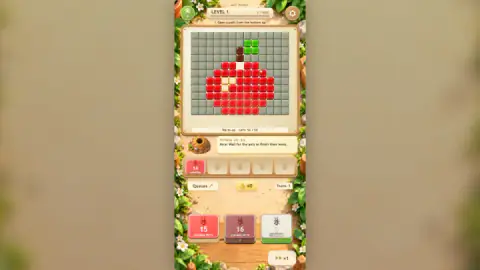
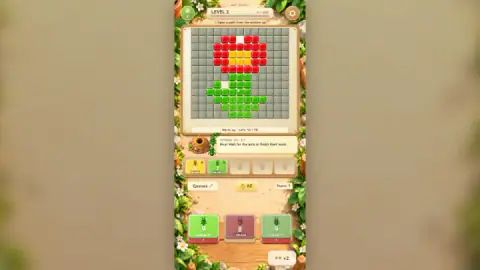
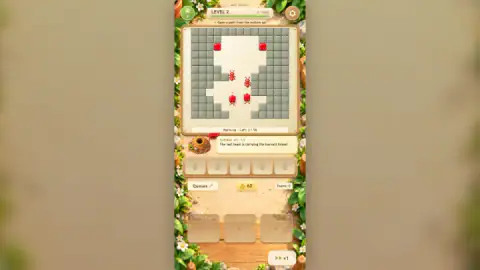
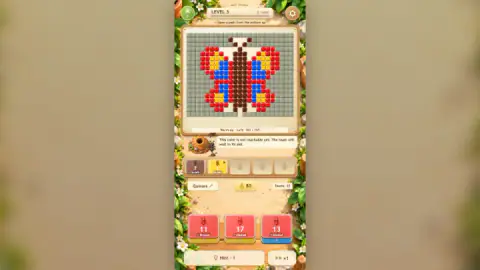
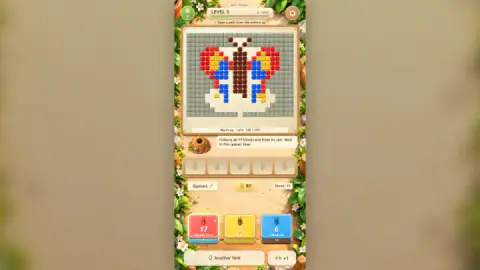
Taken by opening the game ourselves and letting it run — not supplied by the publisher, and not the same picture every other site shows.
How to play Ant Picnic
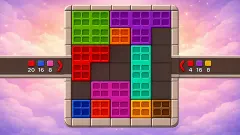
- Look at the bottom of the picture. The goal line says to open a path from the bottom up, and the ants come in from below. Blocks further in have to wait until something opens a way to them.
- Pick a front card. Each of the three queues shows one team, with a color and a number. The number is how many blocks that team will collect, and each team only takes its own color.
- Watch the slots. The team takes one of the five slots above the cards and stays there until its number is done. Then the slot is free again.
- Check the label. A card says available or blocked. A blocked team can still be sent, but it parks in a slot under a No path tag.
- Clear every block. The counter under the board shows how many are left. When it runs out, the win panel offers the next level, a replay and your garden.
Tips from our run:
- Read the strip under each card. That colored band is the next team in that queue. It shows what you uncover by sending the front card.
- A blocked card is sometimes the right move. Level 4 opens with all three fronts blocked. The bottom row is green, and the green team stands behind a one-block brown team. So the brown has to go first and wait.
- Do not stack the same stuck color. We ended up with two green teams parked at once, still owing 7 and 10 blocks, and that was two slots gone.
- Use the first hint when you are lost. Ours marked a card and explained why, and our nectar stayed where it was.
Controls
| Click or tap a front card | Sends that ant team to a work slot, even if the card says it is blocked |
|---|---|
| Keys 1, 2 and 3 | Choose a queue, according to the game's instructions. We played with the mouse |
| Speed button | Switches the ants between x1 and x2. The instructions also give Space for this, but our presses showed no change |
| Hint button | Marks a card and explains what sending it would do |
| Escape | Opens or closes the pause menu, according to the game's instructions |
Features
- A counter on the top bar reads 1 / 1002, and we saw the first 4 of those mosaics
- Five work slots are shared by every team, and a team holds its slot until it has collected all its blocks
- A colored strip under each card shows the color and size of the next team in that queue
- A card marked blocked can still be sent: the team sits in a slot with a No path label until a route opens
- Two tutorial levels with 58 blocks at most, then a butterfly of 185 and a watermelon of 206
- Each win we saw paid 20 nectar, and from level 3 an optional ad offers 20 more
- No timer on screen in any of the levels we played
Game details
- Developer
- VladimirShark
- Release date
- October 2026
- Last updated
- October 1, 2026
- Added here
- October 2026
- Technology
- HTML5 (2D)
- Platforms
- Browser (desktop, mouse), Browser (mobile & tablet, touch)
- Saved progress
- Saving, when available, is managed by this game. Mava cannot confirm your level.
FAQ
How do you play Ant Picnic?
You pick a card from the front of one of three queues, and that team of ants takes a work slot and carries off blocks of its color. The number on the card is how many blocks it collects. Ants come in from below, so blocks only become reachable as the picture is opened from the bottom up. You clear the level by removing the whole mosaic.
How do you lose in Ant Picnic?
The game's instructions say the danger is filling all five slots with blocked teams. We reached the warning, with four slots stuck and a message about the last slot, but our session ended before we saw what comes next. There was no timer on screen in the four levels we played.
What does blocked or No path mean in Ant Picnic?
It means the team's color cannot be reached yet because other blocks stand in the way. You can still send that team, and the tutorial sometimes asks you to, but it occupies a slot and waits. In our run the parked teams seemed to go back to work by themselves once a route had been opened.
What is the colored strip under the cards in Ant Picnic?
It previews the next team in that queue, with its color and its number. The game's own hint confirmed it when it said the next team in the queue was blue, over a blue strip. It tells you what sending the front card would uncover, which matters when the color you need is second in line.
How many levels does Ant Picnic have?
The counter on the top bar reads 1002, which matches the 1,002 mosaics in the game's listing. We played only the first four, clearing three of them, so we cannot vouch for the later ones. The two tutorial levels are short, and level 3 is already more than three times their size.
Does Ant Picnic have ads?
The win panel for level 2 says the first two levels have no ads. From level 3 the panel offers an optional ad for 20 extra nectar, and the listing also ties hints and recalling a team to rewarded ads. No ad ran to the end in our session, so we cannot say how often they appear.
What is nectar for in Ant Picnic?
Each level we cleared added 20 nectar, taking us from 40 at the start of level 1 to 100 at the start of level 4. The listing says it goes towards decorating your garden. We never opened the garden, so we cannot tell you what things cost there.
Who made Ant Picnic?
The game is credited to VladimirShark and dates the game October 2026. It is listed for PC, Android and iOS, in English and Russian.