

About Blast Jam
Most colour-matching puzzles ask you to find the right move. Blast Jam hands you every move up front and asks for something harder: the right order. Each shooter waiting under the board already knows which colour it hits and how many times. Your only decision is which one goes next, and the dock it goes into is small.
That is the whole game, and it is enough. The board is a picture built from glossy coloured cubes. Under it sits a short row of empty slots, the dock, and under that, lanes of numbered shooters. Tap one and it climbs into the dock and starts firing paint balls at every cube of its colour. When its number reaches zero it leaves, and the slot is free again. Cubes rest on the floor of the board, so a stack sinks the moment you clear what was holding it up.
Blast Jam is by Sanket Narola. It was published in September 2026. We went back to it on 20 October for a longer session than our first: ten minutes, the first level cleared, and a good deal of time afterwards spent on the second. Everything below is what we saw.
The numbers on the shooters are the board, counted out
The most useful thing we have learned about Blast Jam is that the numbers are not decoration, and they are not approximate either. A shooter's number is its supply of shots, and that supply matches the board exactly, colour by colour.
Halfway through the first level we stopped and counted. The counter read 60. On the board sat 34 red cubes and 26 yellow ones. Waiting below were a red shooter marked 20 and another marked 14 — and three yellow ones reading 10, 10 and 6.
Near the end the same thing held with tiny numbers. Three red cubes and six yellow were left, the counter said 9, the dock held a red shooter marked 3, and the only thing left on the tray was a yellow 6.
It is true at the start as well. The opening board is ten columns by twelve rows, completely full, and the counter reads 120. Exactly 54 of those cubes are red, and the red lane holds three shooters whose numbers come to the same.
That changes how you think about the puzzle. You can never run short of paint, so there is no point in hoarding a shooter for later. Nothing can go wrong except the order, and the order is decided by the dock.
Three slots in the first level, five in the second
The dock in level 1 has just three slots. That is the jam in the name. With so few places, every shooter sitting there without firing is a third of your room gone.
The second level widens it to five, and then gives you more to fill them with: a third colour, and a third lane of shooters under the board. More room, more to juggle.
The game's own instructions say a level is lost when the dock fills with shooters that cannot fire, and that three shooters of one colour merge into a bigger one when they meet there. We have not seen either happen across two sessions, so we cannot describe them. What we can confirm is the rule underneath both. A shooter holds its slot until its last shot is spent, and we watched a red one with a single shot left sit in the dock across several moves, waiting for its cube.
Level 2 holds more cubes than the board can show
This was the detail we could not explain the first time we played, and now we can.
Level 2 opens with the counter at 160 on a board that holds 120 cubes — and the board is completely full, laid out in clean bands of orange, green and pink. Twenty cubes later the counter read 140, and the board was still completely full.
So the picture is deeper than the frame. As cubes go, the ones above drop into the gaps, and fresh ones arrive from beyond the top row. You are not emptying a grid. You are pulling a tall picture down through a window, and you only ever see the bottom of it.
Between levels there is a map, a purse and a calendar
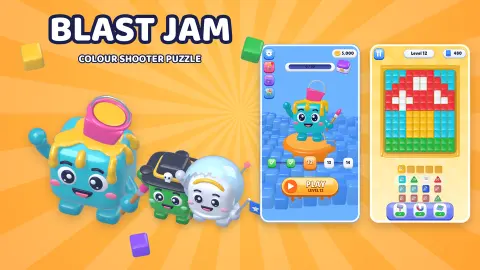
Finishing a level does not drop you into the next one. It takes you back to a home screen, where a round teal jelly character stands on a podium with a paint bucket upended over its head. Along the bottom runs a row of numbered level buttons, a green tick on the one you cleared, and a large PLAY button naming the level you are about to start. Above the character sits a progress bar reading 1 / 10 with a treasure chest at the end, so ten levels appear to buy a chest.
The coins are a real currency rather than a flourish, and they move fast at the start. Clearing the first level paid 32 coins, and the purse in the corner went from nothing to exactly that.
Then a seven-day calendar opened. Day one is 50 coins, days three and five are 100 and 150, and a hammer and a magnet sit on the days between. Day seven is a chest marked three hundred plus boosters. We took day one and the purse read 82. A second button beside the claim offers to double the day's reward in exchange for a video.
Those items explain the three padlocked buttons under every board, marked LVL 4, LVL 6 and LVL 8. Behind each lock is a faded shape, and the shapes are the calendar's: a hammer, a magnet, a blue tile. They look like helpers that open as you get further than we did.
What we could not settle
We cleared level 1 in about three minutes. The rest of the session went on level 2 and we did not finish it. A fair share of that time was wasted: we kept trying to drag shooters onto the board instead of tapping them, and the counter sat still at 140 while we worked that out.
So there are things we still cannot tell you. We have never reached a losing screen, never seen shooters merge, and never had a booster in hand. We do not know what the coins buy, or how far the level map runs.
The game is drawn as a tall portrait screen, so on a computer it sits in a column in the middle of the frame. It is listed as playable on phones and tablets, which fits that shape; we played it with a mouse and have not tried it on a touch screen.
More puzzles to try
Sanket Narola also made Brick Slide, a falling-block puzzle where you slide coloured bricks sideways to fill gaps and clear lines. If the colour-and-order side of Blast Jam is what you like, Bus n Ball Jam sends buses out of a car park so their balls can fill boxes of the same colour, and Wood Blocks Jam asks you to steer each block to a gate of its own colour. For the plain pleasure of a board emptying, Block Sort Puzzle stacks coloured blocks until each tube holds one colour. The rest are in our puzzle games.
Screenshots
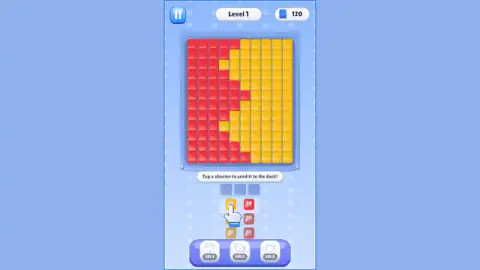
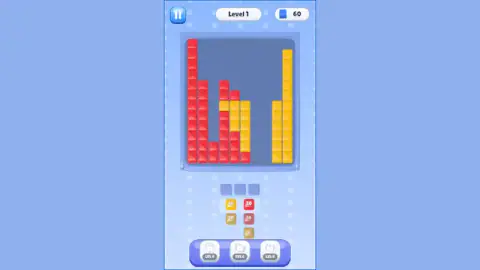
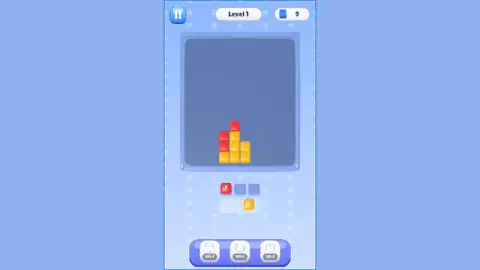
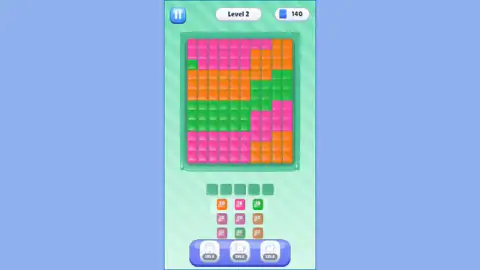
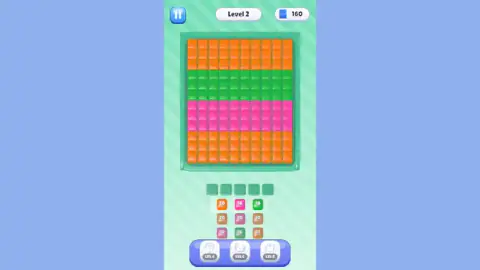
Taken by opening the game ourselves and letting it run — not supplied by the publisher, and not the same picture every other site shows.
How to play Blast Jam
- Read the counter in the top right corner before you touch anything. It is not a score. It is how many cubes are still to clear.
- Look at the lanes of shooters under the dock. Only the bright one at the front of each lane can be picked; the faded ones behind it are waiting their turn.
- Tap a front shooter. It moves into the first free dock slot and fires at cubes of its colour, counting down as it goes.
- When a shooter runs out of shots it leaves the dock, and the next one in its lane moves to the front.
- Clear every cube to finish the level. The cube icon on the counter turns into a coin, and coins spill out where the shooters were standing.
Tips from our games
- Tap, do not drag. The shooters look like pieces you place, and they are not: dragging one onto the board does nothing at all. We lost several minutes of our second session to exactly that mistake.
- Read the faded shooters as well as the bright ones. The colour behind the front shooter is the one you get next from that lane, and it decides what you can afford to do now.
- Do not fill the dock just because there is room. A shooter keeps its slot until it has fired every shot, so a shooter with nothing to aim at is a slot you have lost.
- Watch the counter, not just the board. When it stops falling, every shooter in the dock is waiting, and that is the moment to look for a colour that can still fire.
- The keyboard is not part of this. Arrow keys and letters did nothing we could see or hear.
Controls
| Click or tap a shooter in the front row | Sends it up into the first free slot of the dock, where it starts firing at cubes of its colour |
|---|---|
| Click or tap, never drag | Dragging a shooter onto the board does nothing at all; the game only answers a tap on the shooter itself |
| PLAY button on the home screen | Starts the level named on the button |
| Pause button (top left) | Pauses the level |
Features
- A picture made of coloured cubes fills the board, and the counter in the corner is not a score but the number of cubes still to clear
- Shooters wait in lanes under the dock, and only the one at the front of each lane can be picked
- The number on a shooter is its supply of shots, and the supplies match the cubes on the board colour by colour
- Cubes rest on the floor of the board, so a stack drops as soon as the cubes under it are cleared
- The dock has three slots in the first level and five in the second, and a shooter holds its slot until its last shot is gone
- The second level starts with 160 cubes on a board that only shows 120, and fresh cubes arrive from above as you clear
- Finishing a level pays coins, and a seven-day calendar hands out more, along with a hammer and a magnet
- Three padlocked buttons under every board are marked LVL 4, LVL 6 and LVL 8
Game details
- Developer
- Sanket Narola
- Release date
- September 2026
- Last updated
- September 23, 2026
- Added here
- September 2026
- Technology
- HTML5
- Platforms
- Browser (desktop, mouse), Browser (mobile & tablet, touch)
- Saved progress
- Saving, when available, is managed by this game. Mava cannot confirm your level.
FAQ
How do you play Blast Jam?
Tap a shooter at the front of one of the lanes under the board and it moves up into the dock. From there it fires paint balls at cubes of its own colour, and its number counts down with each shot. Clear every cube on the board and the level is won.
What do the numbers on the shooters mean in Blast Jam?
The number is how many shots that shooter has left. The supplies match the board exactly, colour by colour. With sixty cubes left in the first level we counted 34 red and 26 yellow, and the shooters waiting below read 20 and 14 in red, 10, 10 and 6 in yellow.
What is the counter at the top of the screen in Blast Jam?
It counts the cubes still to clear, not points. The first level starts at 120, which is the full board of ten columns by twelve rows, and when nine cubes are left it reads 9. The moment the board is empty the icon turns into a coin and the counter starts again from zero.
Why does the counter in level 2 say more than the board can hold?
Because the picture is deeper than the frame. The second level opens at 160 on a board that holds 120 cubes, and the board is completely full. After twenty cubes were cleared the counter read 140 and the board was still full, so cleared cubes are replaced from above as you work.
How do you lose in Blast Jam?
The game's own instructions say a level is lost when the dock fills up with shooters that have nothing to fire at. We have not reached a losing screen in two sessions, so we cannot describe it. What we have seen is that a shooter keeps its dock slot until its last shot is gone.
What are the LVL 4, LVL 6 and LVL 8 buttons in Blast Jam?
They are three padlocked slots along the bottom of every board. Behind each lock is a faded shape, and the shapes match the items the daily calendar hands out, which are a hammer, a magnet and a blue tile. They look like helpers that open at those levels. We did not get far enough to use one.
Does Blast Jam give you coins and daily rewards?
Yes. Clearing the first level paid 32 coins. A seven-day calendar then offered 50 coins on day one, 100 and 150 on days three and five, a hammer and a magnet on the days between, and a chest worth 300 plus boosters on day seven. A second button beside it offers to double the day's reward for a video.
How many levels does Blast Jam have?
We cannot say. The home screen shows numbered level buttons with a green tick on the one you cleared, and a bar above the character counting towards a treasure chest at ten levels. We cleared the first level and did not finish the second, so we never saw how far the map goes.