

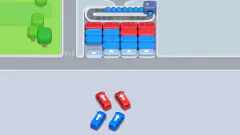









About Bus Color Jam
Two buses sat on the road at the top of the screen, one beige and one white. Below them ran a strip of grey tiles with a few squares tinted pale blue, and below that a small jetty sticking out into the water, with four pale passengers standing on it.
A couple of minutes later the white bus had gone. The beige one was parked at the kerb in its place, and through its windows you could count three beige riders sitting inside. The jetty was empty.
That is the whole game in two pictures, and the part worth slowing down over is the bit you cannot see: you do not pick the passenger. The line the game puts on screen tells you to tap the first player, and the queue comes off the jetty in the order it is standing in. So the puzzle is never "who should I send" — it is "what do I do with the person I have been handed, now, when the bus at the kerb is the wrong colour for them".
The answer is the row of tiles under the road. A passenger who does not match goes and stands there and waits. There are about five of those tiles, which is not many, and nothing on screen counts down or keeps score — we checked four captures from our session and found no clock at all. The only thing in this game that visibly fills up is that little row.
The game is credited to Drivix Games, the studio behind Stack Swipe and Car Escape, and has been available since September 2025.
One honest note before any of the rest. Our session lasted about four minutes. We cleared the opening level, watched the second one start, and stopped there. Everything below describes that opening stretch, and where we did not see something, the page says so instead of guessing.
The waiting tiles are a railway siding, and that is the entire puzzle
Here is the oldest version of this problem, and it is not a video game.
A siding is a short stretch of track running off to one side of the main line. Rail yards have used them for well over a century for one reason: a train arrives with its wagons in the wrong order, and you cannot reach into the middle of it. You can only work from the end. So you shunt a wagon off onto the siding, get it out of the way, carry on with the ones behind it, and bring it back when the right moment comes.
Swap wagons for passengers and the siding for a row of five tiles and you have Bus Color Jam exactly. The jetty hands you people in a fixed order and you take them from the front. The tiles are where you put the ones who turned up too early.
What makes that interesting rather than just fiddly is a fact rail crews learned the hard way and computer scientists later wrote down: one siding cannot sort every order. Some sequences simply cannot be untangled with a single holding track, however clever you are, because getting one wagon out means moving others you did not want to move. Programmers call a holding area like this a stack — the last thing in is the first thing out — and the orders you can fix with one are known as stack-sortable.
So when a level in this game beats you, it will not be because you were slow. There is no clock to be slow against. It will be because the order you were handed needed more parking space than you were given, and you spent yours early. Which is also why these levels can get harder without changing a single rule: nothing needs speeding up or taking away, only shuffling.
The bay holds one bus, and the road keeps sending new ones
The second thing our captures settled is what happens above the tiles.
Only one bus loads at a time. It sits in a bay marked out by a chequered patch of asphalt, with a red STOP sign on a post beside it, and the others wait on the road behind. When it is done it drives off and the next one rolls forward. That is why the white bus vanished between our first two pictures and the beige one took its place with riders already inside.
And a level is not just two buses. Level two opened with a green bus and a red one. Later in that same level — same banner, same screen — the pair at the kerb was hot pink and pale pink, and the queue on the jetty had changed to match. The road is a supply line, and the colours you are matching against rotate as you work through it.
That changes how you play. Treat the bus at the kerb as the only one that exists and every mismatch feels like a loss. Once you know a fresh pair is coming, parking somebody is a decision with an expiry date rather than a surrender.
By the second level you are matching pink against pink
Level one pairs a beige bus with a white one. Those are already close. By the end of level two the pair at the kerb was hot pink and pale pink, and the passengers on the jetty came in those same two shades.
So part of the difficulty here is not planning at all. It is telling two colours apart on a small screen while you are also working out where to put somebody. Worth knowing before you start, especially if you or whoever you are handing this to finds close colours hard to separate: the figures are identical, and the colour is the only label there is.
What we cannot tell you is where that goes. We stopped in the second level, so we do not know how many there are, what happens when the waiting tiles fill up, or whether the game ever gives you a bigger row to work with. We never ran out of space, and we never saw a losing screen.
More puzzles by Drivix Games
The studio has a shelf of these on the site, and they share a family resemblance: a small board, a fixed order, one correct way to undo it. Stack Swipe is the sharpest of them, a colour puzzle where one drag shoves every plate at once and refilling the board costs you. Car Escape is the jam in its most literal form — a grid, a gridlock, and an order that unpicks it.
If it is the buses you came for rather than the studio, Bus Escape: Clear Jam and Bus n Ball Jam run the same colour-and-queue idea on different boards. And if you want the siding problem stripped of everything else, Ball Sort Puzzle is it in its purest form: colours, tubes, and a strictly counted number of empty slots. The rest sits in puzzle games.
Screenshots

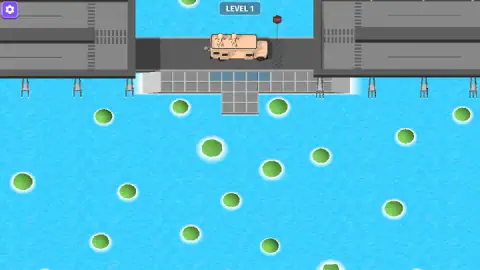


Taken by opening the game ourselves and letting it run — not supplied by the publisher, and not the same picture every other site shows.
How to play Bus Color Jam
- Tap a passenger, do not drag one. This is the first thing to get right, and we got it wrong for most of a session. We pulled people towards buses over and over and the queue never moved. The game's own prompt reads "Tap on first player to move!", and a tap is all it wants.
- Look at the bus in the bay, not at the road. Only one bus is loading at a time. The others are queueing behind it, and their colours do not matter yet.
- Send matching passengers straight on. If the colour at the head of the queue is the colour at the kerb, that one is free — it costs you no waiting space at all.
- Park the mismatches on the tiles. A passenger who does not fit stands under the road until a bus their colour pulls in, and then they board from there.
- Empty the jetty. The level we cleared ended with nobody left standing outside, and a LEVEL CLEAR card over the screen.
What the session taught us:
- A free match is worth more than it looks. Every passenger who boards directly leaves your waiting row untouched, so the cheap moves are the ones that buy you room for the expensive ones later.
- Watch the second bus, not just the first. It tells you which colour is about to become cheap, and therefore which passengers are worth parking rather than panicking about.
- The gear button is in the firing line. It sits in the top-left corner of the play area, and we opened the settings panel by accident mid-level and had to close it again.
- Colour, not shape, is the only signal. The passengers are the same little figure every time. Nothing but the colour tells you where anybody belongs, which matters more than it sounds like it should — see below.
Controls
| Tap or click a passenger | Sends them up the ramp towards the bus in the bay. The game's own prompt names the one you get, "first player", so this is a queue served from the front rather than a free pick |
|---|---|
| Dragging a passenger onto a bus | Nothing moved for us. We spent most of a session pulling people towards buses and the queue never budged |
| The row of tiles under the road | Not a button. It is the holding area a passenger waits in when the bus in the bay is the wrong colour for them |
| Purple gear, top left | Settings. It sits in the same corner on every screen we saw, and it is easy to open by accident mid-level |
Features
- A queue you serve from the front, so the puzzle is the order you are given rather than the passenger you fancy
- A short row of waiting tiles under the road, about five of them tinted pale blue, which is the only space you get to work with
- A bay that holds exactly one bus: it pulls away when it is done and the next one on the road moves up
- Riders you can see through the windows — three beige passengers showing inside the beige bus once the jetty had emptied
- Bus colours that change inside a single level: green and red early in level two, hot pink and pale pink by the end of it
- No clock, no countdown and no score on any screen we reached, which makes the row of tiles the only thing that visibly runs out
- It has been available since September 2025
Game details
- Developer
- Drivix Games
- Release date
- September 2025
- Last updated
- August 10, 2026
- Added here
- July 2025
- Technology
- HTML5 (2D)
- Platforms
- Browser (desktop), Browser (mobile & tablet, touch)
- Classification
- Puzzle
- Saved progress
- Saving, when available, is managed by this game. Mava cannot confirm your level.
FAQ
How do you play Bus Color Jam?
You tap a passenger waiting on the jetty and they walk up the ramp towards the bus parked at the kerb. If their colour matches that bus they get on board. If it does not, they stand on one of the waiting tiles under the road until a bus their colour arrives. The game prints the instruction on screen as "Tap on first player to move!", so you take the passenger at the head of the queue rather than picking one out of the crowd.
What are the tiles under the road for in Bus Color Jam?
They are the holding area. A passenger whose colour does not match the bus currently at the kerb has to stand somewhere, and that row of tiles is the somewhere. There are only about five of them tinted pale blue, so the space is small and deliberately so — it is the one resource in the game that can visibly run out.
Can you choose which passenger gets on the bus in Bus Color Jam?
Not really. The prompt on screen calls the one you move the "first player", and in our run the queue came off the jetty in the order it was standing in. That is what makes it a puzzle instead of a sorting chore, because you are handed an order and have to work with it, using the waiting tiles to hold back whoever has turned up too early.
Why do the buses change colour in the middle of a level?
Because the road keeps sending new ones. The bay at the kerb holds a single bus, and when it is finished it drives off and the one behind it moves up. We saw level two open with a green bus and a red one, and later in the same level the pair at the kerb was hot pink and pale pink, with the queue on the jetty changed to match.
Is there a timer in Bus Color Jam?
Nothing on screen counts down. We looked at four captures from our session and found no clock, no countdown bar and no score anywhere on them. The pressure comes from space rather than time, and the only thing that visibly fills up is the short row of waiting tiles under the road.
How many levels does Bus Color Jam have?
We cannot tell you a number. Our session ran about four minutes, cleared the opening level under a "LEVEL CLEAR" card and stopped part-way through the second one, so we never reached an end. What we can say is that the second level was already pairing two shades of pink against each other, which the first one never did.
Who made Bus Color Jam?
The game is credited to a studio called Drivix Games, the same name behind Stack Swipe and Car Escape. No studio name appears on screen while you play. The game has been available since September 2025.
Can you play Bus Color Jam on a phone?
It is listed for desktop, mobile and tablet, and the frame it is served in is taller than it is wide, which is a phone shape rather than a monitor shape. A single tap is also about as portable as a control gets. We played it on a desktop with a pointer, so we can tell you what the taps do but not how it feels under a thumb.