




About Stack Swipe
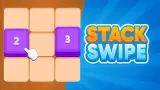
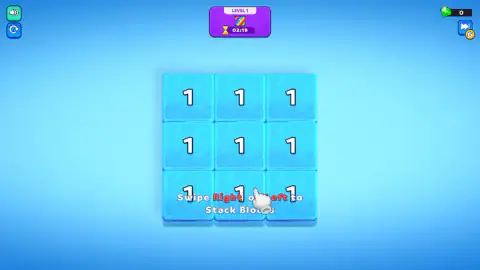
Nine plates sat on a three-by-three board, every one of them marked with a 1. We dragged across them once.
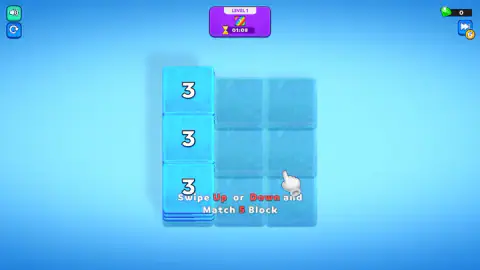
Six of the nine squares came back empty. The three plates that survived stood in a single column, each one now marked 3.
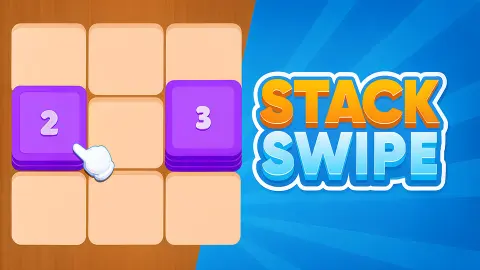
That move is the whole game, and it is worth slowing down over. A drag here does not pick up a plate and put it somewhere else. It shoves every plate on the board in that direction at the same time, and where plates of the same colour run into each other they pile up. The number printed on a stack is not a score and not a value: it is a headcount of the plates underneath the top one, and the pile is drawn with that many layers, so a three looks like three.
The second half of the rule is on screen in the game's own words: "Swipe Up or Down and Match 5 Block". A pile that reaches five of a colour is taken off the board. So you are not building the biggest number you can manage. You are building a pile tall enough to throw away.
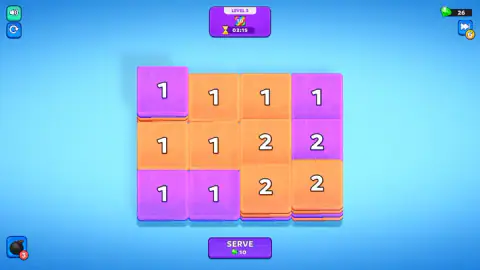
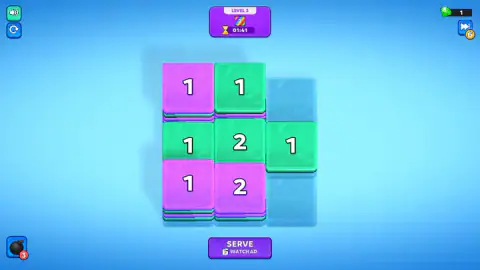
And then comes the part that took us two sessions to find. Nothing arrives to fill the squares you emptied. The board under the grid has a button on it marked SERVE, and SERVE is what refills it — for a price. With a couple of dozen gems in the corner it asked us for ten of them. When the counter was down to one, the same button stopped asking for gems and offered to show us an advert instead.
The game is credited to Drivix Games and has been available since August 2025.
We cleared the opening level, went on a few more, and stopped. So this page describes the first stretch of the game, rather than pretending to an ending we never saw.
Every game in this family refills your board. This one sells you the refill
The move at the centre of Stack Swipe — one gesture, every tile on the board slides — has a short and very well documented family tree.
Threes came first, from a small team called Sirvo: Asher Vollmer on design, Greg Wohlwend on art. It reached the iPhone in February 2014 and took an Apple Design Award that year.
A month later an Italian web developer, Gabriele Cirulli, wrote 2048 over a weekend and put it on GitHub for nothing. It pulled in more than four million visitors in under a week, and by that April one trade publication was counting fifteen new games built the same way arriving on the App Store every day.
Both of them share a rule that almost nobody since has thought to question. In Threes, every swipe brings a new tile onto the board from the side you swiped towards. In 2048, a fresh tile drops into a random empty square after every single turn. The board refills itself whether you want it to or not, and that is where the pressure in both games comes from. You are not racing anything. You are running out of room.
Stack Swipe keeps the gesture and throws that rule away. We emptied six of our nine squares with one drag, and those six squares stayed empty. Nothing arrived.
Handing the player the refill button changes what the game is. In 2048 the board is the opponent: it crowds you until you have no legal move left, and a full board is a dead one. Here the board is inert, an empty board is a safe board, and the thing standing between you and more plates is a price tag.
What the green gems buy
The counter in the top right corner is gems, and for a whole level it sat on zero. The card that ends a level is a red ribbon reading COMPLETED, a line saying "You did it!", and a blue plate wearing sunglasses on the empty grid. That card is where gems come from. Our first clear paid +9, and later ones a little over twenty each.
A yellow button on that card reads 2X REWARD with the doubled figure printed on it, and a video icon beside it. A green NEXT sits below, and that is the one we took every time.
Then the gems go back out through SERVE. This is the part no amount of looking at the opening level will tell you, because the opening level never offers it. On a later board, with the counter reading twenty-six, the SERVE button carried a gem icon and the number ten. On two later captures, with the counter down to a single gem, the same button in the same place read WATCH AD instead.
That is a complete loop, and an unusually plain one: you clear boards to earn refills, and when you cannot afford a refill the game asks for your attention instead. It also explains why the first level feels generous and a later one feels tight. The board never fills up on you. It empties out on you, and an empty board you cannot afford to refill is this game's version of a dead end.
The hourglass, the fourth column, and where the game stops you
At the top of the screen sits a purple panel: the level number on a white tab, a small plate icon, and an hourglass with a time under it. That time counts down, and it starts a little over two minutes in — though the exact figure was not the same on every board we played, so we will not hand you one as a rule.
That is the counterweight to a board that will never crowd you. Nothing is going to force your hand, so the sand does it instead.
The board itself does not sit still either. The first one is three squares by three. A few levels on it is four columns across, the piles are deep enough to show a dozen layers of colour at the edges, and two or three colours are in play at once rather than one.
And the game stops you in a way worth knowing about before you start. Twice a banner dropped over the board mid-session. One read "We skipped the ad this time - enjoy the game!" over the completed-level card. The other read "Oops! No ads available right now" while the board was still live. Both put up a Continue playing button, and both times one click put us back where we were.
There is more we cannot tell you. A round button sits in the bottom-left corner with a small red number on it, which looks like a help of some kind, and we never spent one. We do not know how many levels there are, and we do not know what happens when the hourglass reaches zero, because every board we played ended before the sand did.
More puzzles by Drivix Games
The studio has a shelf of them here, all of them quieter than this one. Car Escape is the closest relative — a grid, a jam, and one correct order to undo it. Find Out Hidden Object and Jigsaw Puzzles are Drivix at its most patient, both about looking rather than moving, and Sticker Art Book Puzzle is the one to hand to a younger player. If it is the three-by-three grid you came for rather than the studio, Slide And Divide runs the same board with arithmetic on it. The rest sits in puzzle games.
Screenshots
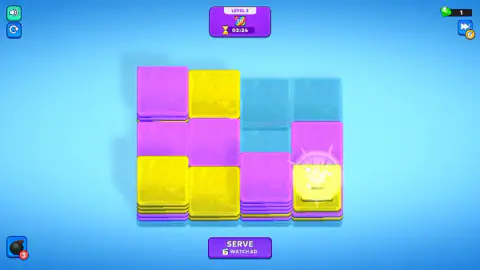
Taken by opening the game ourselves and letting it run — not supplied by the publisher, and not the same picture every other site shows.
How to play Stack Swipe
- Drag long, right across the grid. Most of what we tried did nothing at all. The drags that moved the board travelled its full width or height. A flick the size of a single plate is ignored.
- Pick a direction and watch what collapses. Everything slides at once, so one drag can empty two columns and leave the whole board standing in a single line.
- Count plates, not points. The number on a stack is how many plates are in it, and five is the number you want.
- Finish the pile on the other axis. Dragging sideways gives you short stacks side by side. Dragging up or down is what shunts those together into one tall enough to go.
- Hold your gems for SERVE. The purple button under the board is the only thing that puts new plates into the gaps, and it charges you for them.
What the sessions taught us:
- The keyboard is not wired up. We tried all four arrow keys and the space bar. The board never moved. This is a pointer game on a desktop and a finger game on a phone.
- Empty squares stay empty. Nothing drops in to replace what you cleared, however long you leave it.
- The clock stops if you click away. A banner comes up reading "Click to keep playing" and everything freezes until you click back in, which is easy to mistake for the game hanging.
- Clear a level before you spend. Gems only come in on the card at the end of a level, so an early refill is borrowed against a level you have not finished yet.
- The board is not always three by three. It gains a column as you go, and the piles on it get deeper, so the move that cleared the first board will not clear a later one.
Controls
| Drag left or right | Shoves every plate on the board sideways. Plates of the same colour that meet end up in one stack |
|---|---|
| Drag up or down | The same move on the other axis, and the one that turns three short stacks into a tall one |
| SERVE button | Sits under the board and drops new plates into the empty squares. It is not free — it asks for gems, or for an ad when your gems run out |
| Round button, bottom left | A one-shot help of some kind, with a small red count on it. We finished our sessions without spending one |
| Arrow keys and space bar | Nothing. We tried all four arrows and the space bar, and the board never moved |
| Blue circular arrow, top left | The restart sign, next to the sound button |
| Green speaker, top left | Sound on and off. With the level panel, the gem counter and SERVE, that is most of the interface |
Features
- A board of coloured plates where a single drag moves every plate at once, not the one you pulled
- Stacks labelled with the number of plates in them — nine plates marked 1 became three stacks marked 3 in one move
- The target printed on the board in the game's own words, "Match 5 Block", after which the pile is taken away
- A board that never refills itself, and a SERVE button that refills it for a price in gems
- Gems paid out for clearing a level, with an optional ad on a "2X REWARD" button to double them
- A board that grows — the first level is three squares by three, later ones run four columns across
- It has been available since August 2025
Game details
- Developer
- Drivix Games
- Release date
- August 2025
- Last updated
- August 10, 2026
- Added here
- July 2025
- Technology
- HTML5 (2D)
- Platforms
- Browser (desktop), Browser (mobile & tablet, touch)
- Classification
- Puzzle
- Saved progress
- Saving, when available, is managed by this game. Mava cannot confirm your level.
FAQ
How do you play Stack Swipe?
You drag across a board of coloured plates, and every plate on the board moves in that direction at once. Plates of the same colour that run into each other pile up into a single stack, and the number printed on a stack is how many plates are in it. The game spells out the target on screen as "Match 5 Block", so a pile that reaches five of a colour is taken off the board.
What does the number on a plate mean in Stack Swipe?
It is a headcount, not a score. It tells you how many plates are stacked in that square, and the stack is drawn with that many layers, so a tall pile looks tall. We watched nine plates each marked 1 turn into three stacks each marked 3 after a single drag, which is three plates landing on top of each other rather than any kind of sum.
What is the SERVE button in Stack Swipe?
It is the button under the board that puts new plates into the empty squares. Nothing refills the board on its own in this game, so SERVE is the only way to get more to work with. It is not free — it carries a price in gems, and when your gem counter is low it offers you an ad in place of the gems.
What are the green gems for in Stack Swipe?
They pay for refills. Clearing a level pays you gems on the COMPLETED card, and the SERVE button under the board spends them. With a couple of dozen in the corner the button asked us for ten of them, and once the counter was down to one it switched to offering an ad instead. There is no shop on any screen we reached.
How many levels does Stack Swipe have?
We cannot tell you. We cleared the opening level, went on through several more and stopped there, so we never reached an end. The boards get wider as you go — the first one is three squares by three, and later ones run four columns across — and each of them is played against an hourglass that starts a little over two minutes out.
Who made Stack Swipe?
The game is credited to a studio called Drivix Games, which also made Car Escape, Find Out Hidden Object and Jigsaw Puzzles. No studio name appears on screen while you play. The game has been available since August 2025.
Does Stack Swipe have ads?
Yes, and they interrupt. Twice the game stopped and put a banner over the board, once to say it was skipping the advert that time and once to say none were available, and each banner carried a "Continue playing" button that returned us to the game with a single click. On top of that, the button that doubles your level reward and the fallback on SERVE are both offers to watch one.
Can you play Stack Swipe on a phone?
It is listed for desktop, mobile and tablet, and the game is built around a swipe, which is a gesture that belongs to a touchscreen more than to a mouse. We played it on a desktop by dragging with a pointer, so we can tell you what the drags do but not how the board answers to a thumb.