

About Bottle Color Match Challenge
The ribbon under the man's chin said 0 MATCHES, and the shelf in front of him held exactly the three bottles he was thinking of. Both of those things were true on our screen at the same time, for about a minute, and the reason why is the entire game.
The counter is not counting colours. It is counting places. The same three bottles are on the shelf from the first second to the last — one lime green with slices of lime on the label, one magenta covered in little stars, one pale mint with a wave pattern. You cannot add a colour, remove one or run out. All you can do is change the order. The ribbon then tells you how many of the three are standing where the man wants them, and that is the only information the game ever gives you.
Which makes this a deduction puzzle wearing the costume of a children's matching game. The bottles are drawn like supermarket fizzy drinks, the man pulls faces, and underneath it is a three-slot code you have to break with a single number of feedback.
The game is credited to _cHoKE GaMEs. It was published on 9 February 2026, was last touched there in August. We could not find the studio anywhere else, so treat all of that as one source rather than three.
Here is what this page is and is not. It is an account of one puzzle, played for four minutes on a desktop with a mouse, thirty-eight moves, never solved. The best we managed was a single bottle in the right place. We never saw a finished board, a win screen, a level number or a second puzzle, and in the whole session the game made exactly one sound, the one it plays when it opens. What we did work out, from watching the ribbon, is the rule the thing runs on — and with that rule, you should beat it faster than we did.
The ribbon is counting places, and we can show you
This is the part no feed description will tell you, because you can only learn it by watching the number change.
At one point our shelf read green, pink, mint from left to right, and the bubble was asking for mint, green, pink. Not one bottle was where it belonged, and the ribbon said 0 MATCHES. Fair enough.
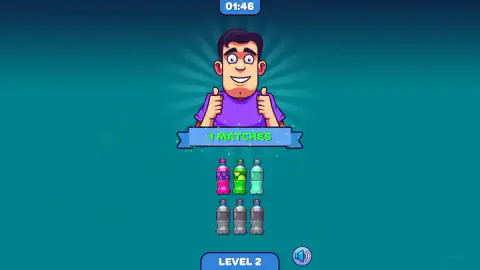
Then we swapped the first two. Now the shelf read pink, green, mint. The colours on the shelf were identical — the same three bottles, nothing added, nothing taken away. The bubble had not changed either. And the ribbon said 1 MATCHES.
One bottle had landed home: the green one, in the middle. That single reading settles what the counter is doing. If it were counting colours it would have said three both times, because all three colours were always there. It counts how many bottles are standing in the slot the bubble asks for, and nothing else.
It also explains the grammar. The ribbon says "1 MATCHES", not "1 match", because it is a slot in a sentence the game fills with a number.
Three bottles, six orders, and the reading you will never see
Three bottles in three places can be arranged six ways, and that is the whole search space. You could brute-force it in six tries with your eyes shut. But the ribbon lets you do far better, because of a small piece of arithmetic that holds for any three objects in three places.
Count the ways those six arrangements can score. One of them is correct, so it scores three. Three of them have exactly one bottle home, with the other two swapped. The remaining two have nothing home at all. Add it up and you get scores of 3, 1, 1, 1, 0, 0.
Two never appears. It cannot: if two bottles are in the right place, the third has nowhere left to go, so it is in the right place too. The ribbon can read 0, 1 or 3, and never anything else.
That gives you two rules worth more than any amount of shuffling:
- A zero means rotate, not swap. If no bottle is home, your arrangement is one full three-way rotation away from the answer — everything shifts one seat, left to middle, middle to right, right back to the left. There are only two rotations, so one of them finishes the puzzle in a single move.
- A one means stop rotating and swap a pair. Exactly one bottle is already correct and the other two are the wrong way round. You do not know which one is the keeper, but there are only three pairs to try, and the ribbon narrows it every time.
We can prove the first rule the embarrassing way. Our shelf read green, pink, mint, the ribbon read zero, and one rotation would have put mint, green, pink on the shelf and ended it. We swapped a pair instead, got our 1, and spent the rest of four minutes not finding it.
A fifty-year-old board game is hiding behind the thought bubble
Strip the bottles away and what is left is Mastermind, the plastic board with the coloured pegs that has sat in family cupboards since the early seventies. One player hides a code; the other guesses; the only answer ever given is a count of how close the guess was. The guesser's job is to squeeze a hidden arrangement out of nothing but numbers.
Mastermind was put together in 1970 by Mordecai Meirowitz, an Israeli postmaster and telecommunications expert, after the big toy companies turned him down. Invicta Plastics, a firm in Leicestershire in England, bought it, tidied the rules and put it on sale the following year. Meirowitz did not invent the idea either: it is a boxed version of Bulls and Cows, a pencil-and-paper game of guessing a number that is older than anyone can date, and that computer scientists were already programming in the 1960s.
The difference here is the feedback. Mastermind answers a guess with two numbers — right colour in the right place, and right colour in the wrong place — and lets colours repeat. This game gives you one number and no repeats, because the three bottles are always all on the shelf. That is a harsher format in one way and a far kinder one in another: with repeats banned and the set fixed, the arithmetic above kicks in, and a zero stops being bad news. It becomes the most useful thing the ribbon can tell you.
What the shop window promises, and what our screen showed
We would rather name the gaps than paper over them. The game's own description talks about levels that grow harder, hints when you are stuck and a mode played against the clock. None of that was on our screen. No timer, no hint button, no level number, no score, no menu. One shelf, one bubble, one ribbon and a speaker.
It is entirely possible those things arrive once you solve the first board and we simply never got there. We did not, so we are not going to tell you about them.
More puzzles that make you work it out
Liquid Sort Puzzle is the other kind of bottle puzzle, the one where you actually pour, and it makes a useful contrast: there the colours move, here only the order does. Memorya asks you to hold an arrangement in your head rather than deduce it. Decode the Movie Quote runs on the same loop as this one — guess, get told how close you were, guess again. CatDoku is the pure version, where every answer is forced by the rules and nothing is hidden at all. The rest are in puzzle games.
Screenshots
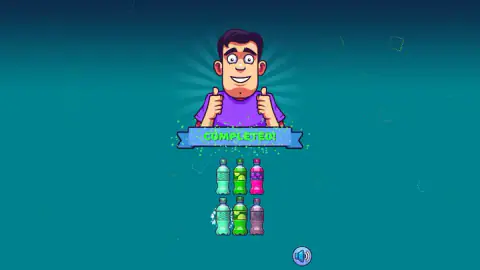
How to play Bottle Color Match Challenge
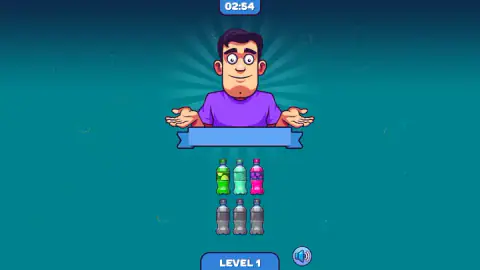
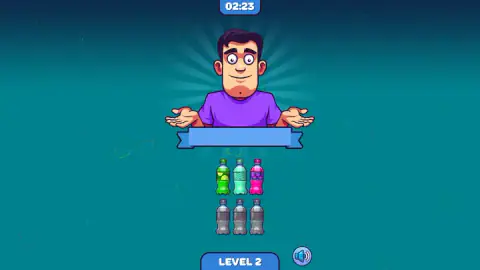
- Read the thought bubble. Three bottles appear above the man's head in a particular left-to-right order. That order is the answer. The bubble fades them out to grey silhouettes every few seconds and then brings the colour back, so if you miss it, wait.
- Drag, do not click. Pick a bottle up and drop it on another one and the two trade places. We spent most of our session clicking bottles in pairs, the way the game's own instructions describe, and the shelf never moved once. The first thing the game shows you is a cartoon hand sliding between two bottles, and that hand is the instruction.
- Read the ribbon. After a swap it reads 0 MATCHES or 1 MATCHES, and it means how many bottles are now in the right place. Give it a second: in our run it trailed a beat behind the swap, still showing the old number while the new arrangement was already on the shelf.
- Use the number, do not guess again. With only three bottles the count tells you almost everything. The next section is the whole strategy, and it is short.
What the run taught us:
- Nothing is lost by a wrong move. No lives, no penalty, no clock that we could see. The only cost of a bad swap is the swap.
- The bottom row is scenery. Three identical grey bottles sit under the coloured ones for the whole game. We dragged them, dropped things on them and clicked them, and they never changed, never filled and never lit up.
- The man's face is the second ribbon. He sits neutral, shrugs with his palms up, and goes wide-eyed with his mouth open when the count comes back zero. It is the only reaction in the game.
- The keyboard does nothing. Everything happens with the pointer.
- The speaker button, bottom right, is the only other control. There is no pause, no restart and no menu on the puzzle screen.
Controls
| Drag one bottle onto another | The two trade places. This is the only way we ever got the shelf to change |
|---|---|
| Click one bottle, then click a second | What the game's own instructions call selecting and swapping; clicking alone never moved anything for us |
| Speaker button, bottom right | Turns the sound on and off |
| Keyboard | Nothing. Every key we tried was ignored; this is a pointer game |
Features
- Three bottles, three places and exactly six possible orders — the whole puzzle fits on one shelf
- A ribbon that counts how many bottles stand in the right place, not how many colours you have
- A thought bubble that pulses from full colour down to grey silhouettes and back, hiding the answer every few seconds
- A cartoon shopkeeper whose face does the rest of the feedback: neutral, shrugging, then open-mouthed when the count comes back zero
- No timer on screen, no level number, no score and no menu in the puzzle we played
- One drag is all a move costs, and there is no penalty for a wrong one
- Made by _cHoKE GaMEs
Game details
- Developer
- _cHoKE GaMEs
- Release date
- February 2026
- Last updated
- August 10, 2026
- Added here
- December 2025
- Technology
- HTML5 (2D)
- Platforms
- Browser (desktop, mouse), Browser (mobile & tablet, touch)
- Classification
- Puzzle
- Saved progress
- Saving, when available, is managed by this game. Mava cannot confirm your level.
FAQ
How do you play Bottle Color Match Challenge?
A shelf holds three different bottles and a man above it thinks of those same three bottles in a particular order. You drag one bottle onto another to make them trade places, and a ribbon under the man tells you how many are now standing where he wants them. Keep swapping until the count is right.
What does MATCHES mean in Bottle Color Match Challenge?
It counts positions, not colours. The same three bottles are always on the shelf, so the colours never change; what changes is how many of them sit in the slot the thought bubble asks for. We saw the ribbon read 0 and then 1 with exactly the same three bottles on the shelf, after a single swap.
Can the ribbon ever read 2 MATCHES?
No, and that is worth knowing. With three bottles in three places, if two of them are already home then the third has nowhere else to be, so it is home too. The count can only be 0, 1 or 3. Reading a 2 is impossible, which means a 1 is better news than it looks.
What should you do when it says 0 MATCHES?
Rotate all three rather than swapping a pair. A zero means no bottle is in the right place, and with three bottles that always means the answer is one full rotation away — left to middle, middle to right, right to left. Only two rotations exist, so one of them ends the puzzle on the spot.
Why does the thought bubble go grey?
The bubble fades its three bottles out to grey silhouettes and then brings the colour back, over and over. It is not three different hints: in our run the bubble always showed the same three in the same order, mint, green and pink, just at different brightness. If you missed it, wait a couple of seconds and it returns.
Is there a timer or a hint button?
The game's own description mentions levels, hints and a mode played against the clock. We did not see any of them. Our screen had a shelf, a thought bubble, a ribbon and a speaker button, and nothing else: no clock, no hint, no level number and no score.
Does Bottle Color Match Challenge work on a phone?
It is listed for PC, Android and iOS, in both landscape and portrait, and the whole game is one drag of a finger, which suits a touch screen. We only played it on a desktop with a mouse, so we cannot vouch for how the bottles handle under a thumb.
Who made Bottle Color Match Challenge?
The game is credited to _cHoKE GaMEs and lists six games under that name, among them Veggie Harvest, Find a Ghost and Paint Mine Mobs. That is the only source we could find: the studio has no site we could reach and no other portal we searched carries the game. It was published on 9 February 2026.