

About Color Blast Puzzle
Most colour-matching puzzles want you to swap two things. You drag a red jewel one square sideways, three of them line up, and the line vanishes. Color Blast Puzzle has no swap in it at all. You tap one block, and every block of that colour touching it goes at once — four of them, or nine, or the whole left-hand column if you have been patient.
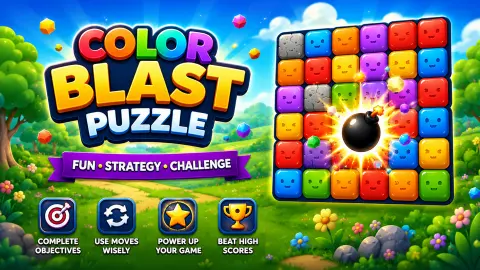
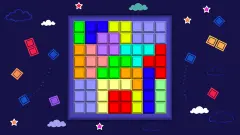
That one difference changes what you are looking at. In a swapping puzzle you hunt for pairs that are nearly in a row. Here you are reading the board for shape: where a colour has pooled, which tap would join two pools into one, and which tap would waste a pool by taking half of it. The blocks are rounded squares with small faces on them, sitting on a green meadow with a tree and some clouds behind, which is about as gentle as a game can look while quietly asking you to plan four moves ahead.
The pressure comes from the counter in the top-left corner, labelled Moves. Level 1 gives you fifteen. The top right holds the Goal: a blue block with an 8 beside it and a green block with a 10. Those numbers count down as you clear, and when one hits zero it turns into a green tick.
The game is credited to DRACOWL STUDIOS. It has been available since August 2026.
We played one session. We finished level 1 with moves to spare and stopped partway into level 2.
The goal counters run down, the score runs up, and they are not the same race
Two scoreboards sit above the board and they want different things from you.
The Goal counters are the level's actual demand, and they only ever go down. Blue started at 8, was at 2 after a couple of clears, and finished as a tick. Green went from 10 to 8 the same way.
The Score is a separate bar underneath, with three stars spaced along it. Level 1 lit its first star when the score passed 100 and its second by 220. Those stars are not where the thresholds are on every level: in level 2 we were on 70 points with all of them still grey.
So you can satisfy a level and still score badly, and the game makes no attempt to hide it. Finishing is one thing. Finishing well is a different calculation, and it is settled almost entirely by the size of the patches you chose to take.
Tapping groups instead of swapping pairs is a 1985 idea
The rule this game runs on is one of the oldest in puzzle games, and it is older than the swap-two-tiles rule most people think of as the standard.
In 1985 a Japanese programmer, Kuniaki Moribe, who wrote under the name Morisuke, published a game called Chain Shot! for Fujitsu's FM-8 and FM-7 home computers through the monthly magazine Gekkan ASCII. The rule was exactly this one: click a group of adjoining same-coloured pieces and the whole group disappears. In 1992 a UNIX version by Eiji Fukumoto renamed it SameGame, and that is the name the genre kept.
The part worth knowing is how it has been scored ever since. Most versions of the rule pay out roughly the square of the group size — remove n pieces and you earn something near n squared. Doubling the size of a patch does not double what it pays; it roughly quadruples it.
That square is the entire strategy of Color Blast Puzzle, and it is why a board full of small two-block matches feels like losing even while the goal counters tick down. Our 30-point tap and our 90-point tap cost exactly the same thing: one move. The game never says this out loud. It just quietly pays you three times as much for being patient, the way it has been doing since 1985.
The level is not over when you have won it
This is the part we did not expect, and it is worth playing for on its own.
With eight moves still on the counter, both of our Goal counters had turned to ticks. The level was solved. We stopped tapping.
The game kept going without us. The counter ran itself down to zero while the entire board came apart in a rain of coloured pieces, with a +320 floating in the middle of it, and the third star finally lit. The card that came up afterwards read: Completed, Level 1, Your Score 1680.
We had earned 390 of those points by hand. The remaining thousand-odd came out of the eight moves we had saved, cashed in automatically once there was nothing left to solve.
Which turns the whole puzzle inside out. The goal is not the goal — it is the toll you pay to reach the real scoring round. Every move you spend fumbling is a move that would have been worth far more after the ticks appeared, and the fastest route to the goal is, by a wide margin, the highest-scoring one.
What is still locked, and what level 2 does about it
Four slots sit on a dark bar under the board, and in level 1 every one of them carries a padlock. They are power-ups, and we never got one open.
By level 2 the first slot had changed: a black bomb with a small blue plus badge on it, where the padlock had been. We ended our session without pressing it.
Level 2 also stops being tidy. Level 1 is a plain six-by-six grid of four colours. Level 2 is seven wide with stepped edges and a notch missing from the middle, and it adds grey, orange and purple — three goals instead of two, twenty moves instead of fifteen, and a shape that makes it much harder to see where a colour has pooled.
Behind the level card sits a map: a winding path of numbered circles, eleven of them visible, with a heart counter reading five and full, a coin total of 300, and a corner bubble offering 50 coins for watching something. What the hearts are for, what the coins buy and how far the path runs are all things we would have to keep playing to tell you.
More puzzles that are about colour, not luck
If it is the tapping you want more of, Blast Jam clears a picture made of jelly cubes by colour rather than by position. Vegetables Match 3 is the other half of this comparison — the swap-two-tiles rule, done properly, so you can feel the difference in a minute. ExitBlocks: Color Match Puzzle and Coffee Color Blocks both take colour-matching away from the grid entirely and make it about getting a shape to the right gate. The rest are in puzzle games.
Screenshots
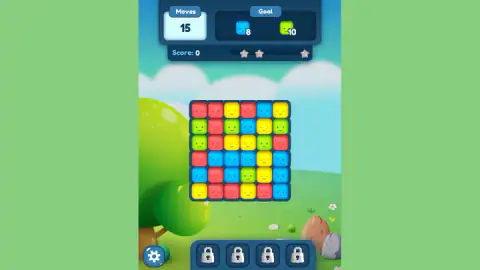
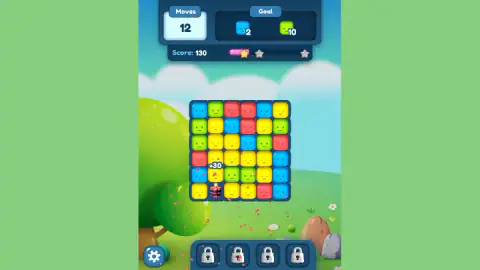
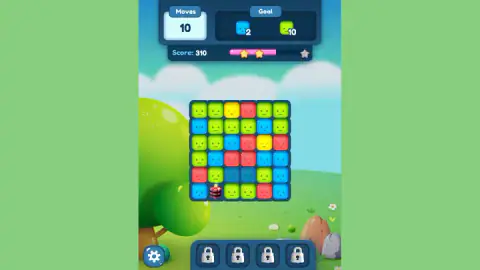
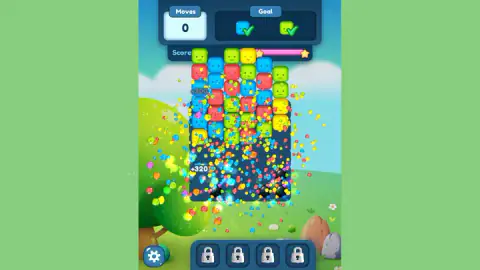
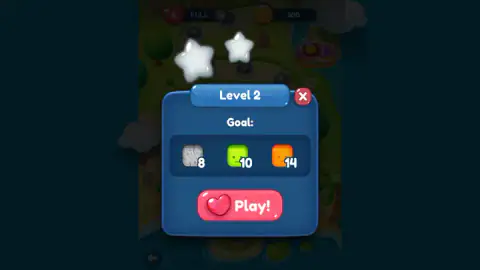
Taken by opening the game ourselves and letting it run — not supplied by the publisher, and not the same picture every other site shows.
How to play Color Blast Puzzle
- Find a colour that has pooled, not a colour that is scattered. A tap only works on a block with at least one same-coloured neighbour. Two blocks is a legal move; it is also a wasted one.
- Tap the patch. The whole connected group goes, a number floats up over the gap, and the blocks above fall into it.
- Watch the Goal counters, not the board. Level 1 asked for eight blue and ten green. Everything else you clear is housekeeping — useful housekeeping, because it drops goal colours into reach.
- Count your moves against what is left on the Goal. Fifteen moves and eighteen blocks to find is not generous. We finished with eight still in hand, and that turned out to matter enormously.
- Press Play! on the level card. It shows you the goals before the board, which is the one moment to decide which colour you are hunting first.
What our session taught us:
- The numbers that float up are the move's wage, and they are not flat. Three of our taps paid 30, then 60, then 90 points. The score moved by exactly those amounts each time. A small tap is not a cheap move; it is the same move at a fraction of the pay.
- Clearing a non-goal colour is often the goal move. Blocks fall straight down. Taking out a pool of yellow underneath a scattering of green is how the green ends up in a pile.
- Do not rush to finish. Hitting the goal early is the single most profitable thing in the level — see below.
- The page pauses itself if you click away. A thin bar comes up asking you to click to keep playing. Nothing is lost.
Controls
| Click or tap a block | Clears that block and every block of the same colour touching it, up, down, left or right. One tap, one move off the counter |
|---|---|
| Play! (on the level card) | Starts the level. The card shows the goals first, and the red X in its corner sends you back to the map |
| Gear button (bottom left) | The settings panel, sitting just outside the board |
| Numbered circles on the map | Pick a level. Only the ones you have reached are open; eleven of them were on the path we could see |
| Arrow keys and letter keys | Nothing we could detect. We tried the four arrows and A and got no response from the board |
Features
- A 6x6 grid in level 1 that stops being a rectangle in level 2, where the board grows to seven wide with stepped edges and a notch missing from the middle
- Goal counters that run backwards as you clear, then turn into a green tick: we watched blue go 8, then 2, then done
- A score bar with three stars spaced along it, lighting as the score passes thresholds the level sets, and floating numbers over each clear that are exactly what that tap paid: we saw 30, 60 and 90
- Unused moves cashed in automatically once the goals are met, which took our level-1 score from 390 to 1,680
- Four slots under the board, padlocked in level 1, with a bomb sitting in the first one by level 2
- A level map with a heart counter, a coin total and a winding path of numbered levels
- It has been available since August 2026
Game details
- Developer
- DRACOWL STUDIOS
- Release date
- August 2026
- Last updated
- August 18, 2026
- Added here
- July 2026
- Technology
- HTML5 (2D)
- Platforms
- Browser (desktop), Browser (mobile & tablet, touch)
- Classification
- Puzzle
- Saved progress
- Saving, when available, is managed by this game. Mava cannot confirm your level.
FAQ
How do you play Color Blast Puzzle?
You tap a block that has at least one neighbour of the same colour, and the whole connected patch of that colour disappears. Nothing is dragged and nothing is swapped. Each tap costs one move from the counter at the top left, and the level is won when the goal counters at the top right have all turned into green ticks.
What do the numbers next to the coloured blocks at the top mean?
They are what the level wants from you, counted down. Level 1 asked for eight blue and ten green, and after a couple of clears the blue figure had dropped from 8 to 2. When a colour is finished, its number is replaced by a green tick. The score is kept separately, on its own bar underneath.
What happens when you complete the goals with moves left over?
The game spends them for you. We met both goals with eight moves still on the counter, and instead of ending there the board came apart in a shower of pieces while the counter ran down to zero. Our score went from 390 to 1,680 in those few seconds, so most of the points came after the puzzle was already solved.
Why does clearing one big group beat clearing several small ones?
It is how this family of puzzles has scored since 1985. Removing a group of tiles is usually worth something close to the square of its size, so doubling the size of a patch roughly quadruples what it pays. In our session three separate taps paid 30, 60 and 90 points, and a single tap is never worth as much as the patch it could have been part of.
What are the four locked slots under the board?
They are power-up slots, and in level 1 all four carry padlocks. By level 2 the first one held a black bomb with a small plus badge on it. We finished our session without pressing it, so what it costs and how wide it clears are things we cannot tell you.
Who made Color Blast Puzzle?
The game is credited to DRACOWL STUDIOS. No studio name appears on screen while you play. It has been listed since August 2026.
Does Color Blast Puzzle have ads?
The only ad-shaped things we met were a panel before level 1 saying it had skipped the ad that time, with a button to carry on, and an optional offer on the level map promising 50 coins for watching one. We were never made to sit through anything. The page also pauses itself with a thin bar if you click away, which is easy to mistake for a freeze.
Can you play Color Blast Puzzle on a phone?
It is listed for desktop, mobile and tablet, and the whole game is one gesture — a tap on a block — so there is nothing a keyboard does that a finger cannot. We played on a desktop, so we can describe the board but not how it feels under a thumb.