








About Super Candy Jewels
Most match-3 games teach you to count matches. The Super Candy Jewels game counts something else: points, against a fixed number of moves. Level 1 sets a points goal and a budget of 15 moves, and the fastest lesson it gave us is that the moves are not equal. One swap of ours was worth 480 points. Another, on the same level, was worth 4,680.
The difference was not skill. It was what fell afterwards. When a line clears, the candies above drop into the gap, and if they land in a new line, that clears too, and it pays better than the first one did. So the game is less about spotting a match than about guessing what the board will look like once the match is gone.
The game is credited to Inlogic Software, whose logo is on the loading screen. It was published in September 2025.
Here is the honest size of our visit. We played about ten minutes on a desktop computer with the mouse, and all of it was level 1, which we started three times. We did not pass it. Our best attempt stopped 320 points short of the goal with nearly all its moves unused, so we can tell you how the level starts and how it scores, and not what happens when it ends.
What one move can be worth in the Super Candy Jewels game
We made exactly one scoring move in each of our three starts, which turns out to be a tidy experiment. Same level, same goal, three different results.
| Start | What the swap did | Points |
|---|---|---|
| First | Lined up three purple candies in a column | 480 |
| Second | Lined up four purple candies in a column | 720 |
| Third | Set off a chain that kept clearing as candies fell | 4,680 |
The third one is the one to study. The game prints a small number over every candy as it vanishes, and half way through the chain we could read them. The blue ones, cleared by the swap itself, showed 160 each. The red and orange ones, cleared a moment later by the fall, showed 240 each. A candy is worth more when it goes as part of a chain than when you clear it by hand.
That changes how the goal reads. At the price of a plain line of three, the goal is about eleven matches inside a budget of fifteen moves, so level 1 is forgiving. At the price of a chain, it is two moves. The level is not really asking whether you can find matches. It is asking how few moves you need.
A warning about what we do not know. The score bar sits under three stars, and at 4,680 points it was about a third full with none of the stars lit. We never saw a star light up, so we cannot tell you what score each one needs.
The board, the striped candies and the three empty slots
The level 1 board is not a square. It is a cross, a rectangle with its corners cut off, which leaves 26 squares. The short top and bottom rows matter, because a column at the edge is only three candies tall and gives you far less to work with than one in the middle.
There are four kinds of candy in level 1: a purple jelly, a red bean, an orange segment and a blue ball. With so few colours on so small a board, lines form often, and that is why chains are common enough to plan around.
Two striped candies turned up. The line of four purples left a striped purple one in the column where the line had been. The long chain left a striped blue one with a fuse on top, like a firework. The game's own instructions say that matching more than three in a row makes "candy bombs" worth more points. We did not manage to set either of ours off, so what they clear is something you will find out before we do.
Under the board there are three slots: a heart, a silver ball and a dark ball with coloured specks. All three read "0x" for our whole session. The instructions call them boosters and say you obtain them; we were never given one, and we saw no shop.
How big it is, as far as we saw
The level map shows twelve levels a page. Level 1 is open and the rest carry padlocks. Under them is a row of ten dots between two arrows, the first dot coloured in. If each dot is a page, the game has 120 levels. We only saw the first page, so treat that as a reading of the map and not a count.
The instructions mention running out of "moves or time". Level 1 has a move counter and no clock, so if there are timed levels they come later.
Swapping two neighbours is an idea from 1994
The rule this game runs on has a traceable start. Wikipedia names Shariki, written in 1994 by the Russian programmer Eugene Alemzhin, as the first of what became known as match-three games. The name means "the marbles". You swapped two adjacent balls, a line of three or more of one colour vanished, and new balls fell from above.
That is, move for move, what you do in level 1 here. Wikipedia adds that Shariki led directly to Bejeweled in 2001, the game that made the idea famous.
What the later games added to Shariki is mostly what we have been describing: a goal per level, a move limit, and special pieces for longer lines. Super Candy Jewels sits firmly in that later family. The swap is thirty years old; the fifteen-move budget is the modern part.
Who it is for
It suits anyone who wants a match-3 that explains itself in one screen. The goal is a number, the limit is a number, and both stay in view.
It is less suited to players who want a story, a map to decorate or characters; we saw none of those. And if you dislike luck, be aware of how much one lucky fall decided in our session.
More games to try next
Royal Jewels Match is the same swap with gems and coins to collect. Lantern Alley: Match 3 also rewards lines of four and five with a power-up. Diamant: Match 3 Sky Story wraps the boards in a city-building story, and Vegetables Match 3 puts them against a clock. The rest are under puzzle games.
Screenshots
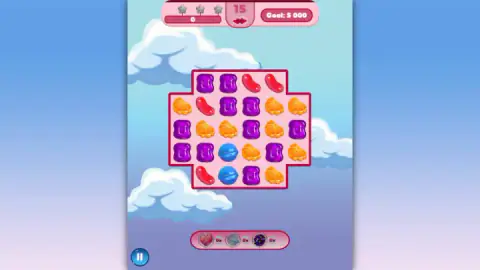
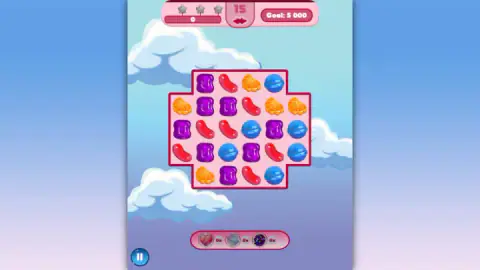
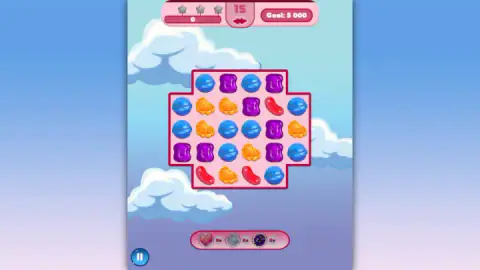
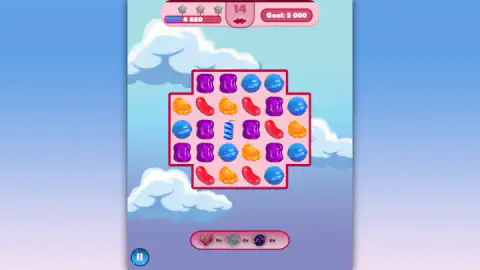
Taken by opening the game ourselves and letting it run — not supplied by the publisher, and not the same picture every other site shows.
How to play Super Candy Jewels
- Pick level 1 on the map. It is the only one without a padlock. A card shows the goal, "Get 5 000 points", and a round play button.
- Drag a candy onto its neighbour. The two swap places. The swap counts when it puts three or more of one colour in a row or a column.
- Watch the fall. The matched candies vanish, the ones above drop, and new ones come in from the top. Any new line clears by itself.
- Read the top bar. The score is on the left under three stars, the moves you have left are in the middle, and the goal is on the right.
- Reach the goal before the moves run out. The game's own instructions say that is how a level is won.
What ten minutes on one level taught us:
- Wasted swaps were free. When a drag of ours lined up nothing, the board stayed as it was and the move counter did not drop. Only swaps that cleared something cost a move.
- Do not take the first match you see. Fifteen plain lines of three, at the 480 points ours paid, would clear the goal with room to spare. But one good chain did nearly the same work in a single move.
- Four in a line is worth setting up. It paid 720 points instead of 480 and left a striped candy on the board.
- The level may open paused. More than once the board came up behind a Pause window with the note "Click to keep playing". The red X closes it.
- The board is dealt fresh each time. Each of our three starts of level 1 had a different layout. The Pause window has a restart button, which we did not press.
Controls
| Drag a candy onto a neighbour | Swaps the two; the swap only stays, and only uses a move, if it lines up three or more of one colour |
|---|---|
| Click the play button on the level card | Starts the level |
| Pause button (bottom left) | Opens the Pause window, which repeats the level goal and has menu, play and restart buttons |
| Red X on the Pause window | Closes it and returns to the board |
Features
- Level 1 asks for 5,000 points in 15 moves on a 26-square board shaped like a cross
- A plain line of three paid 480 points in our run, a line of four paid 720 and left a striped candy behind
- Chains pay more: candies cleared by the swap showed 160 points each, those cleared by the fall showed 240
- The same level deals a different board every time you start it
- Three booster slots under the board, all empty at the start
- A level map with twelve levels a page, eleven of them locked until you clear the first
- Made by Inlogic Software
Game details
- Developer
- Inlogic Software s.r.o.
- Release date
- September 2025
- Last updated
- August 10, 2026
- Added here
- July 2025
- Technology
- HTML5
- Platforms
- Browser (desktop, mouse), Browser (mobile & tablet, touch)
- Classification
- Puzzle
- Saved progress
- Saving, when available, is managed by this game. Mava cannot confirm your level.
FAQ
How do you play the Super Candy Jewels game?
You drag a candy onto the one next to it to swap them. If the swap puts three or more of the same colour in a row or column, they vanish, the candies above drop and you score. Level 1 asks for 5,000 points and gives you 15 moves to get them.
How many moves do you get in Super Candy Jewels?
Level 1 gives 15 moves, shown in the middle of the top bar. In our run the counter only went down when a swap cleared something; swaps that lined up nothing left it where it was. We did not get past level 1, so we cannot give the count for later levels.
How do you get a high score in Super Candy Jewels?
Look for chains, not single matches. A lone line of three paid us 480 points, while one swap that set off a chain paid 4,680, which is most of the level 1 goal. During that chain the candies cleared by our swap showed 160 points each and the ones cleared afterwards showed 240.
What do the striped candies do in Super Candy Jewels?
They appear when you match more than three. A line of four purple candies left a striped purple candy on our board, and a long chain left a striped blue one with a fuse on top. We did not manage to set either of them off, so we cannot say what they clear. The game's own instructions call them candy bombs.
How many levels does Super Candy Jewels have?
We cannot give an exact figure. The level map shows twelve levels on a page, with only the first unlocked, and a row of ten dots under them. If each dot is a page, that would make 120 levels, but we only saw the first page.
Is there a time limit in Super Candy Jewels?
Not in level 1, which counts moves and shows no clock. The game's own instructions speak of running out of moves or time, so timed levels may come later. We did not reach them.
Who made Super Candy Jewels?
It is credited to Inlogic Software s.r.o., and the loading screen shows the Inlogic Games logo. It was published in September 2025. It is listed for PC, Android and iOS in portrait; we played it on a desktop computer with the mouse.