




About Sea Legends - Match 3
Everything about this game says match 3. The title says it. The distributor that sends it to us files it under Match 3. Our own catalogue files it under puzzle and moves on. Then the board loads, and it is not a match-3 board.
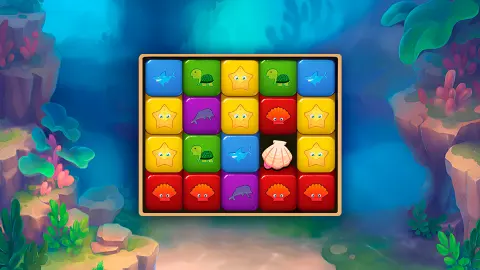
What loads is a grid of chunky square blocks in five colours, each colour carrying one sea animal and never a different one: yellow is a starfish, red is a clam, blue is a shark, green is a turtle, purple is a dolphin. Five columns across, six rows down, with the top cell of the middle column bitten out so the wooden frame has a notch in it. What is missing is the thing every match-3 board is built around — a pair of tiles waiting to trade places.
We found that out the slow way. We arrived with the reflex these games teach you: pick a tile, drag it onto its neighbour, wait for the swap. We used it for most of four minutes. The board did not move. In the whole session the moves counter came down three times, from eighteen to fifteen.
The game had already told us. Before the first move it puts up a card that reads Collect blocks until you reach the target, with a green OK button under it. Collect, not swap. The game is credited to Ermac Alex. It was published in December 2024.
The name says match 3, and the board says something else
A match-3 is a trading game. Two tiles swap places, three or more of a kind line up, and the line vanishes. The grid is always full, nothing is ever connected in a blob, and three is the floor.
This is the other kind. You never trade anything. You press into a region of one colour and the whole region goes, however it is shaped, after which everything above it drops into the hole. The grid is not kept full and the shape of what is left is the puzzle.
The counters settle it. Between two of our published captures a single move went by. The score rose by twenty points and the yellow goal fell by two. One press, one pair, no third block anywhere. A swap-based match-3 cannot accept that move, because two in a row is not a match.
There is a small joke sitting on top of all this. The box holding the moves counter wears a badge of two arrows pointing in opposite directions — the swap icon, the one every trading puzzle in the world uses — on a board where nothing is ever swapped. It is in every capture we took.
This matters because it changes what you look at. In a match-3 you scan rows and columns for near-lines and work out which single tile would complete one. Here lines are irrelevant and you are looking for blobs: the biggest contiguous patch of one colour, and what will fall into the hole it leaves. Those are different habits, and bringing the wrong one is how we spent four minutes clearing three moves.
Chain Shot, 1985: where pressing blocks actually comes from
The mechanic has a name and an inventor. In 1985 Kuniaki Moribe, writing under the handle Morisuke, published a game through the Japanese magazine Gekkan ASCII for Fujitsu's FM-8 and FM-7 home computers. He called it "Chain Shot!". You pick a connected group of same-coloured blocks, they disappear, what is above them falls, and when a column empties the remaining columns slide together.
That is, line for line, what the board in Sea Legends does. The game was ported and renamed for decades afterwards, as SameGame on Unix and Windows and under a long list of other names, and the family it founded is quite separate from the swap-two-tiles family that arrived later and took over the word "match".
One detail from that lineage is worth carrying in. Classic versions score a clear by the square of its size, so taking eight blocks at once beats four clears of two by a wide margin. The size of the group, not the number of groups, is the whole game.
We cannot tell you whether that holds here. Every clear we measured was a pair, and every pair paid the same twenty points. The game's description says the bigger the combination, the more powerful the boosters it produces, so the reward for a large group may be a tool rather than a number. That is their account, not ours.
Three goals, one of which we never understood
The level we played ran three demands at once, which is more than the opening level of a puzzle game usually asks.
Two of them were ordinary: a count of red blocks and a count of yellow ones, each with a picture of the plain block and a number beneath. Those numbers come down as you collect, and watching them is how we worked out the scoring at all — red fell from four, yellow fell from eight, and the score climbed in step.
The third was a white scallop shell, pale pink and clearly not one of the five block colours, with a goal of exactly one. It sat in the fifth row of the fourth column. It was there in our first published capture and it was still there in our last, in precisely the same cell, while the rows above it had turned over completely. Its counter never moved off one.
Underneath the moves counter sits a bar with three star outlines on it. On our first capture the bar was empty and all three stars were brown. By the time the score reached sixty the bar had filled to the first star and that star had turned gold. We never reached the second, so what the three stars cost is something you will find out before we did.
A portrait game in a wide window
The last thing worth saying is about shape. The game's listing gives this for both landscape and portrait, and the board is unmistakably designed for a phone held upright: a tall narrow column, five blocks wide, with the header stacked above it and the booster row stacked below.
Put that in a wide browser window and roughly the middle third is the game. The rest is a painting of a reef — stepped rock terraces, pink and red coral, deep blue water going dark in the distance — and none of it does anything. Behind the board itself sits a second scene, dimmed almost to brown, with a beach ball, a striped parasol and slices of watermelon.
It is a good painting and it is not a problem, but it is worth knowing what a desktop gets you: blocks smaller than the artwork around them, and a column in the middle of a postcard.
More games by Ermac Alex
The same studio has a long shelf with us, and the useful comparison is sitting right on it. Heroes of the Dungeons: Match-3 RPG is a real swap match-3 by the same hand, so you can put the two side by side and feel the difference in a minute. Mansion Design - Match 3 runs the same puzzle under a decorating story.
If it was the blocks that brought you rather than the sea, Block Blast Mania is the same studio going the other way: you place shapes onto a grid instead of clearing them off one. And Tap 3D Wood Block Away is the nearest relative in habit, a board you clear by pressing rather than by trading. The rest is in puzzle games.
Screenshots
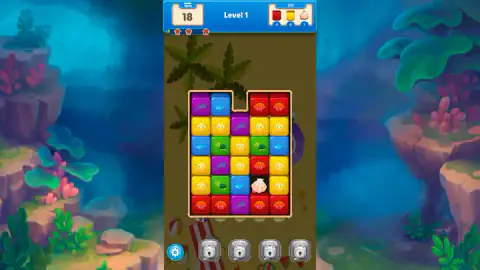
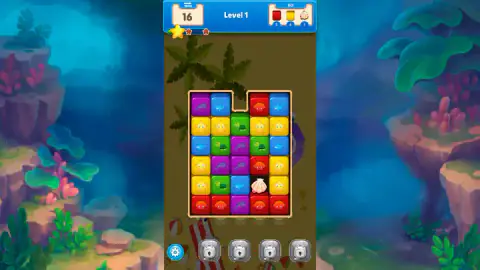
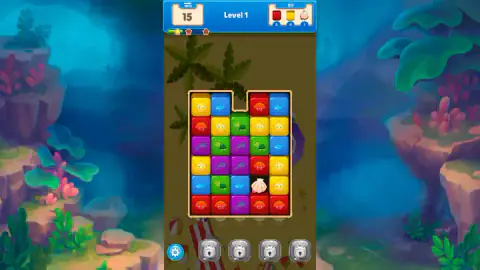
Taken by opening the game ourselves and letting it run — not supplied by the publisher, and not the same picture every other site shows.
How to play Sea Legends - Match 3
- Press a block. Do not drag it. One press is one move. Dragging is the habit the title plants in you and it does nothing here.
- Press where blocks of one colour are already touching. The whole connected group goes at once, and two blocks is a legal group.
- Read the panel in the top right before you spend anything. It is the level's shopping list: a picture of each thing the level wants, with how many you still owe underneath.
- Watch the number on the left. That is how many presses you have left, and it is the only resource in the game.
- Ignore the row of buttons along the bottom at first. On the opening level all four wore a padlock.
What the session taught us:
- Bigger groups are the whole skill, and they are not where you look first. The instinct is to clear the pair you can see. The board is six rows deep and things fall, so the pair you clear low down decides what lands on top of what.
- The goals are a shopping list, not a score. Clearing a beautiful group of a colour nobody asked for still costs a move. On our level the list wanted red and yellow, and every green or purple press was a move spent on the scoreboard alone.
- The notch in the frame is a rule, not a decoration. A missing cell means two blocks that look adjacent are not connected, and a group that should have cleared does not.
- One tile on the board is not a block. A pale scallop shell sat in the fifth row through everything we did and never moved while the rows above it changed completely.
Controls
| Press a block | Clears it together with every block of the same colour that touches it. Two is a legal group, which is the whole difference between this and a match-3 |
|---|---|
| Drag one block onto its neighbour | Nothing. We used the match-3 reflex for most of a session and the board never moved once |
| The panel in the top right | Not a button. It is the level's shopping list, with how many blocks of each kind you still owe |
| The four grey buttons along the bottom | Boosters. All four wore a padlock throughout the level we played, so none of them was available to us |
| The blue cog, bottom left | The one button on that row without a lock on it |
| The keyboard | Enter moved us past one of the opening screens. Once the board was up, a letter key did nothing we could see or hear |
Features
- A block-collapse board of five colours, each with its own animal - starfish, clam, shark, turtle and dolphin - so the colour and the creature are the same fact told twice
- Every clear we could measure was a pair of blocks worth twenty points, which is a move no swap-based match-3 would allow
- Three goals running at once on the opening level: a count of red blocks, a count of yellow blocks, and a single white shell
- A board with a bite out of it, five columns by six rows with the top of the middle column missing, so the shape itself blocks some groups
- Four booster slots along the bottom edge, every one of them padlocked on level one
- A three-star bar under the moves counter, with the first star lit by the time our score reached sixty
- Available since December 2024 and last updated in August 2026
Game details
- Developer
- Ermac Alex
- Release date
- December 2024
- Last updated
- August 10, 2026
- Added here
- April 2025
- Technology
- HTML5 (Unity WebGL)
- Platforms
- Browser (desktop), Browser (mobile & tablet, touch)
- Classification
- Puzzle
- Saved progress
- Saving, when available, is managed by this game. Mava cannot confirm your level.
FAQ
Is Sea Legends - Match 3 really a match-3 game?
No, and this is the most useful thing to know before you start. A match-3 asks you to swap two neighbouring tiles so that three or more line up. Sea Legends gives you a board of square blocks that you clear by pressing a group of the same colour that are touching each other, with no swapping at any point. The name, and the category it is filed under, both describe a game it is not.
How do you play Sea Legends - Match 3?
You press a block that has at least one neighbour of the same colour, and the whole connected group of that colour disappears. Blocks above the gap fall into it, which rearranges what is next to what. Each press costs one move, you have a fixed number of them, and the panel in the top right tells you what the level wants collected before they run out.
What are the icons in the top right corner?
They are the level's goals, and the number under each one is how many you still owe. On the level we played there were three: a red block, a yellow block and a single white shell. The larger number above them is your score, which climbed while those three counters came down.
How many blocks do you need to clear at once?
Two is enough. The clearest measurement we took was a single move that raised the score by twenty points and took two blocks off the yellow goal - one press, one pair, no third block needed. That is a move a swap-based match-3 could never accept, and it is the quickest way to tell the two kinds of game apart.
What are the four buttons at the bottom of the screen?
They are booster slots, and all four carried a padlock for the whole of the level we played, so we never used one. The game's description says the bigger the block combination the more powerful the boosters, and that they can be combined with each other. That is their account rather than ours, because nothing on that row was ever available to us.
What is the white shell on the board?
It sits in the board like a block but it is not one of the five colours, and the level's goal list asks for exactly one of it. It stayed in the same cell through every capture we published while the rows above it changed, and its counter never moved off one. We can tell you it is a goal; we cannot tell you what frees it.
Who made Sea Legends - Match 3 and when?
The game is credited to Ermac Alex. It has been listed since December 2024, was last updated in August 2026. No studio name appears on screen while you play.
Can you play Sea Legends - Match 3 on a phone?
It is listed for desktop, mobile and tablet, and for both landscape and portrait, and the board is plainly built as a tall narrow column rather than a wide one. Our own session was on a desktop, so we can describe what a mouse does and nothing more. On a wide screen the playfield takes up roughly the middle third and a painted reef fills the rest.