






About Heroes of the Dungeons: Match-3 RPG
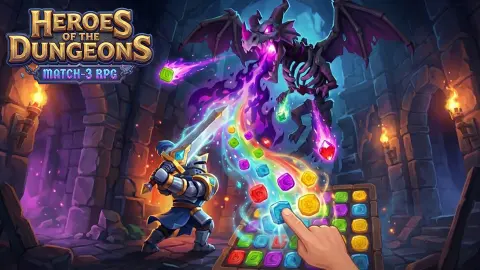
Most match-3 boards ask you to push a number up. This one puts a horned, pink-tusked monster across the top of the screen and gives you nothing to hit it with except a line of three.
The board underneath is seven tiles across and five down, and the tiles are not gems but carved runes in five colours: a green leaf, a blue droplet, a purple crescent, a red flame and an amber sun. Between the board and the monster stands a row of five heroes, and this is where the game shows its hand. Each hero carries a small badge in the corner of their portrait, and each badge holds one of those same five runes. The orc in gold armour has the leaf. The helmeted knight has the droplet. The hooded one has the crescent. A colour on the board is not a scoring category. It is a person.
Under the heroes sits one dark plate with HP written at one end and TIMER at the other: a red health bar carrying a number, and a green bar beside it. Clear a long enough line and the word COMBO lands in the middle of the screen while beams of light fire up out of the gap and into the monster. That is the whole conversation between the puzzle and the fight.
The game is credited to Ermac Alex and has been available since January 2026 and last saw it updated in August. Our own session was short and stubborn, and you should read the rest of this page knowing it: about four minutes, one fight, one monster, and a tutorial that would not let go. We never saw a win, a reward or the castle the listing promises, so none of that is described here.
Five heroes, five runes, and four gauges that never moved
Next to each hero's badge is a thin gauge. In every moment of our fight, four of those five gauges stayed grey and empty, and the fifth — the purple crescent, belonging to the hooded figure third from the left — sat full and bright green, lifted above the row where you cannot miss it.
That is a game telling you something without a line of text. A hero whose gauge is full is a hero holding something back. The four grey ones are what you are working towards, and the colour you clear is how you work towards them. It also explains why a match-3 board here has exactly five colours rather than six or seven: the palette is not a difficulty dial, it is a roster.
What we cannot tell you is what happens when a gauge fills, because in four minutes we never filled one. The listing says heroes have abilities you fire when they are ready. We saw the ready state and never saw the firing, and we would rather say that plainly than describe something we did not watch.
The match-3 battle board is nearly twenty years old, and this one throws away the skulls
Matching coloured tiles to fight a monster is not a new idea, and it has a clear starting point. Puzzle Quest: Challenge of the Warlords arrived on handhelds in March 2007, built by Infinite Interactive and designed by Steve Fawkner, and its whole argument was that a Bejeweled board could carry a role-playing game on its back. You walked a map, you met a monster, and the fight was a grid.
The rules it set became the template. Coloured gems paid mana into your spells, so a colour was a resource. A separate kind of tile — the skull — did the actual damage, so hurting the enemy and powering yourself were two different jobs on the same board. Matching four or more bought you an extra turn. And combat alternated: you moved, then the monster moved, on the same grid you had just left.
Heroes of the Dungeons keeps the first idea and discards the rest. There are no skulls here: the five runes are the whole set, and a clear of any colour sets off an attack over the board. So the split between arming yourself and hurting the thing in front of you is gone, and one move does both jobs. More to the point, nothing alternates. The monster never takes the board. The TIMER takes it instead — the game's own tutorial line is that "You can match more puzzles while the timer remains" — and what you are racing is a clock rather than an opponent's turn.
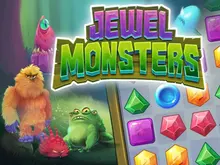
That swap changes the texture completely. In the turn-based lineage, a bad move is bad because the monster now gets a free one. Here a bad move is bad because it was slow. It is the difference between chess and a timed round of Jewel Monsters, which runs the same monster-at-the-top layout and is worth a look if this reads like your kind of fight.
The game is built tall, and your browser is wide
Open it on a desktop and the first thing you notice is that the game is a column. The board, the heroes and the monster all live in a strip down the middle, perhaps a third of the window across, and the rest of the frame is painted scenery: a dark blue wooded swamp with barrels and a lantern on the left, a red canyon at sunset on the right.
Those panels are wallpaper. They did not change once during our fight, nothing in them responds to a click, and they exist because the game was laid out for a phone held upright and something has to fill the sides. The practical consequence is that the tiles are small on a big monitor, and the rune stamped on each one — the thing you actually need to read — is smaller still.
On a phone this problem disappears entirely, because the tall layout is the native one and the board fills the glass. If you have the choice, that is the screen to use. If you are on a desktop, it is worth putting the window somewhere you can lean towards.
More fantasy match-3 to play next
Lantern Alley: Match 3 uses the same charge-a-character idea on a night-lit board and is more generous with its chains. Diamant: Match 3 Sky Story takes the fantasy side further and puts a city in the sky behind the tiles. If what drew you here was the dungeon rather than the puzzle, Undercrown is a top-down crawl with eight heroes and three floors, and Kingdom Tower Defense defends a castle with heroes and spells instead of runes. The rest are in puzzle games.
Screenshots
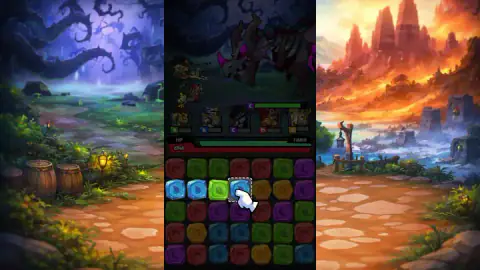
Taken by opening the game ourselves and letting it run — not supplied by the publisher, and not the same picture every other site shows.
How to play Heroes of the Dungeons: Match-3 RPG
- Click once in the middle of the frame to start, and again when a speech bubble parks itself over the tiles.
- Find three of one colour that are one swap apart. Drag the odd tile onto the square beside it rather than clicking both.
- Watch the clear. The tiles vanish, the column above drops into the hole, and the attack plays over the board. That is your damage.
- Keep going while the green TIMER bar lasts. The monster does not wait for a turn of its own, so a slow move costs you the same as a bad one.
What our session taught us:
- The tutorial is not a suggestion. A white hand and a dotted square mark one exact swap, and until you make that swap the board quietly ignores everything else. We spent most of our session proving this the hard way.
- Drag, do not click. Two taps on two neighbouring tiles did nothing for us. The game wants the tile carried onto its neighbour in one motion.
- The speech bubbles block the board. When one appears there is no close button on it. A click in the middle of the playfield clears it.
- The keyboard is dead. Arrow keys and the space bar changed nothing on screen and made no sound.
- Look at the rune, not the colour. The green leaf and the amber sun are easy to tell apart; the red flame and the purple crescent are not, in a dim dungeon, at speed. The shape stamped on the tile is the reliable read.
Controls
| Drag a tile onto the square beside it | Swaps the two. Three or more of one colour in a line clear, and the attack plays out over the board |
|---|---|
| The white hand and the dotted square | Not a control but an instruction. While they are on screen the game wants that one swap, and it refuses the rest |
| A click anywhere in the middle of the board | Clears a tutorial speech bubble that is sitting over the tiles |
| Arrow keys and the space bar | Nothing we could see or hear. This is a pointer game from start to finish |
Features
- A board seven tiles wide and five tall, which is smaller than the eight-by-eight most match-3 games give you
- Five tile colours, each one a carved rune - a leaf, a droplet, a crescent, a flame and a sun
- A row of five heroes above the board, each standing on one of those five colours, each with its own gauge
- One plate under the heroes with HP at one end and TIMER at the other, a red health bar and a green timer bar
- A COMBO banner that fires beams of light up out of the cleared tiles and into the monster
- A tutorial hand that pins the board to one exact swap until you make it
- Available since January 2026
Game details
- Developer
- Ermac Alex
- Release date
- January 2026
- Last updated
- August 25, 2026
- Added here
- November 2025
- Technology
- HTML5 (2D)
- Platforms
- Browser (desktop, mouse), Browser (mobile & tablet, touch)
- Saved progress
- Saving, when available, is managed by this game. Mava cannot confirm your level.
FAQ
How do you play Heroes of the Dungeons: Match-3 RPG?
You drag a tile onto the square next to it to swap the two. Line up three or more of the same colour and they clear, and that clear is the attack - there is no separate attack button anywhere on the screen. A monster stands at the top of the board, and the red health bar on the plate beneath it is what every match is working on.
What do the five tile colours mean in Heroes of the Dungeons?
Each colour is a rune - a leaf, a droplet, a crescent, a flame and a sun - and each one belongs to one of the five heroes standing above the board. Look at the small badge in the corner of a hero's portrait and you will find the same rune that is printed on the tiles. Clearing a colour is how you feed the hero who wears it.
Is Heroes of the Dungeons turn-based?
No, and that is the clearest break from the match-3 role-playing games it descends from. There is no handover to the monster between moves. A green bar marked TIMER runs along the plate above the board, and the game's own tutorial line is that you can match more puzzles while the timer remains.
Who made Heroes of the Dungeons: Match-3 RPG?
It is credited to Ermac Alex. The game has been listed since January 2026, was last updated in August 2026.
How big is the board in Heroes of the Dungeons?
Seven tiles across and five down, which is thirty-five squares in all. That is tighter than the eight-by-eight board most match-3 games hand you, and with five colours sharing it a three-in-a-row is usually sitting somewhere, while a planned four or five rarely is.
Why does the game only use the middle of the screen?
It is built tall, for a phone held upright, and a browser window is wide. The playfield sits in a column down the centre and the rest of the frame is filled with painted scenery - a wooded swamp on one side, a red canyon on the other. Neither changes during a fight, and nothing in them is clickable.
Can you play Heroes of the Dungeons: Match-3 RPG on a phone?
It is listed for PC, Android and iOS, and the tall playfield is clearly designed for a phone first. Every move is a drag of one tile onto the next, which works the same under a finger as under a mouse. We played it on a desktop and did not test a handset.
Is there a castle to upgrade in Heroes of the Dungeons?
The listing says battles pay loot and materials and that those go into castle shops. We cannot confirm it from play - our session stayed inside the opening fight and never reached a win screen, a reward, or anything outside the battle. What this page describes is the battle, because that is what we saw.