
About Good Knight Story
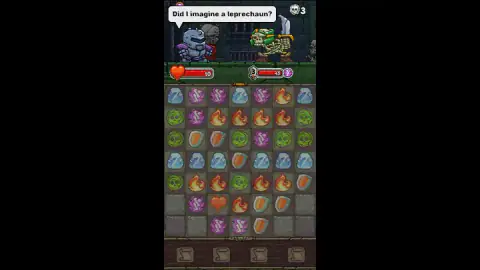
The first board you see in this game would be illegal in most match-3 games. Four flames sit side by side on the second row, and three ice crystals line up on either side of a shield. In a swap game those would have burst before you touched them. Here they wait, because you do not swap tiles at all: you drag a path through touching tiles of one kind, and that chain is your move.
That is the mechanic behind a joke. Your knight wakes up in a dungeon with no memory of the night before, and his first words in the fight we saw were a speech bubble asking "Did I imagine a leprechaun?". A skeleton in a green helmet, holding a curved sword, is the one who gets to answer.
We should be plain about how our own session went. We spent ten minutes with the game and left without completing a single chain. The pause scroll kept opening on us, dozens of times, and most of what we did was press Resume. The knight's health bar read 10 when we arrived and 10 when we left, and the skeleton's 45 never moved. So this page describes what the game shows you in its first minutes, and leans on the published record of its phone version for how a fight plays out.
That record is long. Turbo Chilli, a studio registered in Sydney, released Good Knight Story for iPhone and iPad in March 2016, and the App Store rating stands at 4.7 from about 13K reviews.
The browser version is newer. It was published in May 2026 under the name of Boar Band, which publishes web versions of mobile games.
Connect, do not swap: the board gives it away
The provider's instructions say to connect identical elements, and we could have taken their word for it. The board says it better. On the screen we saw, four flames stood in a row and three crystals stood in a row twice, all untouched. In a swap game the board is generated so that no three-in-a-row exists at the start. In a connect game, runs are not matches until you draw through them, so they can sit there as long as they like.
That changes how you read the board. You are not hunting for the one swap that lines three up; you are looking for the longest crooked path of one colour you can trace. A review of the phone version in Game*Spark in April 2016 describes exactly this: trace a continuous path through gems, and the gem colour decides the element of the attack.
The board itself is a 7-wide grid with the bottom corners cut off, which leaves 43 tiles instead of 49. Those missing corners matter in a path game, because they take away the long edge runs you would otherwise get for free.
Who is who on the battle screen
The fight occupies the top third of the screen and the board the rest, with a row of four empty scroll slots at the bottom. Here is what we could read on the level 1 screen.
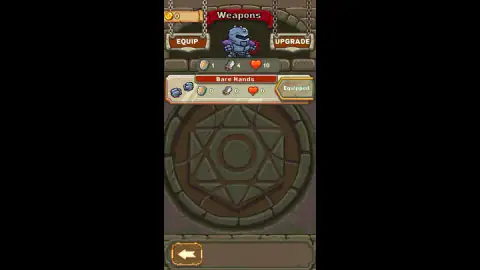
The knight stands on the left under a speech bubble, with a heart bar reading 10. That is the same health the Weapons screen lists for him, next to a sword value of 4 and a shield value of 1. Bare Hands, his starting weapon, adds nothing to any of the three, which is the game's way of telling you the first upgrade is where your coins should go.
The skeleton on the right has a bar reading 45, a shield badge with a 3 on it, and a purple gem beside the bar. Our reading, which we could not test, is that the gem marks its element and the badge is the attack countdown that the phone reviews describe. A second 3 sits under a skull at the top right of the screen. We did not see either number change, so we will not tell you which is which.
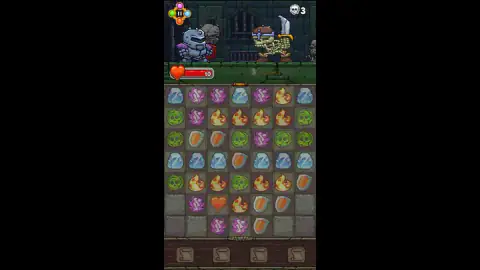
The four orbs around the pause button match the four attacking tile colours, and not the shield or the heart. It reads as a small reminder of what the fight is about: the elements hurt, the rest keeps you standing.
A phone game with ten years of reviews behind it
Most browser match-3 games appear from nowhere. This one has a paper trail. TouchArcade previewed it at GDC in March 2016 as a match-3 RPG about a knight working out what trouble he got into the night before, and the App Store version history starts that same month. Updates followed in 2019, with full-screen support and Game Center achievements, and again in May of this year.
The reviews agree on two things. The writing is the draw: the knight's lines between fights, the puns, the tavern owners. And the later levels get steep, with players describing a grind for coins to keep weapons up to date. The phone version sells coin packs for that; the browser version showed us no shop in our session, only a coin counter at zero.
The App Store rates the game 13+ for cartoon violence, mild crude humour and references to alcohol. That fits what we saw: a hangover plot, skeletons drawn for laughs, nothing frightening. The "survival horror" tag on its listing is wrong, and we have not kept it.
What we did not get to
The list is longer than we would like, so here it is in full.
- A completed chain. We never saw a tile burst, an attack animation or a monster lose health.
- A win or a loss. No level cleared, no reward screen, no stars earned on the map.
- The story. One speech bubble is all the dialogue we can vouch for.
- Level 2. We opened its briefing, but the fight on screen afterwards still showed the same skeleton and the same board, so we cannot describe a second fight.
- Upgrades, boosts, bosses and daily gifts. All promised by the listing, none reached. The Weapons screen exists; what it sells, we do not know.
More match-3 fights and other ports
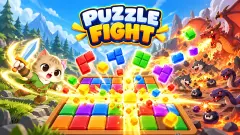
The closest neighbour on our site is Heroes of the Dungeons: Match-3 RPG, which also puts a fight above a board, but uses swaps rather than paths. Puzzle Fight takes a different route to the same idea, with a cat knight fighting on her own while you clear lines in a block puzzle. If you want to feel the difference between swapping and connecting, Lantern Alley: Match 3 is a clean swap game with a long map.
Boar Band's other web ports on our site include Hills of Steel and Grow Empire, both of them phone games first.
More in our puzzle games.
Screenshots
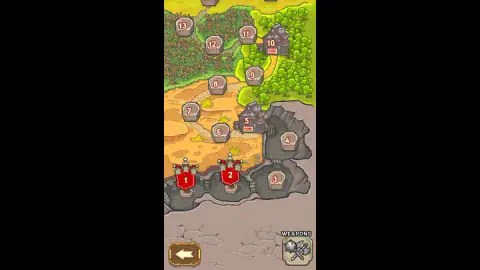
Taken by opening the game ourselves and letting it run — not supplied by the publisher, and not the same picture every other site shows.
How to play Good Knight Story
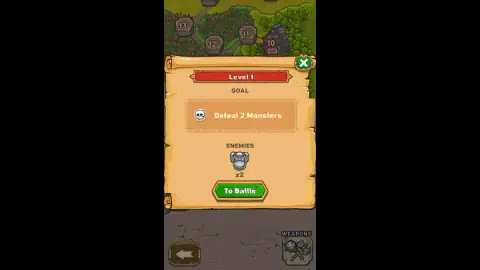
- Press Start and pick a stop on the map. The map is a tall painted path with 13 numbered stops. The first two are marked with red banners; the rest are grey.
- Read the briefing scroll. Each stop opens a scroll with a goal and the enemies in it. Level 1 says Defeat 2 Monsters; Level 2 says Defeat 3 Monsters and shows a purple-mouthed one among two grey ones. To Battle starts the fight.
- Drag a path through matching tiles. The game's instructions say to find identical elements and connect them. The colour of the chain sets what happens: flames, ice, lightning and skulls attack, shields block, hearts heal.
- Watch the two bars. Your knight has a heart bar with his health, and the monster has its own bar with a shield badge beside it. Mobile-era coverage says monsters attack on a countdown, so shield chains are for when that count is about to run out.
- Spend between fights. The WEAPONS button on the map opens Equip and Upgrade tabs. Our knight started with Bare Hands equipped and no coins.
What we can tell you from our own screen:
- The pause button is the ring of four orbs at the top left of the fight, purple, green, blue and orange. If the scroll with Music and Sound Effects keeps appearing, that corner is where to look.
- Admit defeat sends you back to the map. It sits under Resume on the pause scroll, with a scroll icon. We pressed it once and found ourselves on the map afterwards.
- Look at the board before the first chain. Ours offered a four-flame run on row 2 and two three-crystal runs on row 4 from the start. The game appears to seed an obvious opening.
Controls
| Drag through touching tiles of one kind | Connects them into a chain, which the game says is how you attack, defend or heal |
|---|---|
| Tap a numbered stop on the map | Opens that level's briefing, with its goal and the enemies in it |
| To Battle | Starts the fight shown on the briefing |
| Pause button (top left) | Opens the scroll with Music, Sound Effects, Resume and Admit defeat |
| WEAPONS | Opens the Equip and Upgrade screen for your knight |
Features
- A board 7 tiles wide with the corners cut away, so it holds 43 tiles instead of a full square
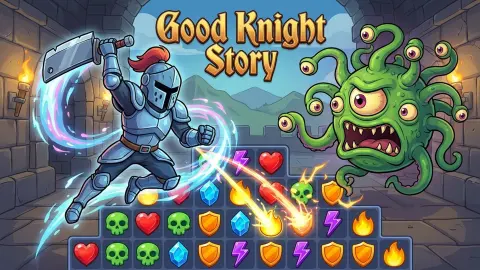
- Six tile kinds on the opening board: ice, fire, lightning, poison, shields and a single heart
- Four flames already sit side by side when the fight begins, which only a connect game allows
- Each level opens with a briefing scroll: a goal such as Defeat 2 Monsters and portraits of the enemies
- Your knight starts with 4 attack, 1 defence and 10 health, and Bare Hands as the equipped weapon
- The map shows 13 stops, two of them buildings marked CLOSED, and a Weapons button in the corner
- A phone game from 2016 with a 4.7 rating from 13K reviews on the App Store, now playable in portrait in a browser
Game details
- Developer
- Turbo Chilli
- Release date
- May 2026
- Last updated
- October 1, 2026
- Added here
- March 2026
- Technology
- HTML5 (2D)
- Platforms
- Browser (desktop), Browser (mobile & tablet, touch)
- Saved progress
- Saving, when available, is managed by this game. Mava cannot confirm your level.
FAQ
How do you play Good Knight Story?
It is a match-3 RPG. A knight stands on the left, a monster on the right, and below them is a board of tiles. You drag a path through touching tiles of the same kind to make a chain, and the chain becomes an attack, a block or a heal depending on the tile. Each level has a goal, such as defeating 2 monsters, shown on a scroll before the fight.
Do you swap tiles or connect them in Good Knight Story?
You connect them. The game's instructions say to find identical elements and connect them, and the opening board confirms it: it has four flames in a row and three ice crystals in a row before anyone has moved, which a swap-based game would never allow.
What do the tiles mean in Good Knight Story?
The board we saw had six kinds: blue ice crystals, orange flames, purple lightning runes, green poison skulls, shields and a red heart. Coverage of the phone version says the colour of the chain sets the element of your attack, shields block the enemy's next hit and hearts heal. We did not complete a chain ourselves, so we cannot add to that.
How many levels does Good Knight Story have?
The map we saw has 13 numbered stops, with the first two open and two of the others shown as buildings marked CLOSED. The store listing for the original phone game promises more than 100 levels. We did not clear a level, so we cannot say how far the browser version goes.
Who made Good Knight Story?
Turbo Chilli, a studio registered in Sydney, released it for iPhone and iPad in March 2016 and later for Android. The browser version is credited to Boar Band, which publishes web versions of mobile games, and was published in May 2026.
Is Good Knight Story free, and does it have purchases?
The browser version is free to play. The original phone game is also free but sells coin packs from about one dollar to thirty dollars, according to its App Store listing. We saw a coin counter at zero on the Weapons screen and no shop in the browser version during our session.
Can you play Good Knight Story on a phone?
Yes. It is listed for PC, Android and iOS in portrait orientation, and the layout is a tall column with the fight at the top and the board below, which is a phone shape. On a computer it appears as a narrow strip in the middle of the screen. We played on a computer.