


About Your Obby Labyrinth
Most maze games open on a start line and an arrow. Your Obby Labyrinth opens in a stone room with no arrow, no tutorial panel and no visible door. Its one instruction is painted on a wall in letters so small that you have to walk up to read them: "You need to get out of here."
That sentence is the whole briefing. You are a small figure seen from behind, in a place built of tall grey blocks over a floor of dark cobbles, and a clock in the corner is counting. The word in the title needs one line of explanation: an "obby" is players' shorthand for an obstacle course.
Here is the awkward part of this page: we played for four minutes and did not leave that first room. So this page covers what the room shows, what the screen tells you, and what to try first. The maze beyond it is still ahead of us.
The game's listing credits the game to KreizLand. It has been available since June 2025.
What the screen tells you before you move
Nothing on screen is labelled with words, so here is what each corner held in our session.
| Where | What is there | What we can say |
|---|---|---|
| Top left | A pause icon marked TAB, a smiley marked Y, an envelope marked T | TAB pauses. The envelope carried a red dot, as if something was waiting to be read. We opened neither Y nor T |
| Top right | A gold coin with a star and a red gem, each with a number | Both read 0 from start to finish |
| Bottom left | A number, a smiley, a name and a small label | The name was a string of random letters given to us by the game. The label read #1.1 |
| Bottom right | A clock | Minutes, seconds and thousandths of a second |
Two of those are worth a guess. A smiley and an envelope are the usual signs for emotes and messages, which would fit a game its listing calls multiplayer. And #1.1 looks like the number of the maze you are in. Both are readings of icons, not things we tested.
The first room sells boosts before you own a coin
Along one wall of the starting room stands a row of white round pads, each inside a glass case. Each pad carries a number and a small shoe with wings: +20 on one, +30 on the next. A third pad sat at the edge of our view with its label cut off.
Above each case hangs a tag, and the tags use the same two icons that sit beside your counters in the top right corner.
| Pad | Tag above it |
|---|---|
| First, label cut off | Gold coin, 200 |
| +20 | Red gem, 50 |
| +30 | Red gem, 100 |
Put together, this reads like a small shop: a winged shoe for speed or jump height, a number for how much, and a price above it in one of the two currencies. Higher up, on a ledge we did not reach, two more tags of 100 were visible.
We could not buy anything, because both our counters stayed at zero for the whole session. We walked up beside the +30 pad and stood there, and the counters did not move. So the shop is our reading of the signs, and we do not know what the boost changes or how long it lasts.
What it does tell you is the shape of the game. Coins and gems are found somewhere past this room, and the first thing they are for is waiting back at the start.
The clock is running before you take a step
The clock shows minutes, seconds and then three more digits. That is the kind of precision a game uses when times are meant to be compared.
Ours already read 03:50 the first time we stood in the room. We had spent that time getting through the opening screens, not walking. From there it kept pace with a real stopwatch to our last look at it, three and a half minutes later, without a pause.
Two practical things follow. If you care about your time, the minutes you spend on the way in appear to count, so do not leave the game open while you do something else. And reading the wall, studying the pads and working out the keys all cost time. A second visit should be much faster than a first, simply because you will already know what the room is.
Labyrinth or maze: the old difference, and a rule for getting out
The title says labyrinth and the listing says maze. Today the two words are used as one, but for a long time they meant different things.
A classical labyrinth has a single path. It winds, doubles back and fills the whole figure, but it never forks. The one laid into the floor of Chartres cathedral around 1200 works that way: eleven rings, one route, no decisions. You cannot get lost in it. A maze is the other thing, a set of branching paths and dead ends where every junction is a choice.
By that measure this game is a maze. Its listing speaks of hidden paths, and a single winding path would not need a sentence on the wall telling you to get out.
There is an old rule for mazes, and it suits a room like this one. Put a hand on one wall and never take it off. Follow that wall around every corner, and in a maze whose walls are all joined to the outer edge you will reach the exit, slowly but surely.
The rule has a known weakness. If you begin inside a block of walls that stands free of the rest, it will walk you in a circle back to where you started. This game starts you inside. We did not get far enough to test the rule here, so take it as a first plan, and switch walls if you pass the same writing twice.
What the listing promises that we did not reach
The game's own description speaks of friends playing together, character skins and pets, monsters, doors, levers, keys, traps and portals between mazes. None of that turned up in the first room, and we are not going to describe things we did not see.
What we can confirm is narrower. The world is fully 3D and seen from behind the character. The collectables are coins and gems. There is a clock and there are icons for pausing and for two more panels. We saw no other player's character in our four minutes.
Who it is for
Someone who likes being dropped into a place and left to work it out. The game explains almost nothing, and for the right player that is the appeal: the first puzzle is the room itself.
It is not for anyone who wants a quick win. We are used to finding our feet in a browser game inside a minute, and here four were not enough to see a second room. A young child playing alone may well stop where we did.
More mazes to try
Marble Maze is a tidier kind of maze, seen from above, where you roll a marble over every open tile. Neon Maze turns the idea into a logic puzzle with arrows to clear. TENKYU BALL has you tilt the whole stage to guide a ball to the goal. And if it was the running and jumping you came for, Parkour Runner 3D is an obstacle course with no walls to get lost between. The rest are under puzzle games.
Screenshots
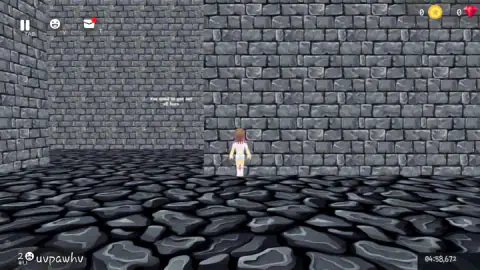
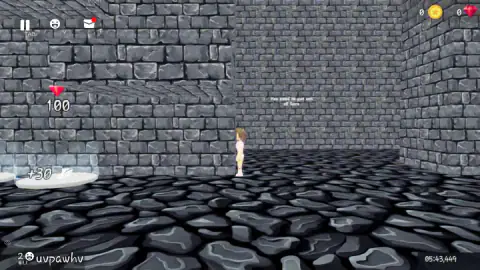
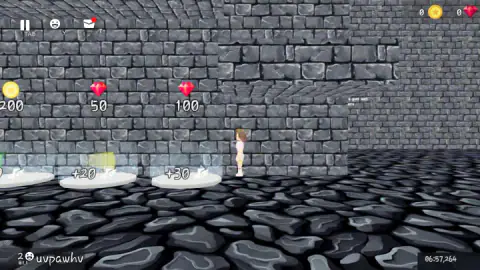
Taken by opening the game ourselves and letting it run — not supplied by the publisher, and not the same picture every other site shows.
How to play Your Obby Labyrinth
- Click through the opening screens until the stone room appears. There is no start button inside it; you have control as soon as you see your character from behind.
- Walk with W, A, S and D. Jump with Space.
- Find the white writing on the wall and read it. It is the only hint the room gives.
- Look round the corners. The room is not a plain box: the wall with the writing is set back behind two nearer blocks, so there are sides you cannot see from the middle.
- Keep an eye on the bottom right corner. That is your time.
What four minutes in one room taught us:
- Short taps get you nowhere. We pressed each key for about a second at a time and the character only shuffled a few steps. Hold the key down and commit to a direction.
- Jumping at a wall is wasted time. The walls are several times taller than the character. We pressed Space in front of them more than once and were still in the room afterwards.
- The clock does not wait for you to understand the room. It ran the whole time we stood reading.
- The pads are not the exit. We stood right beside one and nothing happened. See below for what we think they are.
Controls
| W, A, S, D | Walk; the character moved around the first room under these keys |
|---|---|
| Space | Jump, according to the listing; we pressed it several times and it did not get us over anything |
| TAB | Pause; the label is printed under the pause icon in the top left corner |
| Y | Printed under a smiley icon in the top left corner; we did not open it |
| T | Printed beside an envelope icon with a red dot; we did not open it |
| E | Interact, according to the listing; pressing it in the first room did nothing we could see |
| Shift and mouse wheel | Free the cursor and zoom in or out, according to the listing; not tested |
Features
- A third-person maze built from tall grey stone walls over a floor of dark cobbles
- One instruction, written in small white letters on a wall of the first room
- A clock in the bottom right corner that counts in thousandths of a second and was already running when we arrived
- Two counters in the top right corner, one for gold coins and one for red gems
- A row of white pads in glass cases marked +20 and +30, each under a tag in coins or gems
- A name tag in the bottom left corner with a number and a small label that read
Game details
- Developer
- KreizLand
- Release date
- June 2025
- Added here
- June 2025
- Technology
- HTML5 (3D)
- Platforms
- Browser (desktop)
- Classification
- Adventure , Arcade , Multiplayer , Puzzle
- Saved progress
- Saving, when available, is managed by this game. Mava cannot confirm your level.
FAQ
What is Your Obby Labyrinth?
It is a 3D maze game played in third person and credited to KreizLand. You steer a small character through rooms and corridors of grey stone while a clock runs in the corner. "Obby" is players' shorthand for an obstacle course.
How do you play Your Obby Labyrinth?
On a computer you walk with W, A, S and D and jump with Space. The game gives one instruction, written on a wall of the room where you start, and it says you need to get out. The listing adds E to interact, TAB to pause and the mouse wheel to zoom.
What is the goal of Your Obby Labyrinth?
The listing puts it in one line, which is to get to the end. Inside the game the only hint we found was a sentence on the wall of the first room. In four minutes of play we did not find the way out of that room, so we cannot describe the end.
What are the +20 and +30 pads in Your Obby Labyrinth?
They are white round pads in glass cases along one wall of the first room, each marked with a winged shoe. Above each one hangs a tag in gold coins or red gems, from 50 gems up to 200 coins. We read those as prices for a speed or jump boost, but we had no coins or gems to try one.
Does the timer in Your Obby Labyrinth stop?
Not in our session. It kept real time from our first look at the room to our last, and it already read close to four minutes when we first stood there. Treat it as running from the moment the game opens.
Is Your Obby Labyrinth multiplayer?
The game's listing describes it as a multiplayer maze. We saw no other character in the first room during our session, so we cannot confirm how other players appear or how you would join a friend.
Can you play Your Obby Labyrinth on a phone?
It is listed for PC, Android and iOS and says the phone version uses on-screen controls. We played on a desktop with a keyboard only, so that is the listing's word and not something we tested.
Who made Your Obby Labyrinth?
The game's listing credits KreizLand. The game was published in June 2025.