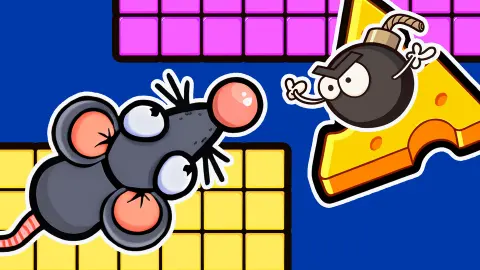






About Mouse Survivor
Most runners keep the shop and the scoreboard politely apart, so you can post a good number and still own nothing. Mouse Survivor collapses the two into one object. The thing scattered across the floor while you run is cheese. The thing the shop takes is cheese. The cheapest item in that shop costs a hundred of them, and we came out of our run with two.
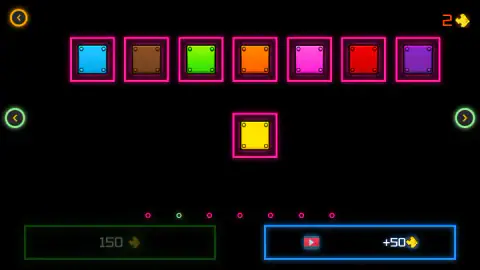
That gap is the clearest statement the game makes about itself, and the shop is where you feel it. It sells floors. Nothing else. Seven pages of tile sets, and on the first page every frame is locked in pink except the plain blue one you already have, which wears a green border and a little diagonal slash. Everything you do while running is in service of changing the colour of the ground under your feet.
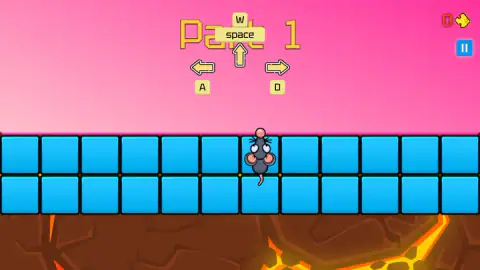
The running itself is simpler than that makes it sound. You arrive on a platform two tiles deep, a solid shelf of blue over a floor of dark rock shot through with orange, and the key map is drawn straight onto the sky above you: W and space stacked over an up arrow, A under an arrow pointing left, D under one pointing right. Behind the diagram, in large gold letters, the word Part 1. You get a jump and two directions. There is no attack, no dash and no second life.
Asgarath10 made it, and it has been listed since February 2025. The same developer has one other game out, a platform game. Both facts come from the same place, which is worth knowing before you take either of them as gospel.
The tiles tell you before they take you
Any game can kill you out of nowhere. The interesting ones give you a tell, and then make the tell cost something to read.
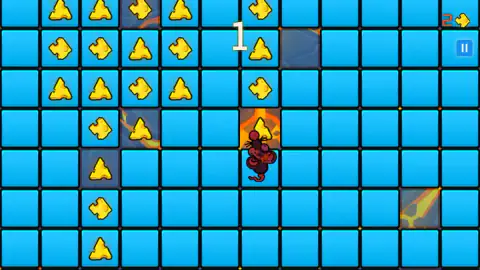
In Mouse Survivor the tell is colour, and there are three states on screen at once. A healthy tile is bright blue with a soft highlight. A failing tile greys over, loses its shine, and an orange crack opens diagonally across it with light bleeding out at the edges. A failed tile has no blue left at all; it is molten, and the heat shows around its border.
What makes this more than a traffic light is where the cheese sits. The pickups are scattered over the field without regard for which squares are healthy, so a cracked tile with cheese on it is a genuine question rather than a warning. You can have it. It will cost you a beat you may not have. And because your only verb is a jump, there is no way to reach across a bad square and grab the thing on it from safety. You either stand where the danger is or you do not.
So nothing is hidden from you. The pressure comes entirely from how fast you have to price what you can plainly see, which is a good place for a runner to be.
Real mice would walk straight past the cheese
Here is the part the game does not know about itself. The mouse-and-cheese pairing it is built on is almost entirely a human invention.
In 2006, Dr David Holmes, an animal behaviourist at Manchester Metropolitan University, looked at what mice actually prefer to eat and found cheese well down the list. Mice are opportunists and will eat it if they are hungry enough, but given a choice they go for grains, fruit and sweet things. Strong-smelling cheeses are worse than neutral: a mouse's sense of smell is sharp enough that a ripe one actively repels it. Pest controllers have known this for years, which is why the bait that works is more often peanut butter or chocolate than cheddar.
Where the myth came from is guesswork. The most-repeated explanation is domestic rather than zoological: grain and meat were stored carefully in old pantries and cheese was left hanging in the open, so cheese was what people found nibbled and cheese is what got the blame.
The irony is that the one thing this game asks a mouse to do is the thing real mice are genuinely remarkable at. Guides published by United States university extension services put a house mouse's standing vertical jump at somewhere between ten and twelve inches, from an animal a few inches long, and note that it can squeeze through a gap barely over a quarter of an inch wide. So the economy is fiction and the physics is flattery. Your mouse's jump is the honest part of the design.
What a hundred cheese buys
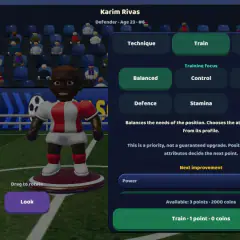
The shop is the only screen in the game with any depth to it. Seven dots run along the bottom, one per page, and each page holds eight tiles in a single style: a row of seven colours across the top, and a yellow one on its own below. The styles go plain, then riveted at the corners, then bevelled like cut glass, then overlapping scales.
The pricing is a flat ladder. The first page is 100, the second 150, the fifth 300, and the two pages past that we never priced. Fifty more per page, regardless of what the style actually is. Every page also carries a blue button with a video icon offering 50 cheese, which is half of the cheapest set and a fair indication of how the game values your time against its own.
None of it changes how the game plays. These are skins for the floor. What they change is why you run a fourth time, which for a game with one verb is not a small job.
What we did not see
Four minutes is a thin slice and you should treat this as a first report rather than a full one. We never got past the screen marked Part 1, so we cannot tell you whether a Part 2 looks different or only sounds like it should. The game's own description promises snakes and exploding obstacles; we met neither, so we do not describe them. We never bought a tile set, because we never had the hundred. We did not price the sixth or seventh page of the shop. And we played on a desktop with a keyboard, so the swipe controls the game lists for phones and tablets are its claim and not our report.
More to jump across
If the one-verb runner is what you came for, Rooftop Run does the same job at street level and Dinosaur Shifting Run adds a swap you have to time. For the jumping on its own, Climb Up! and Mega Jump are both built around a single leap and nothing else, and Super Onion Boy is the one to open when you would rather have proper levels than an endless field. The rest live in adventure games.
Screenshots
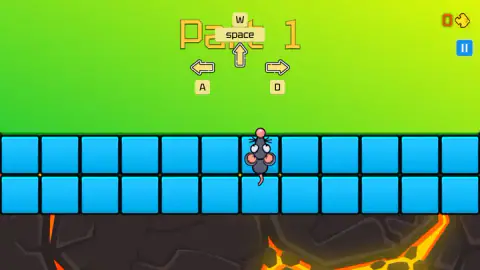
Taken by opening the game ourselves and letting it run — not supplied by the publisher, and not the same picture every other site shows.
How to play Mouse Survivor
- Wait out the loading bar. It is a small black rectangle filling with green, and it is over in a few seconds.
- Read the key map before it goes. It is drawn over the sky on the opening screen and it is the only instruction you get.
- Move. The shelf you start on is safe, and the moment you step off it the view opens out into a full field of tiles.
- Watch the colour of the squares ahead of you, not the one under you. Blue is safe, grey with an orange crack is about to stop being safe, and orange is already too late.
- Take the cheese you can take on the way. It is the only thing in the game that accumulates.
What we would tell someone starting now:
- The cheese is bait as often as it is reward. In the screen we kept, a piece of cheese is sitting on a square that has gone fully molten, and the mouse under it is charred dark red with a burst mark across its body. The game does not move the pickups off the dangerous squares. Deciding which cheese to skip is most of the skill.
- A cracked tile is a countdown, not a wall. It still holds you, for a moment. That moment is the difference between a route and a trap, and it is why looking one square ahead beats reacting.
- Jump is three keys and one action. W, Arrow Up and Space all do exactly the same thing, drawn as one arrow on the tutorial. There is nothing hiding behind the key you are not using.
- Two cheese is a normal first result. Ours was two. The shop prices start at a hundred. Expect several runs before you can change anything, and do not read that as the game being stingy; read it as the shop being the long game and the run being the short one.
- The sky changes and nothing else does. Our first attempt opened on lime green, the next on hot pink, with the platform, the counter and the key map identical. It is decoration, not a level marker, and it is easy to mistake for progress.
Controls
| W, Arrow Up or Space | Jump. The opening screen draws all three of them above a single up arrow, so they are the same button |
|---|---|
| A or Arrow Left | Move left |
| D or Arrow Right | Move right |
| Swipe up, left or right | The game's own instructions give this as the phone and tablet equivalent of the three keys. We played with a keyboard and have not tested it |
| The pause button, top right | Holds the run |
Features
- The whole economy is one thing: the cheese counter in the corner of the run is the same counter the shop spends from
- Tiles warn you before they take you. A safe one is solid blue, a doomed one greys over with an orange crack running through it, and a dead one is open lava
- Cheese sits on cracked tiles as readily as on safe ones, so the thing you want and the thing that kills you are often the same square
- The shop sells floors and nothing else: seven pages of tile sets, eight colours on each page, and only the plain blue one is yours when you arrive
- Prices climb in fifties, from 100 for the plain set to 300 five pages along, with two more pages behind that
- A video button on every shop page offers 50 cheese, which is half of the cheapest set
- The run opens labelled Part 1, with the key map drawn over the sky behind it
Game details
- Developer
- Asgarath10
- Release date
- February 2025
- Last updated
- October 24, 2026
- Added here
- April 2025
- Technology
- HTML5 (2D)
- Platforms
- Browser (desktop), Browser (mobile & tablet, touch)
- Saved progress
- Saving, when available, is managed by this game. Mava cannot confirm your level.
FAQ
How do you play Mouse Survivor?
You run a mouse across a field of tiles and keep it off the ones that are about to melt. W, Arrow Up or Space jumps, A and D move you left and right, and that is the entire control set. Cheese is scattered over the tiles, and picking it up is the only thing that pays.
What do the cracked tiles in Mouse Survivor mean?
They mean that square is going. A safe tile is bright, solid blue. A tile about to fail greys over and an orange crack opens across it. A tile that has finished failing is molten orange, and standing on one leaves the mouse charred. The warning is short but it is always there, so the game is readable if you look a square ahead rather than at your feet.
What is the cheese for in Mouse Survivor?
It is the currency, not the score. The counter in the top-right corner of the run is the same counter the tile shop spends from, so every piece you pick up while running is money you can take to the shop afterwards. There is nothing else to spend it on.
How much do the tile sets cost in Mouse Survivor?
They go up in fifties. The first page of the shop is 100, the second 150, and the fifth is 300, with two more pages beyond that we did not price. Each page holds eight colours of the same style, and only the plain blue one is unlocked when you start.
Can you play Mouse Survivor on a phone?
The game lists PC, Android and iOS, and its instructions give a swipe up, left or right in place of the three keys. We played it on a desktop with a keyboard and have not tested the touch controls, so we cannot tell you how a swipe-jump feels under pressure.
Who made Mouse Survivor?
A developer credited as Asgarath10. The listing we play it from shows two games under that name, this one and a platform game called Pixi Platform, and gives a release of February 2025.
Does Mouse Survivor have ads?
Yes, and they are offered rather than forced in the one place we saw them: every page of the tile shop carries a blue button with a video icon that pays 50 cheese. That is half the price of the cheapest set, which tells you roughly what the game thinks a run is worth.
How far did you get in Mouse Survivor?
Not far, and it is worth saying so. We spent four minutes with it, finished with two cheese, and never left the screen marked Part 1. The game's own description promises snakes and exploding obstacles further in; we never met either, so we do not describe them.