


About We Are In A Simulation Simulator
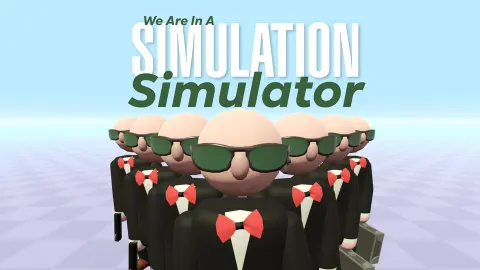
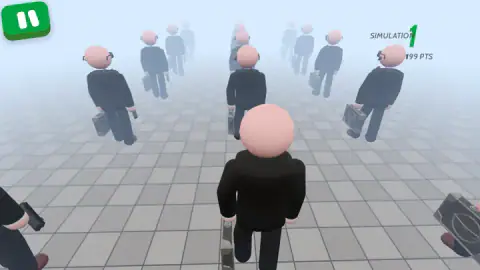
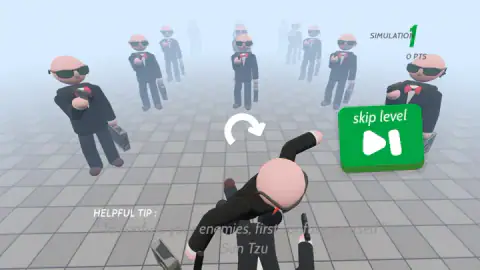
A crowd of identical men walks away from you across a grey tiled floor and into fog. Bald, pale, dark suits, a briefcase in one hand. You are one of them, seen from behind, and the floor gives you nothing: no walls, no signs, no horizon, just tiles until the white closes in. No goal is written anywhere on the screen. The crowd is the goal. Whatever it does, you do.
Most browser games spend their first ten seconds teaching you a special move. This one spends them teaching you that you do not get one. No weapon, no dash, no upgrade. The entire skill is noticing what the figure ahead of you is doing early enough to be doing it too, which sounds like nothing until you are inside it and realise you cannot see very far.
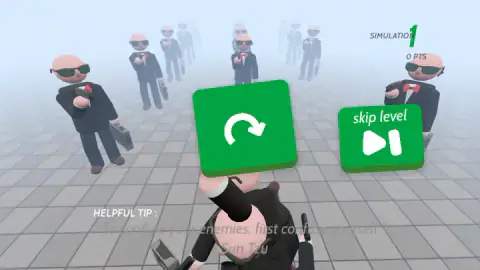
Being wrong is not subtle. The crowd stops. It turns around. The suits come back in dark glasses and red bow ties, put their arms out, and point at you, in a ring, while you lie face-down on the tiles. Nothing hits you. The punishment is being looked at. Two green panels then float up: a large one with a circular arrow, which puts the round back to the start, and a smaller one marked skip level.
The game is credited to mutgames. This one went up in September 2025 and was last updated in August 2026.
Here is what this page is built on, and it is less than we would like. We played it on a desktop with a keyboard and a mouse, for about four minutes, and never got past the first simulation: caught, restarted, caught again. We never opened the pause menu, never pressed skip level, and never saw the end of anything. Part of why the run went so badly is in the next section, and it is useful to you.
The crowd is the only thing on screen worth reading
The stage is empty on purpose. In most 3D games the scenery does half the teaching: a lit doorway, a path worn into the grass, a pile of crates where the fight will be. Here there is a floor the colour of an office corridor, a sky the colour of the floor, and fog that erases everything more than a few paces out. Strip all that away and the eye has one place to go.
That blankness is also what makes the rule bite. In a normal game you can be slightly out of position and the level will carry you; here, position is the whole state of play, because the only way to be wrong is to be doing something nobody else is doing. The crowd even changes costume between the walking stretch and the moment you are caught — dark glasses and red bow ties appear the instant it turns on you — which is the game's way of making sure you notice that these were never background figures. They were the rules, wearing faces.
Sun Tzu never wrote the helpful tip
Along the bottom of every caught screen runs a banner: HELPFUL TIP, then a line of strategic wisdom in quote marks, credited to Sun Tzu. The advice is that to confuse your enemies, you should first confuse yourself.
No such line exists in The Art of War. The book's famous sentence about deception runs the other way round — warfare is founded on deceiving the other side, not yourself — and its most quoted passage is about knowing yourself and knowing your enemy. Sun Tzu's name has become a magnet online for invented aphorisms in much the way Einstein's and Mark Twain's have, and the game is in on it.
It also fits what the game is doing. A tip banner is a promise of help. This one appears only once you have already failed, and what it offers is advice that would make you worse. No tip could save you, because the information you needed was never text. It was the figure three paces ahead, doing a thing, a second ago.
What happens when everybody else gives the wrong answer
The game's premise has a serious version, run in an American university psychology lab in the 1950s. Solomon Asch sat a volunteer at a table with a handful of other people and showed the group a card with a line on it and a card with several lines of clearly different lengths. The question was which one matched. It was not a hard question.
The other people at the table were in on it. One after another, out loud, before the volunteer's turn, they gave the same wrong answer. Across the trials where that happened, about a third of the volunteers' answers went along with the group, and roughly three in four conformed at least once. The control condition matters most: people judging the same lines alone got them right almost every time. Nobody's eyesight was failing. The company was the variable.
Asch's follow-up work found that what breaks the effect is not the size of the group but its unanimity. Put one other person in the room who says the right answer out loud, and conformity falls away sharply. A single ally is worth more than a smaller crowd.
Which is exactly what this game refuses to give you. Every figure on the tiles moves together, every time. There is never a second person hesitating, never one who gets it wrong first and shows you the shape of the mistake. That is why a round you cannot read feels different from ordinary difficulty: you are the only one who might be out of step, and there is nothing to check yourself against except the thing you are copying.
The number only ever went down
In the top-right corner, beside the words SIMULATION 1, sits a number followed by PTS. We read it a dozen times and never once saw it rise.
The best reading we got was 199, near the start of a fresh attempt. Later attempts opened lower: 191, and then 186.
Lower again after that, 181, and the last walking screen we recorded showed 172. Every screen where we were face-down on the tiles read 0.
So this is not a score you build, and the game never told us what it is. It behaves more like something you are spending, or a margin you lose while you fail to keep up, and it is wiped the moment you are caught. We never completed a round, so we never found out what the number is worth at the end of one. That is a real hole in this page, and we would rather point at it than invent a rule for you.
More games where the smart move is to watch first
The same studio's Mom I Can Fly is the opposite bargain: there the crowd is gone and the whole level is one patch of ground you are trying to reach. Stickman Simulator: Final Battle takes this game's idea to its extreme: you spend your gold, place your figures on the grid, and then you cannot touch the fight at all. Medieval Battle 2P does it for two people on one keyboard, with not one order you can give once the armies meet. Mini Dice Chess removes your choices from the other end, letting two dice decide which piece you may move — its own kind of being told what to do. And English Checkers is the plain old version of looking at the whole board before you commit. The rest of the shelf is in strategy games.
Screenshots
How to play We Are In A Simulation Simulator
- Read the card before the first round. The game shows a short control card on the way in, and it is the only direct instruction you will get. It lists three things: Move, Crouch, Jump.
- Use the letter keys, not the arrows. Movement is on the W, A, S and D block, crouch is on C, jump is on Space. We spent most of our run pressing arrow keys and the figure never took a single step.
- Watch the figure directly ahead of you. The fog is close enough that the far side of the crowd is a grey suggestion. The nearest one is the one you can read in time.
- Match the action, not just the direction. Walking forward is only the version of the rule you meet first. The card hands you a crouch and a jump as well, and they are there for something.
- Take the circular arrow, not skip level. The big green panel with the looping arrow puts the round back. The smaller one beside it moves you past, and we cannot say what it costs, because we did not press it.
What our run actually taught us:
- The arrow keys are a trap for anyone who assumes. Four minutes of a third-person game where the character would not move, because we had never looked properly at the card.
- There is no information anywhere except the crowd. The display holds two things, a pause button in one corner and a round name with a number in the other. Everything else on screen is people.
- Getting caught costs nothing but the number. The restart panel appears at once and puts you back at the start of the round. No lives counter, no waiting.
- Do not trust the helpful tip. More on that below, but it is a joke, and taking it seriously is part of the joke.
Controls
| W, A, S and D | Move. The card the game shows before the first round lists these as Move |
|---|---|
| C | Crouch, on the same card. The crowd we saw only ever walked, so we never had to use it |
| Space | Jump, on the same card, and the same applies |
| Arrow keys | Nothing we could get out of them. We pressed all four, repeatedly, and the figure never took a step |
| Pause button (top left) | A green rounded square with two white bars. It is the only button on screen while you are walking |
| Circular-arrow panel | Appears when you are caught and puts the round back to the start |
| skip level panel | A smaller green panel beside it, offering to move you past the round. We never pressed it |
Features
- One rule and no special move: whatever the crowd of identical suited men does, you do, at the same moment
- A stage stripped on purpose — pale grey tiles, white fog a few paces out, no walls, no landmarks — so the only thing worth looking at is the other figures
- Getting caught is public rather than violent: the crowd stops, turns, and stands in a ring pointing at you while you lie face-down
- A two-item display: a pause button top left, SIMULATION 1 and a number top right, and nothing else
- That number never went up for us. The best reading we got was 199, and it showed 0 on every screen where we were down
- A HELPFUL TIP banner that gives you a line of strategic advice and credits it to Sun Tzu, who never wrote it
- Made by mutgames, a six-game studio
Game details
- Developer
- mutgames
- Release date
- September 2025
- Last updated
- August 10, 2026
- Added here
- August 2025
- Technology
- HTML5 (WebGL)
- Platforms
- Browser (desktop, keyboard & mouse), Browser (mobile & tablet, touch)
- Classification
- Arcade , Simulation
- Saved progress
- Saving, when available, is managed by this game. Mava cannot confirm your level.
FAQ
How do you play We Are In A Simulation Simulator?
You copy the crowd. The game puts you in a group of identical bald men in black suits and gives you no goal text, no map and no special move. Whatever the figures around you are doing, you do, at roughly the same moment. Doing something of your own is what gets you caught.
What are the controls in We Are In A Simulation Simulator?
The card the game shows before the first round lists three things: Move on the W, A, S and D keys, Crouch on C, and Jump on Space. A green pause button sits in the top-left corner throughout. The arrow keys did nothing for us: we pressed all four over and over and the figure never moved.
What happens when you get it wrong?
Nothing chases you. The crowd simply stops being a crowd you belong to. The figures turn around, put their arms out and point at you, and you end up face-down on the tiles while they stand in a ring. Two green panels then appear, a large one with a circular arrow that restarts the round and a smaller one marked skip level.
What is the number next to SIMULATION 1?
We cannot tell you what it is for, only what it did. It sat in the top-right corner beside the words SIMULATION 1, and across our whole run it only ever went down. The highest we saw it was 199, it was lower on each later attempt, and it read 0 on every screen where we had been caught. We never finished a round, so we never learned what it is worth at the end.
Is We Are In A Simulation Simulator a Simon Says game?
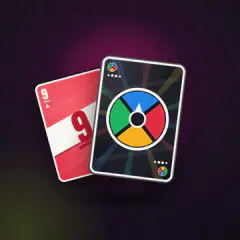
That is the shape of it, yes, and the game knows it. The words Simon says appear on the dark card it drops to between attempts. The difference from the playground version is that nobody gives you an instruction out loud. The crowd is the instruction, and you have to notice it rather than be told.
How many levels does We Are In A Simulation Simulator have?
Nobody publishes the number and we never found out. The rounds are called simulations and are numbered, and we never got past SIMULATION 1 in four minutes of trying. The crowd we met in that first round only walked, while the control card hands you a crouch and a jump as well, which suggests later rounds ask for more than walking.
Does We Are In A Simulation Simulator work on a phone?
It is listed for Android and iOS as well as PC, and lists it as a landscape game, which matches the wide view we played in. We only played it on a desktop with a keyboard, so how the movement, crouch and jump are handled on a touchscreen is something we have not checked.
Who made We Are In A Simulation Simulator?
mutgames, according to the game's listing. The game was published in September 2025 and last updated in August 2026. We found no studio website to confirm the name against a second source, so it rests.