







About Pow
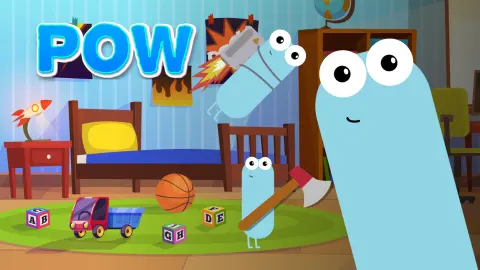
The virtual pet that invented this genre was a thing you could kill. It ran down while you were at school, and if you left it long enough it got sick and died, and a screen the size of a postage stamp drew you a headstone. Pow opens on a flat green room with a calendar in the corner, a blue creature whose two eyes are bigger than the rest of it, and nothing anywhere that looks like a punishment.
Look at what is on the glass. Four cards sit across the top: a water drop, a spoon, a crescent moon and a blue ball. A glowing yellow dot hangs above one of them, a round arrow waits in each top corner, the purse reads fifteen and the calendar reads five. On the wall beside the pet, floating in mid-air, there is a light switch.
Press one of those corner arrows and the whole room slides sideways. That is the moment it stops being a screen and turns into a house, because the row of cards is not a dashboard. It is a floor plan, and you have been standing in one of its rooms the entire time.
Pow is credited to Renato Duchini, who works under the studio name Onduck Games. It has been available since June 2025. Our own run lasted four minutes on a desktop, we never reached the games room the listing describes, and nothing below pretends otherwise.
The row of cards at the top is a floor plan
At first glance the four cards look like status meters, and the provider's instructions nudge you that way: the game's listing says Pow's needs show as vertical bars at the top of the screen, one set per room. What is up there is four rounded cards with a picture on each, and a small orange tab on the left edge of every one — taller on the moon card than on the other three, in both our captures of that room. We never saw one move, so we will not tell you it is a meter; we will tell you the game's listing says it is.
What the cards definitely are is rooms, and three separate things say so. The glowing dot sat above the moon card while we were in the green room, and had moved to the spoon card by the time we were in the sand-coloured one. Each card is a paler tint of its own room's colour. And in the last capture we kept, the green room is visibly sliding off the right-hand edge of the sand one — exactly where it belongs, because the moon card sits immediately right of the spoon card. So the cards are a map, drawn in order with your position marked: drinking, eating, sleeping and playing each get a room rather than a bar on a dial.
The light switch, and the room that goes dark
The green room has two versions of itself and moves between them while you watch. In one it is bright, a pale disc glows high on the right, and Pow sits on its cushion with both eyes open. In the other, the same room from the same angle has gone deep bottle green, the disc is a flat grey circle, and Pow's eyes are shut. Across our session it went light, dark, light again and dark again, so it is a cycle, not a one-off.
What we cannot tell you is what drives it. There is a light switch on that room's wall, which we clicked at repeatedly, and a calendar counting days, which suggests a clock. Either would explain what we saw, and four minutes cannot separate them, so we are leaving it open rather than inventing a rule.
What matters for playing is simpler: the room tells you its state without a word of text, and a dark room with a sleeping creature in it is not one to go hunting for something to click.
What a key-ring fixed in 1996, and what Pow leaves out
Almost every page about a game like this calls it a Tamagotchi-like and stops there. The Tamagotchi was a specific object, and it is worth knowing what it did.
Akihiro Yokoi, at a company called WiZ, and Aki Maita, at Bandai, built an egg-shaped key-ring with three buttons, and Bandai put it on sale in Japan on 23 November 1996. Inside were meters for hunger, happiness and discipline; the creature left droppings you had to clear up; you fed it, played with it, told it off and praised it. And in the first two models a creature left alone could die in under half a day — a skull on the screen, a ghost and a headstone in Japan, an angel in the English versions.
That is the inheritance, and Pow keeps about half of it. The needs are still four, the game still counts days, and it still expects you back for them. What it drops is the threat: nothing we touched implied a timer running against us, and the worst thing that happened in four minutes was that a pet went to sleep. We never tested neglect, so we are not claiming the punishment does not exist — only that the game never waved it at us, which is a very different front door from the one a key-ring opened with. It refuses the single screen too: where that screen stacked everything into one picture, Pow gives each need a room and makes you walk there.
Fifteen coins, and a pineapple that costs five
The economy is small enough to describe completely, which in a browser game is rare.
Coins come from a daily reward board that opens over the game. It lays out a week of squares, pays fifteen for turning up on the first day and climbs by five-coin steps to fifty by the seventh: it pays for the habit, not for anything you do once you are there. Beside its collect button sits a second, marked with a film strip, offering to double the lot for a video — the same offer that sits permanently in the game's bottom-left corner.
Against that, prices. The only one we saw was under the card row in the food room: a pineapple for five coins. Our purse held fifteen throughout, so the shop was asking a third of everything we had for one piece of fruit — and the fork planted tines-down beside Pow, about as tall as the creature, is presumably what you do with it afterwards. We never found out: clicking the fork did nothing and no purchase went through.
That is the honest shape of four minutes with Pow: a house we mapped, a light we watched go out, a shop we window-shopped, and a blue creature we are fairly sure we did not help in any way at all.
More games by Onduck Games
The same studio has plenty else on our shelves, one of them this game's direct cousin. My Dogy Virtual Pet is the same idea with a puppy instead of a blue capsule: feed it, wash it, keep it happy. Neko's Adventure goes the other way entirely — a cat, twenty levels and a fire beam, nothing to look after. Happy Coloring Book is the quietest thing they make.
If it is the cosy pet-keeping you came for, Flufflings: Pocket Pets is another studio working the same seam, with stray kittens and a yard to decorate. The rest is in casual games.
Screenshots
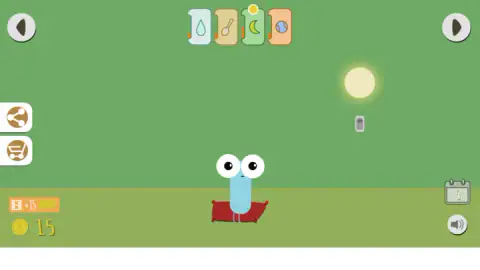
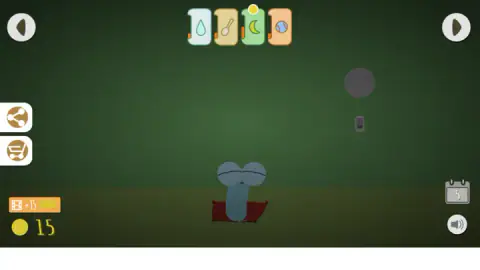
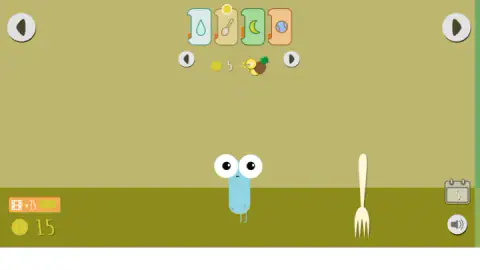
Taken by opening the game ourselves and letting it run — not supplied by the publisher, and not the same picture every other site shows.
How to play Pow
- Click, and only click. Everything that happened in our session happened because of a mouse click. The arrow keys and the space bar gave us nothing.
- Find the glowing dot above the card row first. It marks the room you are in. Until you find it, the four cards look like a menu, and they are not.
- Use the round arrows in the top corners to change room. They slide the view rather than cutting, so for a moment you see both rooms at once.
- In the sand-coloured room, read the row under the cards. A coin, a price and a thing to buy, with a small arrow either side to page through it.
- Check the calendar in the bottom-right corner. A game that counts days is a game that expects you back tomorrow.
What the session taught us, including the parts that went nowhere:
- The light switch is on the wall, not on the pet. In a game about tending a creature, the one object we could see clearly in the sleeping room hung on the far side of it. Look at the walls, not just at Pow.
- Clicking Pow itself did nothing we could see. Nor did the fork in the food room, the most obvious object in it. If the pet will not answer, the answer is elsewhere on screen.
- A dark banner reading "Click to keep playing" turns up repeatedly. It is not a button: one click on the background clears it and the game carries on.
- The orange button in the bottom-left offers coins for a video. It carries a film strip and reads plus fifteen, exactly what the game hands you for a first day of logging in. It is optional, we left it alone, and so can you.
Controls
| Left click | Everything we managed to do, we did with a click. No key we pressed changed anything we could see |
|---|---|
| Round arrow, top-left or top-right corner | Slides the view to the room next door. The view really does slide - one of our captures caught the next room still coming in at the edge |
| The row of four cards across the top | Not a control so much as a map. The glowing yellow dot above one of them is the room you are standing in |
| Small arrows under the card row | In the sand-coloured room these page through things to buy, with the price between them |
| Speaker button, bottom-right | Sound on and off. The calendar sits just above it |
| Trolley button, left edge | The shop. It is on screen in the green room and absent from the sand-coloured one |
Features
- Four cards across the top - a water drop, a spoon, a crescent moon and a blue ball - with a glowing yellow dot above whichever room you are in
- Rooms that slide rather than cut, with round arrows in both top corners to move between them
- A light switch on the wall of the room with the cushion, and a version of that room with the lights out and the pet's eyes shut
- A fork planted tines-down in the ground of the food room, standing about as tall as the pet itself
- A buy row under the cards offering a pineapple for 5 coins against a purse that held 15
- A daily reward board that pays 15 coins on the first day and climbs to 50 by the seventh
- A calendar in the bottom-right corner, reading 5 for the whole of our session
- Available since June 2025 and last updated in August 2026
Game details
- Developer
- Renato Duchini (Onduck Games)
- Release date
- June 2025
- Last updated
- August 10, 2026
- Added here
- June 2025
- Technology
- HTML5 (Construct)
- Platforms
- Browser (desktop), Browser (mobile & tablet, touch)
- Classification
- Casual , Simulation
- Saved progress
- Saving, when available, is managed by this game. Mava cannot confirm your level.
FAQ
How do you play Pow?
With the mouse, and in our session with nothing else. Pow is a pet-care game built around a row of four cards at the top of the screen - a water drop, a spoon, a crescent moon and a ball - and each of those cards marks a room. Round arrows in the top corners slide you from one room to the next, and a glowing yellow dot above the card row tells you where you are. The listing's notes say you touch or click Pow and the objects around it and follow the prompts on screen.
What are the four cards at the top of the screen in Pow?
They are the rooms of Pow's house, laid out in order. The card showing a crescent moon is green and so is the room with the cushion in it; the card showing a spoon is sand-coloured and so is the room with the fork and the food for sale. A glowing yellow dot sits above whichever one you are standing in, and it moved from the moon card to the spoon card when we moved rooms. Each card also carries a small vertical orange tab on its left edge, which the listing's instructions describe as a progress bar for that need.
Is Pow the same as anything else called Pow?
No. Pow is an ordinary English word - the comic-book noise a punch makes - and a well-known abbreviation besides, so plenty of unrelated things carry the name. This Pow is a browser pet-care game credited to Renato Duchini, working as Onduck Games, in which you look after a small blue creature with very large eyes. It has no connection to any film, band, product or organisation that shares the word.
Who made Pow and when did it come out?
The game is credited to Renato Duchini under the studio name Onduck Games. It has been published since June 2025 and was last updated in August 2026.
Does Pow die if you neglect it?
We cannot tell you, and we would rather say that than guess. Nothing in four minutes threatened us, and the handheld that invented this genre in the nineties very much did - sickness, then a skull. The game's description talks about Pow growing and levelling up rather than about losing it, but we never tested neglect and we never saw a fail state, so we are not going to claim there is none.
Does Pow have ads?
It offers them rather than forcing them, at least in what we saw. An orange button in the bottom-left corner carries a film-strip icon and reads plus fifteen coins, and the daily reward board offers to double your coins through a second button with the same icon. Both are video offers and both are optional. We did not press either, so we cannot describe what the video itself looks like.
What can you buy in Pow and how do you get coins?
In the food room a row under the cards shows a price and an item, with a small arrow either side to page through the catalogue. The one we saw was a pineapple for five coins. Coins arrive through a daily reward board that pays fifteen on the first day and climbs by five-coin steps to fifty on the seventh, and through the optional video button. Our purse sat at fifteen for the whole session, so we never completed a purchase to see what arrives.
Can you play Pow on a phone?
It is listed for PC, Android and iOS and says it works in both landscape and portrait, and our database marks it as a mobile title. Our own session was on a desktop with a mouse, so we will not tell you how it feels under a thumb. What we can say is that nothing in the interface depends on a keyboard - every control we found was something you point at and press.