




About Mini Dice Chess
Chess asks you to look at every piece on the board and pick the best move among all of them. Mini Dice Chess takes most of that choice away. You press ROLL, two dice land showing chess pieces, and only your pieces of those two kinds are allowed to move. The question is no longer "what is the best move?" but "what is the best thing this knight can do?"
That makes it quicker and much more forgiving for anyone who finds a full chessboard tiring. It does not make it a game of pure luck. You still choose which of your rooks moves, where it goes, and in which order to spend the two dice. And the game changes several rules of chess on top of that, which matters more than the dice once you are a few turns in.
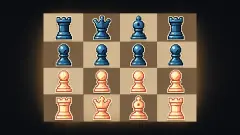
The board is six columns wide and seven rows deep. Each side has six pawns and a back row of rook, knight, queen, king, knight and rook: twelve pieces instead of sixteen, and not a single bishop. There is no check. You win by capturing the king.
Mini Dice Chess is by Koartist Games, a name that appears both in the game's About screen. It was published on 20 February 2026.
Is it real dice chess? Yes, with three changes to the rules
The rule that defines dice chess is that the roll decides which kind of piece you may move, and Mini Dice Chess follows it exactly. What it changes is the rest. The common version uses one die, with one face for each piece: pawn, knight, bishop, rook, queen and king. This game rolls two dice, so you usually get two moves a turn. It has no bishops on the board, so it removes the bishop face and prints a second knight in its place. And, like most modern dice chess, it replaces checkmate with capturing the king, covered in the next section.
That single change decides how the game feels. With two dice, a knight comes up in more than half of your rolls, while the rook, queen, king and pawn each appear in about three rolls out of ten. The knight is the piece you will move most, so the knights are the pieces worth developing first. A plan built around your queen may wait several turns for the right roll.
Rolls with a matching pair happen about two times in nine. Those are the turns that swing a game, because a single piece moves twice before your opponent can answer.
No check, no checkmate: the king is just a piece you can lose
Standard chess never lets a king be captured. Checkmate is declared one move before that happens. Dice chess cannot work that way. If a roll can forbid you from moving your king, you cannot be obliged to escape check, so most dice versions drop check altogether and play for the capture.
Mini Dice Chess does the same. The king moves one square in any direction, like the ordinary king, but it can step onto an attacked square and it can be left under attack. The game ends the instant a piece lands on it. There is also no castling, no two-square pawn step, no capture in passing and no promotion.
In practice it means a king that looks safe is only safe from the dice your opponent has not rolled yet. A rook staring down an open column is a threat you should count every turn, because one lucky roll turns it into the end of the game.
Dice chess is centuries old, and the small board has a history too
Adding dice to chess is not a modern shortcut. The English chess writer Anne Sunnucks recorded that dice were used to play chess in Europe between the eleventh and fourteenth centuries, and even earlier in Burma and India, where one version used three dice. A present-day three-dice version is played online at dicechess.com, also without check and also won by taking the king.
The board has its own ancestor. In 1956, Paul Stein and Mark Wells at the Los Alamos laboratory programmed the MANIAC I computer to play Los Alamos chess: a six-by-six board without bishops, with two rooks, two knights, a queen, a king and six pawns per side, no two-square pawn step, no capture in passing and no castling. The program was about 600 instructions long and took roughly twenty minutes per move. In its third game it beat a beginner, a laboratory assistant, the first time a computer beat a person at a chess-like game.
Mini Dice Chess uses exactly that army and drops the same three rules, then adds a seventh row and a pair of dice. We found nothing saying Koartist Games had Los Alamos in mind. The resemblance is still the clearest way to understand why the board looks the way it does: take the bishops out and six columns is enough.
One player or two on the same screen
The 2 PLAYER mode is the better way to play. Both sides roll, and the side whose turn it is has its name outlined at the top, WHITE on the left and BLACK on the right. There is no clock, so nobody is rushed, and nothing is saved when you close the page.
The 1 PLAYER computer is simple. It takes your king whenever it can. Otherwise it grabs any capture on offer, without telling a pawn from a queen, and if there is nothing to take it moves whatever gets closest to your king. It never looks at what you can do next. So offer it a pawn to pull a piece out of position, keep your queen out of reach of anything it rolls, and it will leave its own king uncovered sooner or later.
The game runs in a tall, phone-shaped frame and uses only clicks and taps. It is listed as mobile ready, but we have not tried it on a touchscreen. A banner advert can appear on the main menu and when a game ends, at most once every 45 seconds.
More chess and draughts
For a different full board experience, Carrom Pro has three modes and pass-and-play for two, with a computer rival that shows its aim before it shoots. If you would rather face the computer directly, English Checkers offers ten computer levels of classic draughts. Medieval Battle 2P trades the board for real medieval strategy, two players with 2,000 coins each and not one order you can give once the fighting starts, and Castel Wars keeps the two-people-one-screen setup, building your own stairs in mid-air before a catapult decides the rest. More thinking games are in our strategy category.
How to play Mini Dice Chess
- Pick a mode. 1 PLAYER puts you on white against the computer. 2 PLAYER is for two people sharing one screen. White moves first.
- Roll. Press ROLL. After a short spin, each die shows a piece. Your pieces of those types that have at least one legal move get an orange outline.
- Move. Click or tap an outlined piece. Small dots mark empty squares it can reach and grey rings mark pieces it can capture. Choose one and that die is spent.
- Use the second die. The remaining die updates the outlines. When both dice are used, or the one left matches nothing that can move, the turn passes.
- Take the king. Landing on the enemy king ends the game at once. To play again, open the menu at the top of the screen and choose New Game.
Tips worth knowing:
- You cannot pass. If a die matches a piece with a legal move, the only way to end your turn is to move it. Keep pieces where a forced move will not hurt you.
- Order matters. With a knight and a queen rolled, moving the knight first can open a line for the queen that did not exist before. Look at both dice before you touch anything.
- Doubles can move one piece twice. Two queens and only one queen on the board means that queen gets two moves. That is often the fastest way to reach a king.
- Do not rush your pawns to the end. A pawn on the last row never turns into anything and never moves again. Pawns are more useful as a wall in front of your king.
- Watch your king, because the game will not. Without check, nothing stops you from leaving your king open, and nothing warns you when it is.
Controls
| Click / tap ROLL | Roll both dice; the pieces you are allowed to move get an orange outline |
|---|---|
| Click / tap an outlined piece | Select it; dots show where it can go, rings show what it can capture |
| Click / tap a dot or ring | Move there and use up that die |
| Menu button (top centre) | Resume, sound settings, New Game or back to the main menu |
Features
- A six-column, seven-row board with twelve pieces a side and no bishops
- Two dice per turn, each showing a piece type, so you usually make two moves
- The knight has two faces on each die, so it comes up far more often than anything else
- No check and no checkmate; the game ends the moment a king is taken
- Pawns step one square, never two, and a pawn that reaches the far row stays stuck there
- 1 PLAYER against a simple computer, or 2 PLAYER on one device
- Mouse or touch only, in English, with no timer and nothing saved between visits
Game details
- Developer
- Koartist Games
- Release date
- February 2026
- Added here
- June 2025
- Technology
- HTML5 (Phaser 3)
- Platforms
- Browser (desktop), Browser (mobile & tablet, touch)
- Classification
- Multiplayer , Strategy
- Download size
- 6.7 MB
- Ad requests
- 5 (some)
- Has a save
- Yes
- Saved progress
- Saving, when available, is managed by this game. Mava cannot confirm your level.
Measured by opening the game ourselves on 2026-09-11, not taken from the feed. Twelve seconds on a phone-sized screen, with ad requests counted and blocked rather than loaded.
FAQ
How do you play Mini Dice Chess?
Press ROLL. Each of the two dice shows a chess piece, and only your pieces of those types that have a legal move light up. Move one for each die, then the turn passes. If a die matches nothing that can move, the game says "No moves available" and hands the turn over.
How do you win Mini Dice Chess?
By capturing the enemy king. There is no check and no checkmate, so nobody warns you that your king is attacked, and a king may even walk onto a square where it can be taken. The first player to land a piece on the other king wins on the spot.
Why are there no bishops in Mini Dice Chess?
The board is only six squares wide, and the back row holds rook, knight, queen, king, knight and rook. The dice follow the same idea, with no bishop face and a second knight face instead — no bishop is ever placed on the board.
What happens when you roll doubles?
You get two moves with that piece type, and they can both go to the same piece. Doubles come up in about two rolls out of nine, and double knights are the most common of them because the knight has two faces on each die.
Is Mini Dice Chess real dice chess?
Yes. As in every dice chess variant, the roll decides which kind of piece you may move. It differs from the common one-die version in three ways — it rolls two dice, it has no bishop face and gives the knight two faces instead, and you win by capturing the king rather than by checkmate. Pawns also never promote, and there is no castling.
Can two people play Mini Dice Chess on one computer?
Yes. Choose 2 PLAYER and pass the mouse, phone or tablet between turns; the name of the side to move is outlined at the top. There is no online mode and no timer, so a turn takes as long as you like.
How good is the computer in Mini Dice Chess?
Not strong. On its turn it takes a king if it can, otherwise any capture, and otherwise moves towards your king. It does not look at your reply and does not tell a pawn from a queen, so it leaves pieces unprotected and will trade its queen for a pawn.
Who made Mini Dice Chess?
Koartist Games, according to both the game's own About screen and its listing; it was published in February 2026. The About screen links to koartistgames.com, but that address returned an error when we checked in September 2026, so we have no more details about the studio.