






About Ludo World
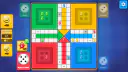
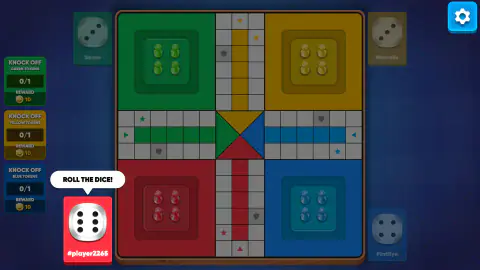
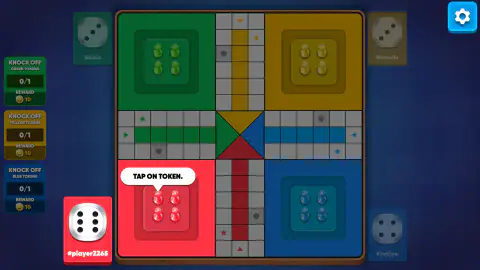
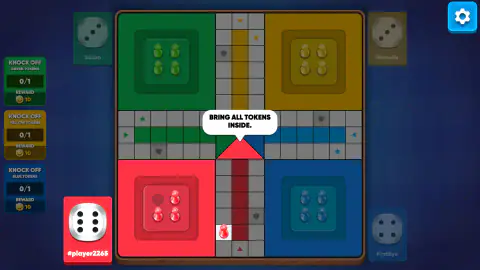
Ludo is a game most people learn once, as children, from whoever owns the board. Ludo World assumes you have forgotten all of it. It teaches the whole game with three speech bubbles. The first one sits over your die and says "ROLL THE DICE!". The second points at your tokens and says "TAP ON TOKEN." The third points at the middle of the board: "BRING ALL TOKENS INSIDE."
What it adds to the cardboard version is a reason to be bold. Down the left side sit three cards, one for each rival colour. Each one asks you to knock off a token of that colour, and shows a reward of 10 coins. Plain ludo lets you race past the others. This one rewards you for hunting them.
This is the browser game by Inlogic. It is not the phone app "Ludo World-Ludo Superstar", which only shares the name. We played red, from the bottom left corner, against Saxon (green), Marcello (yellow) and FirstKyu (blue). We played a short game in October and a longer one in November, about 26 minutes. In that time we knocked off four tokens, lost one and brought one home.
Stars are safe. White squares are not
This is the rule that decides most turns. The four coloured stars are safe squares. Once a blue token landed right on top of ours while it stood on green's star. Another time our new token came out onto the red star, where a blue token already stood. Both times the two tokens just shared the square.
White squares are a different story. Once our token stood on a white square, three squares in front of a blue token. FirstKyu rolled a three, blue landed on us, and our token went back to the base.
So before you move, look behind the square you are going to. Any rival one to six squares back can roll that number. If you can stop on a star instead, do it.
After you lose a token, a window pops up over the board. The red X in its top right corner closes it.
Count the squares to the token in front
The other half of the rule works for you. Count the squares from your token to a rival token ahead of it. If your roll is that exact number, click that token. Yours lands on the rival and sends it back to its base.
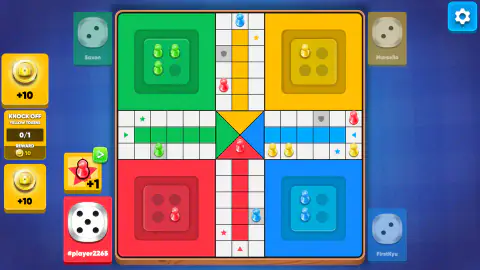
We did this four times. A six took us straight onto a blue token. Later a three took us onto a green one. Each time the rival token flew home, and our panel stayed lit for one more roll.
The first knock-off of each colour also finishes that colour's quest. The card shows 1/1 for a moment and then turns into a gold coin card with "+10".
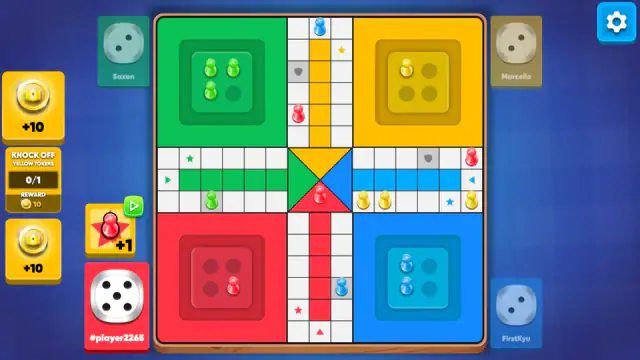
One thing did not work. Two yellow tokens stood together on a white square, five squares ahead of us. We rolled a five and landed on them. Nothing was knocked off. All three tokens stayed on that square, and the turn passed on. So a pair is not a target. Pick a token that stands alone.
The last few squares
Your last lap runs down the right side of the bottom arm and across to the red arrow. From there the token turns up the red column towards the centre.
Our token stood two squares into the column. We needed four to reach the centre, and we rolled a four. The token went in, and we got one more roll. We never rolled too much at that point, so we cannot tell you whether an extra point still lets you move.
Stars and shields are the oldest thing on the board
Ludo is a simple form of pachisi, an Indian game played on a cross stitched on cloth. Players threw six or seven cowrie shells and counted how many landed with the opening up. The cross had twelve marked castle squares. A piece resting on one could not be captured.
The game sold in England as Ludo from 1896 kept the cross. It folded it into a square board and swapped the shells for a die. Look at Ludo World with that in mind and the old game is still there. The four arms are the cloth cross. The eight marked squares, four stars and four grey shields, do the job of the castles.
In Ludo World the stars still work like castles. We saw that twice. The shields we cannot vouch for: no token was ever landed on while it stood on one.
Settings, and what we did not see
The gear at the top right opens SETTINGS. It has a sound slider, a music slider and a language row with seven choices. The quest cards change language at once. There are also two buttons: FORFEIT, with a house on it, and PLAY, which takes you back to the board.
The publisher speaks of a classic and a quick mode and a trophy road. We did not see them. Both times, Let's Play went straight to a four-player board, and we did not press FORFEIT. We also never finished a whole match. After 26 minutes we had one token home and the others still on their way.
A yellow card with a red token, a star and "+1" sits above your die. It has a green play badge. We did not press it, so we cannot tell you what it does.
More board games on Mava Games
If you want ludo against another person on the same screen, try Ludo Game Multiplayer. Domino Battle deals you seven tiles against the computer. English Checkers is draughts on the usual eight-by-eight board. Mini Dice Chess keeps the die and changes the game around it. The rest are in card and board games.
Screenshots
How to play Ludo World
- Wait for your panel to light up. Yours is the red one at the bottom left, with your die in it.
- Click the die. It rolls and stops on a number.
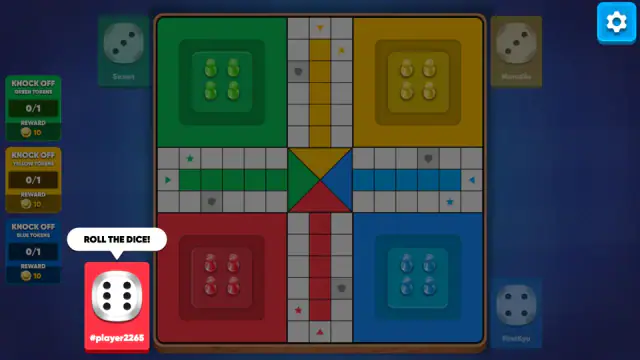
- If you rolled a six, click a token in your base. It steps out onto the red star, your starting square. Then roll again: a six gives you one more roll.
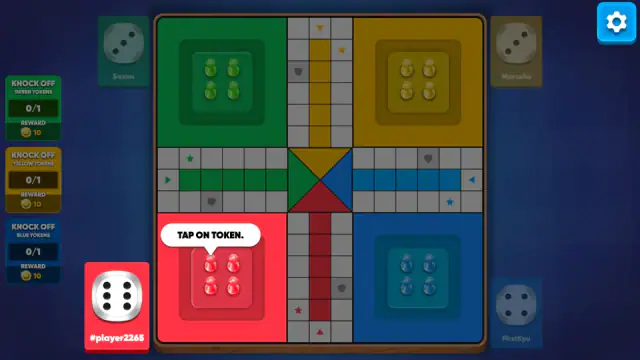
- On later turns, click the token you want to move. The ones you can move have a dashed red ring around them. If only one token can move, it moves by itself.
- Take each token all the way round, up the red column and into the centre. That is what the third bubble asks for.
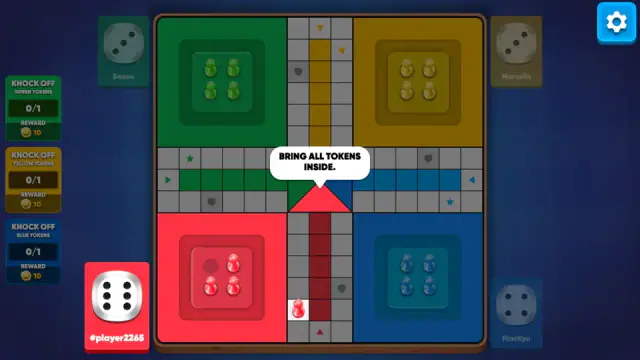
Things worth knowing before the first roll:
- The number on your die is your last roll. It stays there between turns. Click the die first. Clicking a token before you roll does nothing.
- Your route goes up, then left. From the red star the token climbs four squares, turns left and runs along the lower edge to the corner. Then it heads up towards green's star.
- A six is a choice. You can bring a new token out or move one that is already on the board. More tokens out means more ways to use each roll. It also means more tokens a rival can hit.
Controls
| Click your die | Rolls it when your red panel at the bottom left is bright |
|---|---|
| Click a token | Moves it by the number rolled; the tokens you can move have a dashed red ring around them |
| Gear button (top right) | Opens SETTINGS with sound, music, language, FORFEIT and PLAY |
Features
- A four-colour board where you play red against Saxon (green), Marcello (yellow) and FirstKyu (blue)
- Three KNOCK OFF quest cards, one per rival colour, each showing a reward of 10 coins
- Four coloured stars where we saw two colours share the square, and four grey shields we never saw tested
- A six or a knock-off gives you another roll
- Three bubbles that teach the game in the first turn, with no separate tutorial screen
- Seven languages in the settings, including Spanish, French, Italian and Portuguese
Game details
- Developer
- Inlogic Software s.r.o.
- Release date
- April 2026
- Last updated
- August 10, 2026
- Added here
- February 2026
- Technology
- HTML5
- Platforms
- Browser (desktop, mouse)
- Classification
- Cards & Board
- Saved progress
- Saving, when available, is managed by this game. Mava cannot confirm your level.
FAQ
How do you play Ludo World?
Click your die when your red panel lights up, then click the token you want to move. A token leaves its base only on a six. Take it round the board, up the red column and into the centre. The game asks you to bring all your tokens inside.
Do you need a six to start in Ludo World?
Yes. In both of our sessions, a token only left the base on a six. A six also gives you another roll, so you can bring a token out and then move again.
Which squares are safe in Ludo World?
The four coloured stars. A blue token landed on our red token while it stood on a star, and both stayed there. Our new token also came out onto a star where a blue token stood, and they shared it. On a plain white square, a blue token landed on ours and sent it back to base. We never saw what happens on the grey shields.
What are the Knock Off quests in Ludo World?
They are three cards on the left, one for each rival colour. Each asks you to send one token of that colour back to its base. When we did it for blue and for green, the card turned into a gold +10 coin card.
What happens when you knock off a token in Ludo World?
The rival token flies back to its base and has to wait for a six again. You also get another roll. That happened after each of our four knock-offs.
Can you knock off two tokens on the same square?
Not in our match. Our red token landed on a square with two yellow tokens, and all three stayed there. The yellow quest stayed at 0/1, and the turn passed to the next player.
Can you play Ludo World in Spanish, French, Italian or Portuguese?
Yes. The gear button opens the settings, and the language row has seven choices: English, German, Spanish, French, Italian, Portuguese and Russian. The quest cards and the buttons change at once.
Are the opponents in Ludo World real players?
The game does not say. We played in October and in November, and both times the rivals were called Saxon, Marcello and FirstKyu. Only our own guest number changed. Each rival rolled and moved within about a second, and there was no chat.
Can you play Ludo World on a phone?
The publisher lists it for Android and iOS as a landscape game. We only played on a computer with a mouse, so we cannot tell you how it feels on a small screen.